-
10 Wendell Ave Extension Pittsfield, MA 01201
-
210 Columbia St., Lee, MA 01238

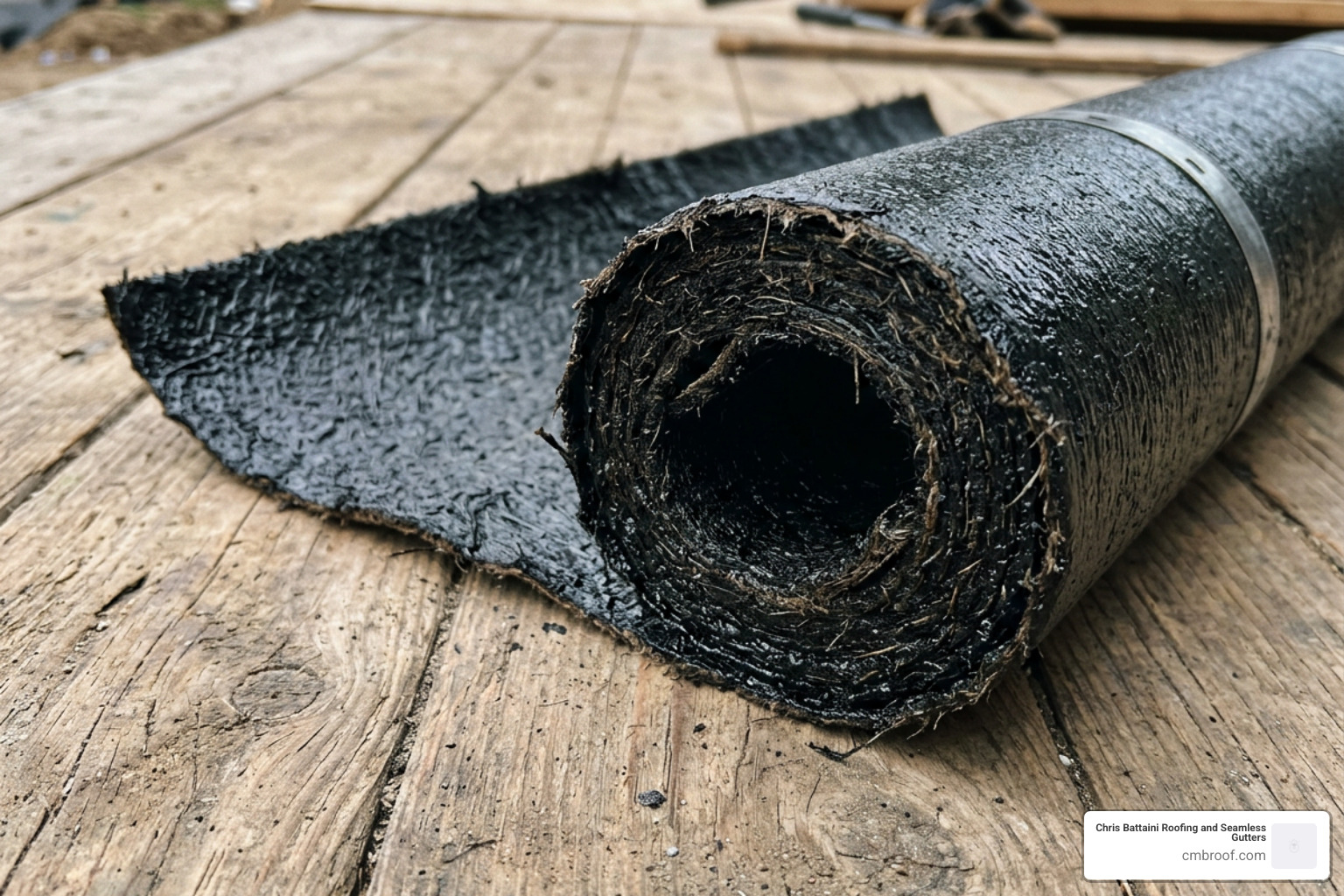
A roll of tar paper is one of the most important — and most overlooked — parts of your roofing system. Before the shingles go on, this layer goes down. It sits between your roof deck and your shingles, acting as a secondary moisture barrier that protects your home if water ever gets past the outer layer.
Quick answer: What is a roll of tar paper?
Tar paper has been used in roofing for well over a century. It is made by saturating kraft paper or organic felt with asphalt (bitumen). The result is a flexible, water-resistant sheet that rolls out fast and gives your home a critical layer of protection — especially important in areas like Pittsfield, Dalton, and Lenox, MA, where winters bring freeze-thaw cycles, ice dams, and heavy snow loads.
It is not a perfect product. It has real limitations compared to modern synthetic underlayments. But it remains widely used because it is affordable, familiar, and still does the job on many roof types.
I’m Christopher Battaini, owner of Chris Battaini Roofing and Seamless Gutters, and after more than two decades installing and replacing roofs across the Greater Boston and Berkshire County area, I’ve laid down more rolls of tar paper than I can count. In this guide, I’ll walk you through everything you need to know to make a smart decision for your home.
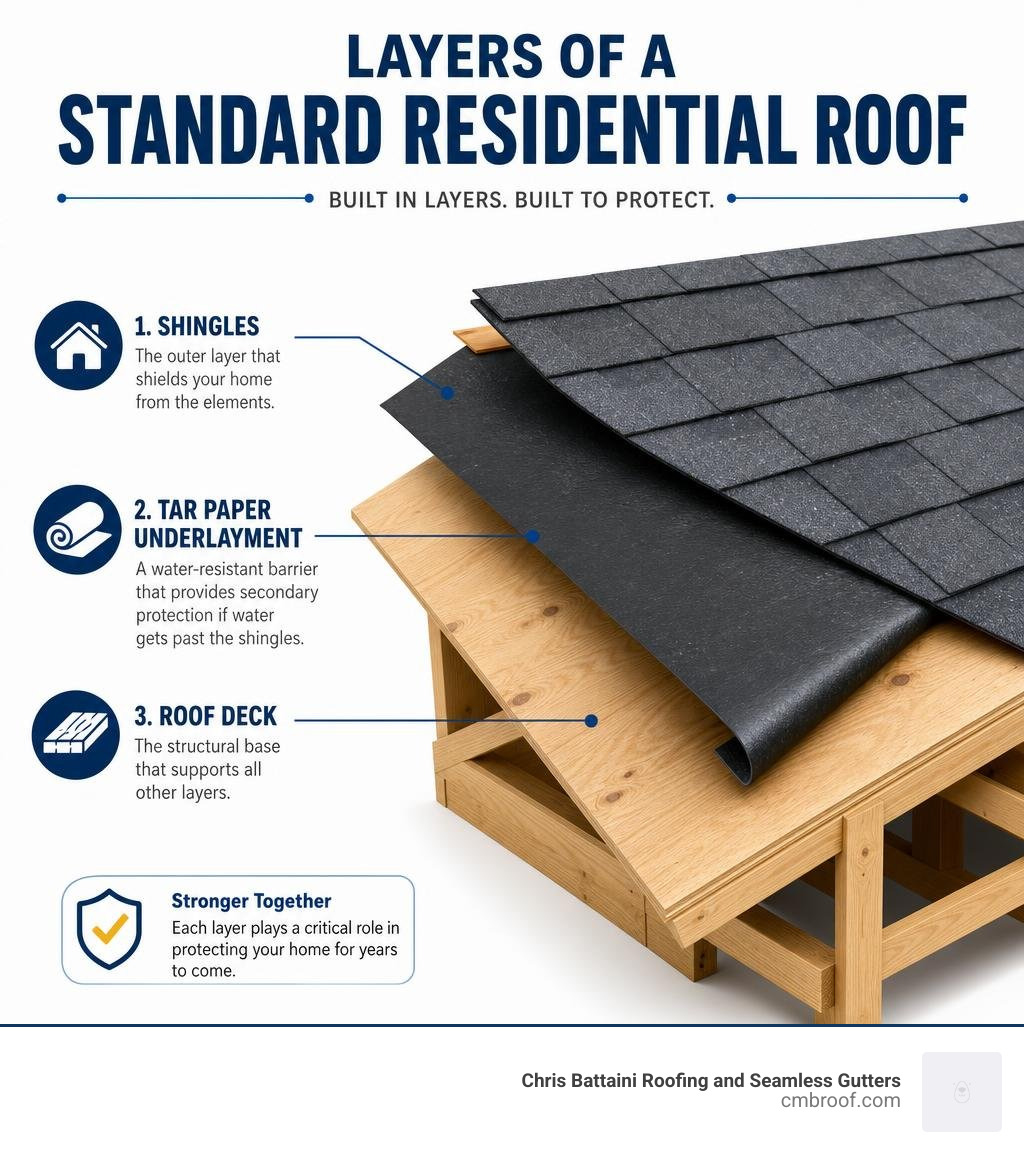
At its core, a roll of tar paper serves as the unsung hero of residential and commercial roofs. It is a heavy-duty building material used as an underlayment beneath shingles, slate, tile, and metal roofing. To understand its construction and history, we can look at the basic definition of Tar paper – Wikipedia, which notes that this material is created by impregnating a base material with tar or bitumen to provide a highly water-resistant barrier.
When we install a roof in Pittsfield, MA, or surrounding towns like Dalton, MA, we lay the underlayment directly over the wooden roof deck (usually plywood or oriented strand board). This serves several critical functions:
While you can purchase basic Roofing Paper Rolls & Underlayment – Ace Hardware for minor sheds or temporary outbuildings, installing a full residential or commercial roof requires professional grades that meet strict building standards.
The roofing industry has seen major material advances over the last century. Originally, tar paper was made from recycled cotton rags and textile fibers saturated with coal tar. Over time, the industry transitioned to wood-based cellulose fibers (kraft paper) saturated with petroleum-based asphalt, which is the standard today.
According to the historical and technical overview from Roll Roofing Tar Paper: A Practical Guide – New England Metal Roof, the shift to asphalt-saturated organic felt improved the material’s consistency, tear resistance, and overall water shedding. Modern manufacturers produce this by running organic felt sheets through giant asphalt baths, drying them, and rolling them into tight, standardized rolls.
While some specialty papers like RED ROSIN PAPER – Multi-Purpose Building Paper – W. R. Meadows are used as separation sheets to prevent squeaks and dust under wood flooring or in built-up commercial roofing systems, asphalt-saturated felt remains the primary traditional choice for sloped shingle roofs.
When shopping for or specifying a roll of tar paper, you will encounter two primary grades: #15 felt and #30 felt.
Historically, these designations meant that a 100-square-foot section (one “square” in roofing terms) weighed exactly 15 pounds or 30 pounds. Today, modern manufacturing efficiencies mean they weigh slightly less, but the naming convention remains. Modern standards are regulated under ASTM (American Society for Testing and Materials) guidelines:
Typical dimensions and coverage specs include:
In recent years, synthetic underlayments made from woven or spun-bonded polypropylene or polyethylene have grown in popularity. While traditional felt has a proven track record spanning over 100 years, synthetic products offer high tear strength and lighter weights.
| Feature | Traditional Tar Paper (Asphalt Felt) | Synthetic Underlayment |
|---|---|---|
| Material Composition | Cellulose fibers saturated with asphalt | Polypropylene or polyethylene |
| Weight per Roll | Heavy (approx. 35–45 lbs for 400 sq ft) | Light (approx. 20–25 lbs for 1,000 sq ft) |
| Tear Resistance | Moderate (can tear in high winds or when walked on) | Extremely high (virtually tear-proof) |
| Vapor Permeability | Permeable (allows wood deck to “breathe”) | Low to non-permeable (acts as vapor barrier) |
| UV Exposure Limits | Low (must be covered quickly to prevent cracking) | High (can remain exposed for 30–180 days) |
| Slippage Risk | Low (natural traction when dry) | Low to high (depends on surface grip tech) |
| Average Lifespan | 10 to 20 years | 25 to 50 years |
If you want to dive deeper into how underlayment choices impact your overall roofing investment, take a look at our Asphalt Shingle Roofing Complete Guide.
One of the most unique advantages of a traditional roll of tar paper is its natural vapor permeability. Traditional 15 lb felt is rated at approximately 6 perms, and 30 lb felt is rated at 5 perms.
This permeability allows moisture vapor from inside your attic to escape through the roof deck rather than getting trapped. If warm, humid air rises from your home into the attic, it can pass through the wood deck and the breathable tar paper, preventing moisture entrapment, mold, and rot.
In contrast, some synthetic underlayments have perm ratings lower than 0.1, making them impervious vapor barriers. While this is highly waterproof, it requires a flawless attic ventilation system to prevent moisture buildup underneath the roof deck.
On the durability side, synthetic options win when it comes to raw strength. Tar paper can tear if walked on roughly by installers, or if high winds catch it before the shingles are laid down. If left exposed to the summer sun, asphalt felt will dry out, curl, and degrade. Synthetic options can sit exposed to weather for months without losing integrity.
Cost is a major factor in any roofing project. To give you an idea of the market landscape, let’s look at some average material costs based on general online retail data:
Disclaimer: The prices above represent average retail costs sourced from publicly available internet data as of June 2026. They are not the actual prices or rates of Chris Battaini Roofing and Seamless Gutters. Project costs vary significantly based on labor, roof pitch, complexity, and regional material availability.
When considering professional installation, the average cost of underlayment materials and labor combined typically runs in a wide range of $150 to $750+ per square (100 sq. ft.) depending on whether you use basic felt, advanced synthetics, or heavy-duty self-adhering ice and water barriers.
For a comprehensive breakdown of complete roof replacement pricing, read our Asphalt Shingle Roof Cost Guide.
While laying out a roll of tar paper might look simple in DIY videos, achieving a flat, wrinkle-free, and fully code-compliant barrier in the unpredictable climate of Berkshire County requires professional expertise. We strongly advise against DIY roof installations. Working on sloped roofs is highly dangerous, and improper underlayment installation can void your shingle manufacturer’s warranty, leading to thousands of dollars in premature repairs.
Our team at Chris Battaini Roofing and Seamless Gutters handles every step of the Asphalt Roof Replacement process, ensuring that your home in Lanesborough, MA, Lenox, MA, or Dalton, MA is fully protected from the elements.
To prevent water from finding its way under the felt, we follow industry-standard overlapping and fastening protocols:
For low-slope sections (roof pitches between 2:12 and 4:12), building codes require a double layer of underlayment. This involves overlapping each 36-inch-wide sheet by 19 inches, effectively creating a continuous two-ply protective shield across the entire low-slope area. If you want to learn more about the technical details of roll applications, you can explore The Ultimate DIY Guide to Installing Asphalt Roofing Rolls.
Our local weather in Western Massachusetts is notoriously tough on roofs. From heavy winter snows in Lanesborough, MA, to freezing rain in Lenox, MA, your roof underlayment faces extreme temperature swings.
Traditional tar paper performs exceptionally well in cold weather because the asphalt content remains relatively flexible when flat. However, in extreme cold, unrolling a cold roll of tar paper too quickly can cause it to crack. Our professional crews know how to store and handle the material to maintain its flexibility.
Furthermore, in areas prone to ice dams, building codes require a self-adhering polymer-modified bitumen membrane (like Grace Ice & Water Shield) at the eaves, extending from the eave edge to a point at least 24 inches inside the warm wall line. We integrate this heavy-duty barrier seamlessly with traditional tar paper to give your home a robust, multi-layered defense against winter weather.
The primary differences are thickness, weight, and durability. A roll of #15 felt is thinner, lighter, and easier to handle, making it a common choice for standard residential roofs with steep slopes. A roll of #30 felt is much thicker, heavier, and offers far superior tear resistance.
We often recommend #30 felt for steeper roofs where installers need better traction, or when the roof will be exposed to wind and weather for several days before the shingles are installed. For more on this, check out Roll With It: Your Ultimate Guide to Asphalt Roll Roofing Installation.
Traditional tar paper is compatible with slate and wood shake roofs, often serving as a reliable slip sheet. However, when it comes to modern metal roofing, traditional tar paper has limitations.
Metal roofs can reach extremely high temperatures in the summer. This intense heat can cause the asphalt in traditional felt to soften, stick to the metal panels, and degrade prematurely. For metal roofing systems, we typically recommend high-temperature synthetic underlayments designed to withstand temperatures up to 250°F without breaking down.
Yes. The International Residential Code (IRC) and local Massachusetts building codes require an approved underlayment beneath all asphalt shingles. Skipping the underlayment is not only a code violation, but it will also immediately void your asphalt shingle manufacturer’s warranty. Underlayment is a non-negotiable component of a safe, dry, and fully warranted roof.
Whether you choose a traditional, time-tested roll of tar paper or a modern synthetic underlayment, the key to a long-lasting roof lies in the quality of the installation.
At Chris Battaini Roofing and Seamless Gutters, we pride ourselves on delivering owner-led, on-site service with exceptional workmanship warranties. We live and work right here in Berkshire County, helping homeowners in Pittsfield, Dalton, Lenox, Lanesborough, MA, and surrounding towns protect their greatest investments.
Ready to secure your home with a roof built to withstand Massachusetts winters? Fill out our online quote form to schedule your professional consultation!
Need a reliable roofer? CMB Roofing provides licensed, insured, and professional roofing services for homeowners and businesses.
We stand by a simple promise: Clear estimates. Quality workmanship. Clean job sites.
From roof repairs and full replacements to storm damage restoration, our team delivers dependable results with durable materials, expert installation, and complete site cleanup.