-
10 Wendell Ave Extension Pittsfield, MA 01201
-
210 Columbia St., Lee, MA 01238

The best roofing materials for flat roofs aren’t one-size-fits-all — and if cost isn’t your primary concern, you have access to some genuinely outstanding options that can last decades with minimal headaches.
Quick Answer: Best Flat Roof Materials Ranked by Performance
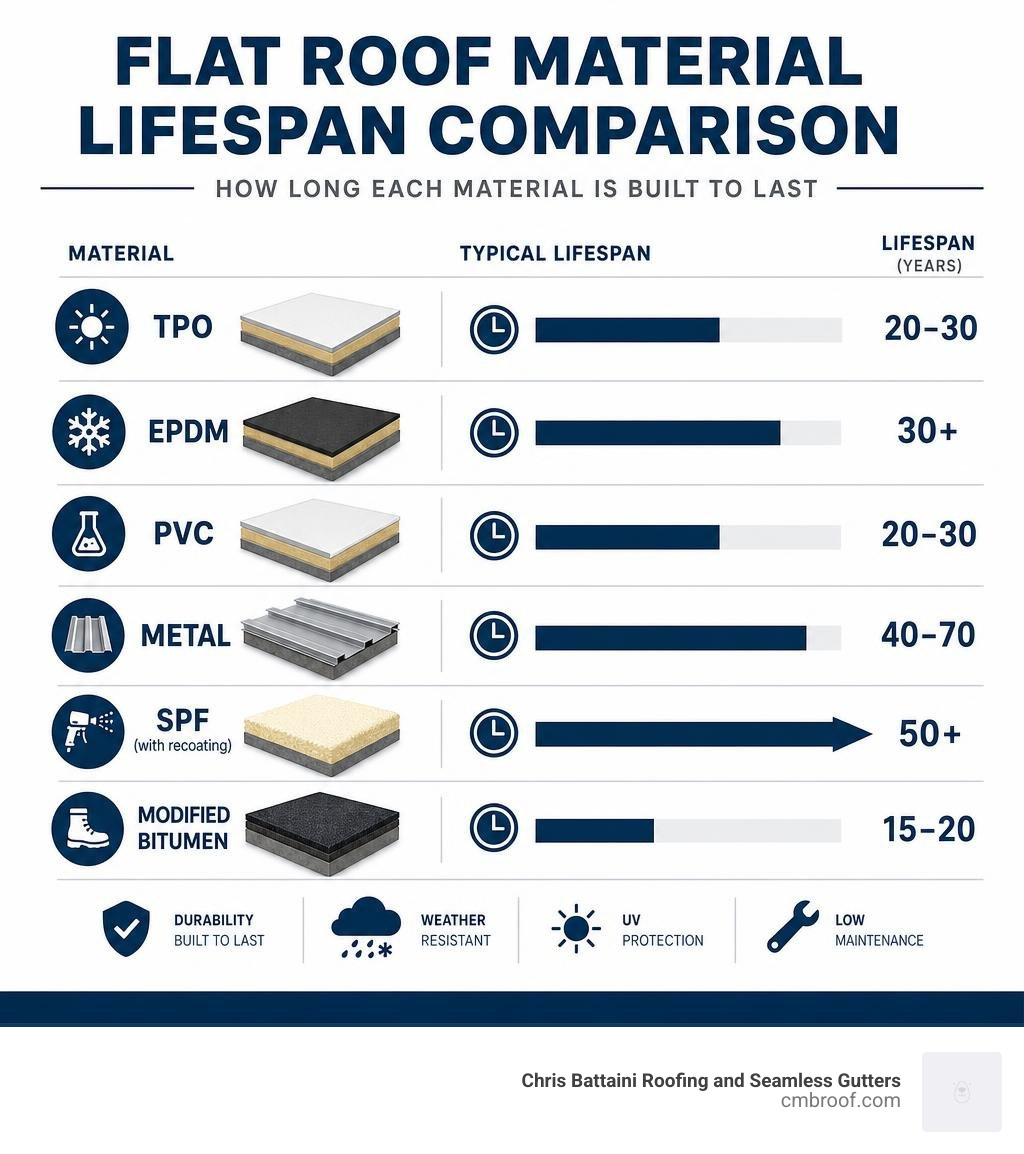
| Material | Lifespan | Best For |
|---|---|---|
| Standing Seam Metal | 40-70 years | Maximum longevity, low maintenance |
| EPDM Rubber | 30+ years | Cold climates, large simple roofs |
| PVC Membrane | 20-30 years | Chemical/grease exposure, commercial kitchens |
| TPO Membrane | 20-30 years | Energy efficiency, hot sun exposure |
| Spray Polyurethane Foam (SPF) | 50+ years (with recoating) | Insulation + waterproofing in one |
| Modified Bitumen | 15-20 years | Walkable surfaces, foot traffic |
Flat roofs are everywhere in Massachusetts — from commercial buildings in Pittsfield to row-style homes and modern additions in Dalton and beyond. But they come with a real challenge: they’re far less forgiving than sloped roofs. Poor drainage, freeze-thaw cycles, UV exposure, and ponding water can all cut a roof’s life short — especially in New England’s demanding climate.
The good news? When you invest in the right material and the right installer, a flat roof can perform beautifully for 30, 40, even 70 years.
I’m Christopher Battaini, owner of Chris Battaini Roofing & Seamless Gutters, and with over two decades of roofing experience serving homeowners and businesses across Massachusetts, I’ve seen which best roofing materials for flat roofs hold up — and which ones fail prematurely due to poor material or installation choices. Below, I’ll walk you through the top options so you can make a truly informed decision.
When we evaluate the best roofing materials for flat roofs, we have to look past the upfront price tag. Instead, we focus on lifecycle value, climate resilience, and structural suitability. In places like Williamstown MA and Cheshire MA, flat roofs face a unique set of weather challenges. We experience hot, humid summers followed by freezing winters with heavy snow loads and constant freeze-thaw cycles.
Unlike sloped roofs that shed water instantly using gravity, flat roofs actually have a very slight pitch — usually between 1/4 inch and 1/2 inch per foot. Because water drains slowly, these systems require a continuous, watertight membrane rather than overlapping shingles. If water sits on the roof for more than 48 hours (known as ponding water), a low-quality material will quickly break down, leading to costly interior damage.
To help you compare the primary options, let’s look at how they stack up in key performance areas:
To dive deeper into how these systems compare side-by-side, check out our guide on Flat Roof Materials Compared: TPO, EPDM, PVC, and Modified Bitumen (2026 Guide) or explore our overview of Flat Roof Material Options.
If you are looking for a “once-in-a-lifetime” roof and budget is not an obstacle, standing seam metal is the premier choice. While we typically associate metal with pitched roofs, it can be adapted beautifully for low-slope applications with the help of tapered insulation systems.
A standing seam metal roof can easily last 40 to 70 years. It handles New England’s heavy snow loads effortlessly, allowing ice and snow to slide off safely rather than piling up and creating ice dams. The raised seams sit well above the water level, protecting the fasteners from rust and moisture exposure.
For properties in Windsor MA or West Stockbridge MA, metal provides an incredibly durable, fire-resistant, and wind-resistant shield. It is also entirely recyclable at the end of its life, making it the most environmentally friendly option on the market. To learn more about how metal compares to other low-slope systems, read about our Low Slope Roofing Options and discover why metal is often regarded as one of The Best Roofing Materials For New England Weather.
Polyvinyl Chloride (PVC) is a premium single-ply membrane that has been trusted in the industry for decades. If your building hosts a restaurant, commercial kitchen, or manufacturing facility in Pittsfield MA, PVC is almost always the default recommendation.
Why? Because PVC is highly resistant to animal fats, grease, oils, and harsh chemicals that are frequently vented onto commercial roofs. Other membranes, like EPDM or TPO, can soften, swell, and disintegrate when exposed to these substances.
Beyond its chemical resistance, PVC features heat-welded seams. During installation, a specialized hot-air welder fuses the overlapping sheets together, creating a single, monolithic barrier. These welded seams are actually stronger than the membrane itself, making them incredibly reliable against leaks. PVC also offers excellent fire resistance and high solar reflectance. You can explore our full breakdown of these systems on our Flat Roofing Materials page.
Thermoplastic Olefin (TPO) is currently the fastest-growing flat roofing material in North America. If your primary goal is reducing your summer cooling bills while maintaining a highly reliable roof, TPO is a phenomenal choice.
TPO is a bright white, highly reflective single-ply membrane. It can reflect up to 85% of solar radiation, keeping the roof surface up to 50°F to 70°F cooler on a hot July afternoon. This dramatically reduces the heat load on your building, lowering HVAC stress and saving you 10% to 25% on utility costs.
Like PVC, TPO seams are heat-welded for superior watertight integrity. It is highly resistant to ozone, UV radiation, and punctures. However, because TPO is a relatively young material (introduced in the 1990s), quality can vary between manufacturers. That is why we always recommend specifying a thick, high-quality 60-mil or 80-mil membrane from a trusted manufacturer. For an in-depth comparison of how TPO holds up against other rubber options, check out The Great Debate: TPO vs EPDM Roofing Showdown.
While metal, PVC, and TPO are incredible options, two other high-performance materials deserve a spot at the top of your list: EPDM rubber and Spray Polyurethane Foam (SPF).
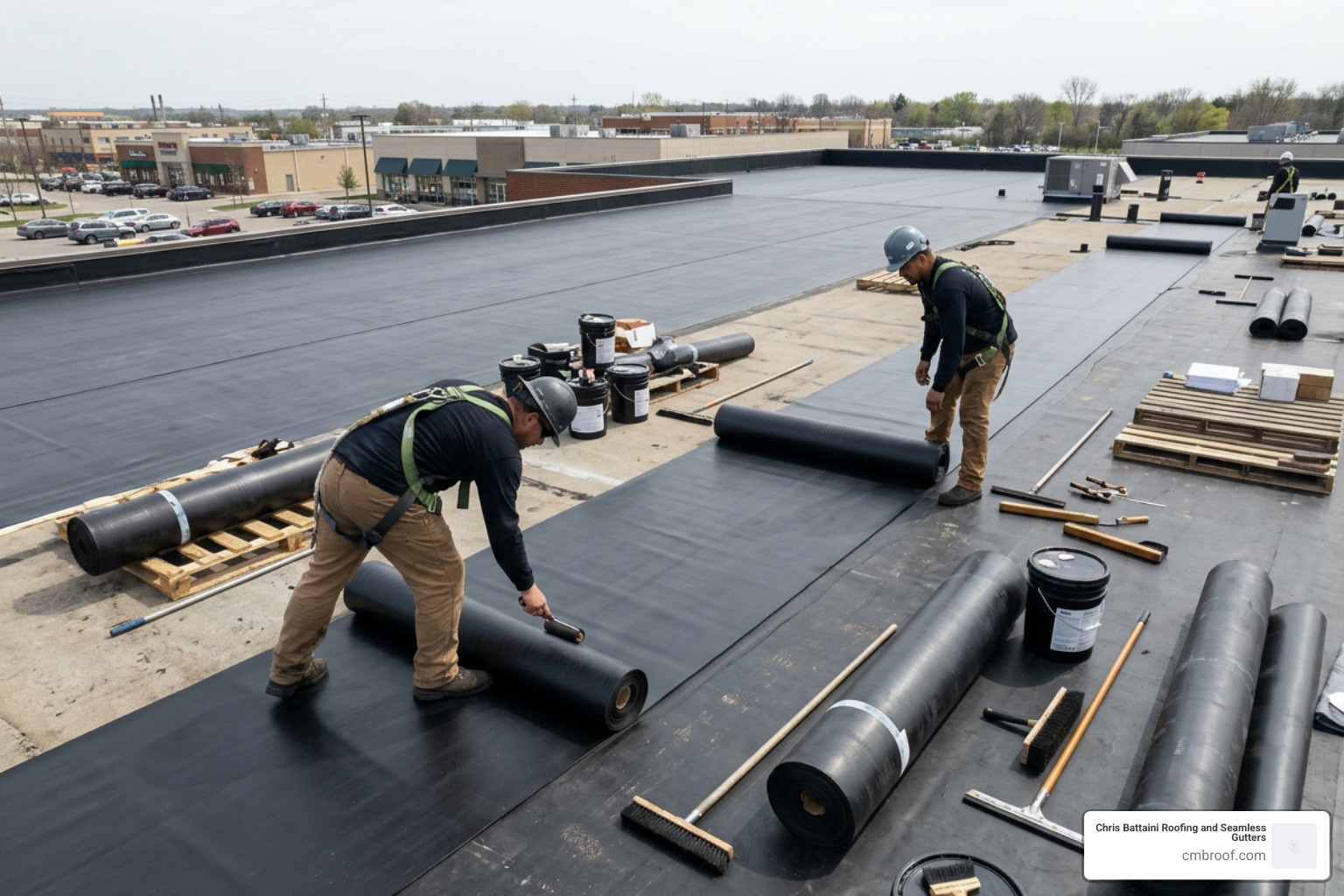
Ethylene Propylene Diene Monomer (EPDM) is a synthetic rubber membrane that has been the dependable workhorse of the roofing industry since the 1960s. Unlike thermoplastic membranes (TPO and PVC) which can be melted and re-welded, EPDM is a thermoset material. This means its molecular structure is chemically cross-linked during manufacturing, allowing it to stretch up to 300% without losing its shape.
This extreme flexibility makes EPDM incredibly resilient in cold climates. In towns like Lenox MA and Berkshire MA, where winter temperatures regularly plunge below freezing, EPDM won’t crack or shatter. Furthermore, its natural black color absorbs solar heat during our long winters, helping to melt snow faster and reduce heating loads. EPDM can also be manufactured in massive sheets up to 50 feet wide, drastically reducing the number of seams on a large roof. For a comprehensive look at commercial applications, see the EPDM Roofing Guide for Commercial Buildings in 2026 and read our article on Rubber or Not: Exploring Your Flat Roof Material Choices.
Spray Polyurethane Foam (SPF) is another premium alternative. It is applied as a liquid that expands into a dense, closed-cell foam layer, conforming perfectly to every penetration, curb, and wall on your roof. Once cured, it is coated with a protective elastomeric layer. SPF provides both waterproofing and industry-leading thermal insulation (R-6.5 per inch) in a single, completely seamless application. With proper maintenance and recoating every 10 to 15 years, an SPF roof can easily last over 50 years.
Even if you buy the most expensive, top-tier material on the market, your roof’s performance ultimately comes down to two things: installation quality and climate adaptability.
Statistics show that roughly 80% of all flat roof failures are caused by installation errors rather than material defects. Flat roofs are highly technical systems. Flashings around HVAC units, pipes, drains, and parapet walls require absolute precision. For example, EPDM rubber naturally shrinks by 1% to 2% over its lifespan. If your contractor fails to install mechanically fastened reinforced securement strips (base tie-ins) at the base of the parapet walls, that shrinkage tension will eventually pull the membrane away from the wall, causing massive leaks.
In Berkshire County, our roofs must endure extreme weather shifts. During freeze-thaw cycles, trapped moisture freezes, expands, and then melts. If water gets into a poorly sealed seam in Dalton MA or Cheshire MA, it will quickly rip the seam apart. This is why we highly advocate for heat-welded seams (found in TPO and PVC) or seamless systems (like SPF or liquid-applied coatings) when long-term reliability is your top priority.
Additionally, membrane thickness matters. While a 45-mil membrane is a common budget option, premium installations should always utilize at least a 60-mil or 80-mil membrane. The extra thickness provides superior puncture resistance against falling branches, wind-blown debris, and foot traffic from service technicians. To learn more about how different systems handle these stresses, read our guide on the various Types of Flat Roofs.
If maintained properly, standing seam metal and EPDM rubber are the longest-lasting flat roofing materials. A high-quality standing seam metal roof can last between 40 and 70 years, while a properly installed EPDM rubber roof can easily exceed 30 to 50 years of service. Spray Polyurethane Foam (SPF) can also last over 50 years, provided the protective topcoat is renewed every 10 to 15 years to maintain its structural integrity.
Disclaimer: All prices mentioned below are average costs sourced from publicly available internet data and are not the actual prices or rates of Chris Battaini Roofing.
Because premium flat roof installations require specialized materials, advanced equipment, and highly skilled labor, the costs reflect a premium investment. Based on general online industry data, a premium flat roof replacement in Massachusetts typically ranges from $8,000 to $95,000 for the total project, depending on the building size, accessibility, and material chosen. On a square-foot basis, you can expect average industry costs of $8 to $70 per square foot installed.
A fluid-applied roof restoration or silicone coating is an excellent, cost-effective alternative to a full replacement if your existing roof is still structurally sound. If your current membrane is mostly intact, has minimal seam failures, and an infrared moisture scan reveals that the underlying insulation is dry, a professional coating can easily extend your roof’s life by 10 to 20 years. However, if the insulation is saturated or the deck is damaged, a full tear-off and replacement is necessary.
When cost isn’t an issue, the best flat roof material is the one that perfectly aligns with your building’s specific needs and our demanding New England climate. Whether you choose the unmatched longevity of standing seam metal, the chemical resistance of PVC, the energy savings of TPO, or the cold-weather flexibility of EPDM, the key to a leak-free future is partnering with an experienced, local professional.
At Chris Battaini Roofing and Seamless Gutters, we have spent more than 20 years providing exceptional craftsmanship across Berkshire County, including Pittsfield MA, Dalton MA, Lenox MA, and the surrounding towns. We are proud to offer owner-led, on-site service and industry-leading workmanship warranties that give you total peace of mind.
If you are ready to invest in a premium, long-lasting flat roof system for your home or commercial property, we are here to help. Contact our team today to discuss your project and find the perfect solution for your building.
Need a reliable roofer? CMB Roofing provides licensed, insured, and professional roofing services for homeowners and businesses.
We stand by a simple promise: Clear estimates. Quality workmanship. Clean job sites.
From roof repairs and full replacements to storm damage restoration, our team delivers dependable results with durable materials, expert installation, and complete site cleanup.