-
10 Wendell Ave Extension Pittsfield, MA 01201
-
210 Columbia St., Lee, MA 01238

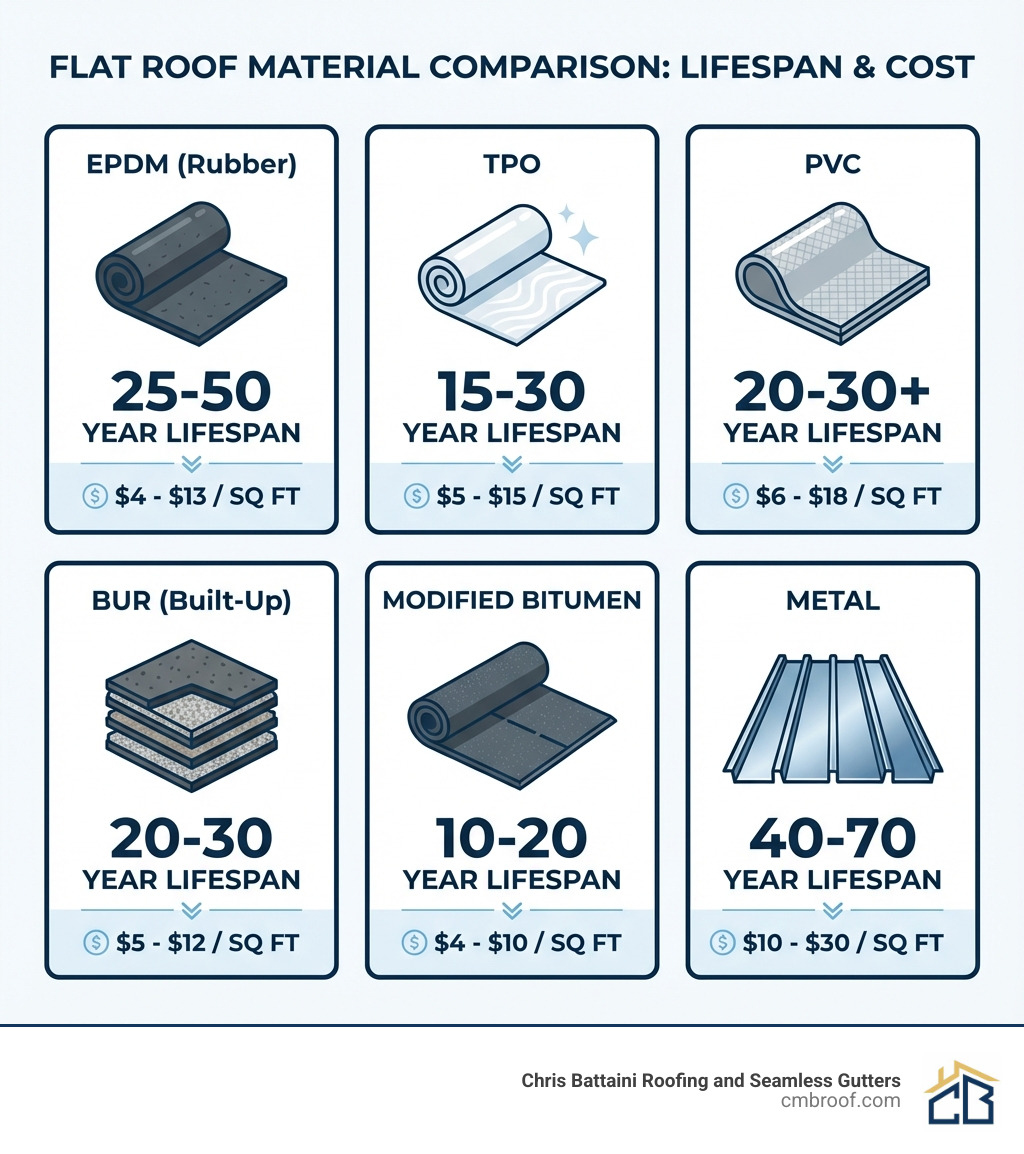
Flat roof material options determine not just how long your roof will last, but also how much you’ll spend on energy bills, maintenance, and eventual replacement. Here’s a quick comparison of the most common choices:
| Material | Lifespan | Average Cost/Sq Ft | Best For |
|---|---|---|---|
| EPDM (Rubber) | 25-50 years | $4 – $13 | Budget-conscious, moderate climates |
| TPO | 15-30 years | $5 – $15 | Hot climates, energy efficiency |
| PVC | 20-30+ years | $6 – $18 | Heavy traffic, chemical resistance |
| Built-Up (BUR) | 20-30 years | $5 – $15 | Maximum waterproofing |
| Modified Bitumen | 10-20 years | $4 – $12 | Temperature fluctuations |
| Metal | 40-70 years | $10 – $30 | Long-term investment |
Note: These are average national costs from internet data and not actual pricing from Chris Battaini Roofing and Seamless Gutters.
Flat roofs face unique challenges. Water doesn’t run off as quickly, meaning the material must handle ponding water. UV exposure hits the surface directly all day. And in New England, you’re dealing with everything from heavy snow loads to summer heat waves.
The wrong material can cost you thousands in premature failure.
According to the National Roofing Contractors Association, properly maintained EPDM roofs have an average service life of over 20 years, with some lasting much longer. But that’s only if you choose the right type for your climate and have it installed correctly.
I’m Christopher Battaini, owner of Chris Battaini Roofing & Seamless Gutters. For over two decades, I’ve helped hundreds of homeowners and businesses across Western Massachusetts and Southern Vermont find flat roof solutions that last. Understanding which material works best for your specific situation—whether it’s a garage, addition, or commercial building—can mean the difference between a roof that protects your investment for decades and one that fails in just a few years.
Simple guide to flat roof material options:
Choosing the right flat roof material options is a big decision, whether for a new home, an extension, or a commercial property in Western Massachusetts or Southern Vermont. It’s not just about the upfront cost; it’s about finding a solution that fits your needs and stands the test of time.
Here are the key factors we consider when guiding our clients:
For more detailed information on selecting a high-quality flat roof, you can explore our resources on High Quality Flat Roofing.
Single-ply membranes are a significant leap forward in flat roofing. Unlike traditional multi-layer systems, these are large, flexible sheets of synthetic material installed in a single layer. They’ve become popular for commercial and residential use due to their versatility, ease of installation, and excellent performance.
These membranes are generally categorized as either elastomeric (rubber-like) or plastomeric (plastic-like). Installation typically involves adhering, mechanically fastening, or ballasting the membrane to the roof deck.
For those considering flat roofing for their home, understanding these modern options is crucial. Learn more about Residential Flat Roofing.

EPDM (Ethylene Propylene Diene Monomer), or “rubber roofing,” is a synthetic rubber membrane known for its resilience and adaptability.
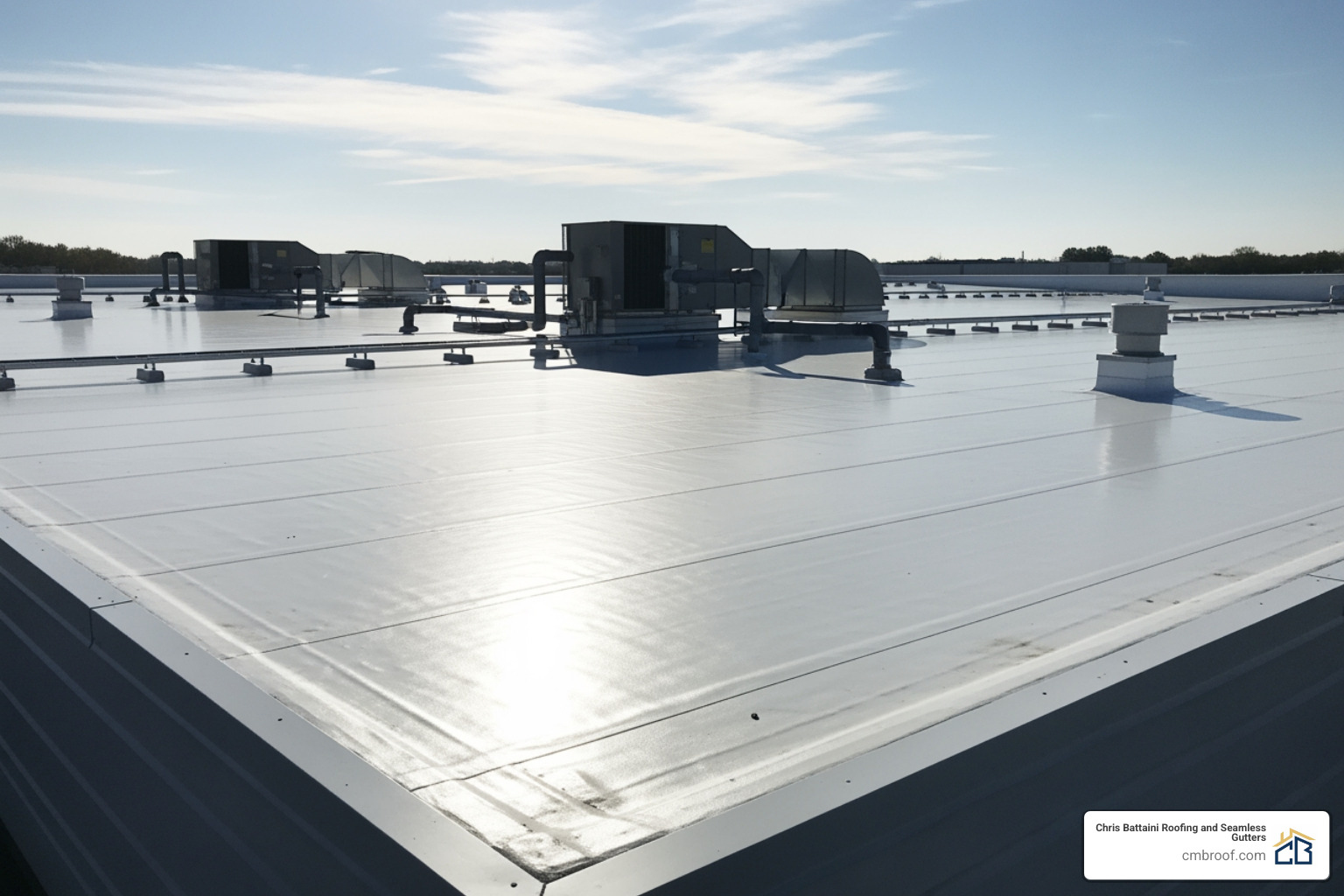
TPO (Thermoplastic Olefin) is a single-ply membrane blending rubber and plastic polymers. Typically white, it’s a fantastic choice for energy efficiency.
PVC (Polyvinyl Chloride) is another single-ply thermoplastic membrane known for exceptional durability, making it a premium choice among flat roof material options.
Before single-ply membranes, multi-layer systems were the standard for flat roofs, and they remain effective today. These methods involve building up layers of materials on the roof deck to create a robust barrier. While modern materials offer different advantages, these time-tested options have proven their worth over decades, especially in demanding New England winters.
For commercial properties, these options are particularly relevant. Learn more about Commercial Flat Roofing.
Built-Up Roofing (BUR), or “tar and gravel,” is one of the oldest and most trusted flat roof material options. It’s made by alternating layers of bitumen (asphalt) with reinforcing fabrics, topped with a layer of gravel or crushed stone.
Modified Bitumen (Mod-Bit) is an evolution of BUR, combining asphalt with polymer reinforcements for added flexibility and resilience to temperature changes—a big plus in New England.
Standing seam metal roofing is an excellent and increasingly popular option for low-slope roofs. These systems consist of continuous metal panels joined with raised, interlocking seams.
Choosing the best flat roof material options for your property in Western Massachusetts or Southern Vermont requires careful consideration. Here’s a quick comparison to help you weigh your choices:
| Material | Lifespan | Average Cost/Sq Ft | Energy Efficiency | Durability | Best For |
|---|---|---|---|---|---|
| EPDM (Rubber) | 25-50 years | $4 – $13 | Moderate | Good | Budget-conscious, moderate climates, large areas |
| TPO | 15-30 years | $5 – $15 | High | Very Good | Hot climates, energy savings, lightweight |
| PVC | 20-30+ years | $6 – $18 | High | Excellent | Heavy traffic, chemical resistance, fire resistance |
| Built-Up (BUR) | 20-30 years | $5 – $15 | Moderate | Excellent | Maximum waterproofing, fire resistance |
| Modified Bitumen | 10-20 years | $4 – $12 | Moderate | Good | Smaller roofs, temperature fluctuations |
| Metal | 40-70 years | $10 – $30 | High | Exceptional | Longevity, aesthetics, low maintenance, high-end |
Note: These are average national costs from internet data and not actual pricing from Chris Battaini Roofing and Seamless Gutters.
When deciding, ask: What’s the primary goal? Is it maximum lifespan, lowest upfront cost, best energy savings, or a specific aesthetic?
New England’s four-season climate—with hot summers, snowy winters, and heavy rain—is a major factor in choosing a flat roof material.
Roof design is also key. A “warm” roof, with insulation installed above the deck, is best for our cold climate. This design keeps the roof structure warm and dry, preventing condensation. “Cold” roofs, with insulation below the deck, are discouraged as they can cause moisture issues.
We encourage clients to consider the “lifecycle cost”—the initial price plus long-term maintenance, energy savings, and lifespan. A cheaper roof today can cost more in the long run through repairs and early replacement.
For a more in-depth understanding of costs, please refer to our Residential Flat Roof Cost Complete Guide.
Even the best material will fail if installed poorly. This is especially true for flat roofs, where small flaws can cause major water damage. Professional installation is non-negotiable.
Metal roofing, especially standing seam systems, is the longest-lasting option, often reaching 40-70 years. High-quality PVC and EPDM are also very durable, with lifespans of 20-50 years depending on the specific material and maintenance. These are excellent long-term investments.
For the lowest initial cost, Modified Bitumen and EPDM are typically the most budget-friendly flat roof material options. Their upfront price is attractive, but it’s crucial to weigh this against their shorter lifespan compared to premium options. True cost-effectiveness considers the entire lifecycle cost, including maintenance and eventual replacement.
In New England, the choice between EPDM and TPO depends on your priorities.
The best choice depends on whether your priority is managing winter snow load or reducing summer heat. We help clients in Western Massachusetts and Southern Vermont make the right decision for their property.
Navigating flat roof material options can feel overwhelming. We’ve covered the main choices, from modern single-ply membranes (EPDM, TPO, PVC) to traditional systems (BUR, Modified Bitumen) and durable metal. Each offers a unique balance of cost, lifespan, and performance in our demanding New England climate.
The best choice for your home or business in Berkshire, Hampden, Hampshire, or Franklin Counties in Massachusetts, or Southern Vermont, depends on your specific needs and budget. What remains constant is the critical importance of professional installation. A superior material installed poorly will inevitably lead to problems.
At Chris Battaini Roofing & Seamless Gutters, we pride ourselves on providing owner-led, on-site service, ensuring every project benefits from our direct expertise and attention to detail. We stand behind our work with exceptional warranties, giving you peace of mind that your investment is protected.
For expert advice and installation on your next flat roof project, explore our residential flat roofing services. We’re here to help you make the right choice for a roof that will protect your property for decades to come.
Need a reliable roofer? CMB Roofing provides licensed, insured, and professional roofing services for homeowners and businesses.
We stand by a simple promise: Clear estimates. Quality workmanship. Clean job sites.
From roof repairs and full replacements to storm damage restoration, our team delivers dependable results with durable materials, expert installation, and complete site cleanup.




Book your Spring installation now and save $500 on a complete roof and seamless gutter system.
Spring booking required for discount eligibility.
Mention code SPRING2026 during your estimate to qualify.
Valid for complete roof + gutter system installations only. Must book by April 1, 2026. Mention SPRING2026 at the estimate to qualify. Not combinable with other offers.