-
10 Wendell Ave Extension Pittsfield, MA 01201
-
210 Columbia St., Lee, MA 01238

A new asphalt roof is one of the most important investments you can make to protect your home or commercial property. Here’s a quick overview of what you need to know:
| Topic | Key Facts |
|---|---|
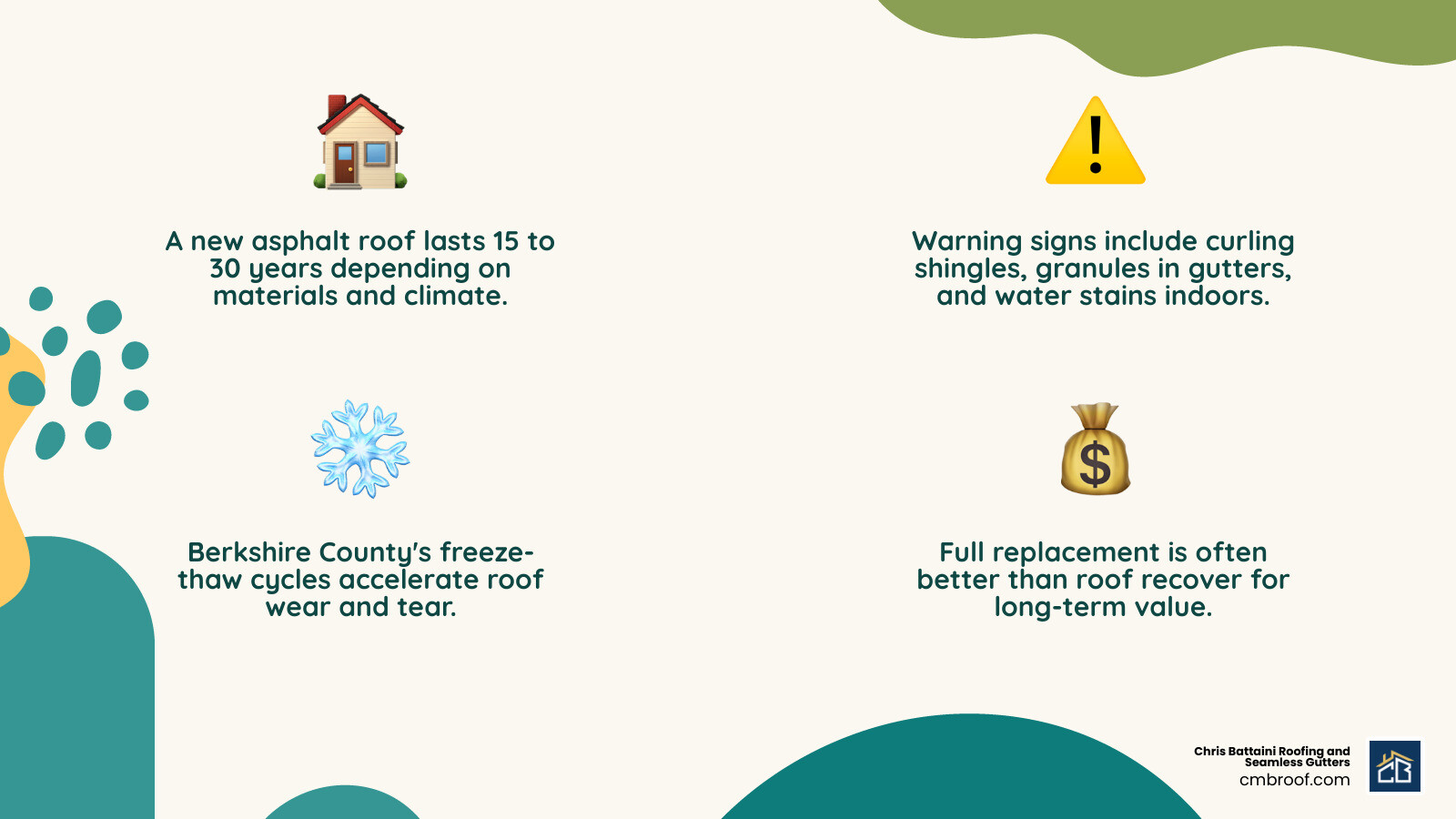
| Average lifespan | 15 to 30 years depending on materials, climate, and maintenance |
| Common shingle types | 3-tab, architectural (dimensional), and premium architectural |
| Warning signs you need a new roof | Curling or missing shingles, granules in gutters, water stains indoors, sagging roofline |
| When to replace vs. recover | Most codes allow a maximum of 2 layers; full replacement is often the better long-term choice |
| Why asphalt? | Most affordable, widely available, and proven roofing material in the U.S. |
Your roof does a lot of quiet, unglamorous work. It keeps your family dry during Berkshire County’s heavy winters, stands up to freeze-thaw cycles that batter communities like Pittsfield and Lenox year after year, and protects everything inside your home from the elements.
But roofs don’t last forever. And when one starts to fail, the damage doesn’t stop at the shingles. Water works its way into decking, insulation, and framing — turning what could have been a straightforward replacement into a much more expensive structural repair.
Knowing when to act, and what your options actually are, is the first step.
This guide is designed to help Berkshire County homeowners and small business owners cut through the confusion — and make a confident, informed decision about their roof.
I’m Christopher Battaini, owner of Chris Battaini Roofing & Seamless Gutters, and with over two decades of hands-on roofing experience across the North Shore and Greater Boston area, I’ve helped hundreds of homeowners navigate the process of getting a new asphalt roof done right — from the first inspection to the final cleanup. I’ll walk you through everything you need to know in this guide.
Easy New asphalt roof word list:

Identifying when your property is ready for a new asphalt roof is critical to protecting your long-term asset. Many property owners make the mistake of waiting until water is actively dripping through the ceiling before they consider calling a professional. By then, the damage has already migrated from the exterior shingles into the structural wood decking, rafter systems, and insulation.
Regular professional inspections are the most effective way to evaluate the health of your roofing system. When we inspect homes in Pittsfield MA and Lanesborough MA, we look closely at both the visible exterior surface and the underlying structural components. If you want to understand the complete replacement process from start to finish, you can read our Complete Roof Replacement Guide 2025.
A failing roof does more than just let water in; it compromises the entire structural integrity of your building. In our Berkshire County climate, where heavy snow loads and high winds are common, a weakened roof deck can become a serious safety hazard. Recognizing the early indicators of wear allows you to plan your replacement strategically, rather than dealing with an emergency middle-of-the-winter failure.
There are several clear warning signs that indicate your roof is reaching the end of its functional life. Outdoor indicators are often the easiest to spot if you know what you are looking for:
Indoors, you should regularly inspect your attic space, especially after a heavy rainstorm. Look for active water stains on the rafters, damp insulation, musty smells, or pinpricks of daylight shining through the roof boards. For a deeper dive into diagnosing these issues, check out our Asphalt Shingle Roofing Complete Guide.
On average, a standard asphalt shingle roof has a lifespan of 15 to 30 years. However, this timeline is not set in stone and is heavily influenced by several critical factors:
The local climate is one of the biggest drivers of roof aging. In Berkshire County, our roofs must endure extreme temperature swings, heavy snow accumulation, ice dams, and intense UV exposure during the summer months. The constant freeze-thaw cycles cause materials to expand and contract, which can stress the shingle seals and hasten deterioration.
Additionally, if a previous roof was installed as a “recover” (laying new shingles directly over old ones), the lifespan of that second layer is typically reduced to about 20 years or less because heat gets trapped between the layers, baking the shingles from both sides. To learn more about what to expect when planning your project, read our guide on getting a New Roof.
Understanding the financial investment required for a new asphalt roof is essential for budgeting. Before discussing the numbers, please note our pricing disclaimer: all prices mentioned in this article are average costs sourced from publicly available internet data and are not the actual prices or rates of Chris Battaini Roofing and Seamless Gutters. Every roof is unique, and actual costs will vary based on your specific property’s needs.
When searching online for average roofing costs, you will find a wide range of estimates. To give you a realistic idea of the market variability, online data shows that a professional roof replacement for a typical 1,700 square foot home can range from $12,000 to $45,000, which translates to an average cost of $10.18 to $33.30 per square foot.
This wide range accounts for different regional labor rates, structural complexities, and material choices. If you are looking for a baseline budget estimate for your property, you can explore our Asphalt Shingle Roof Cost Guide to learn more about how these figures are calculated.
Several key variables dictate where your project will fall within that broad price spectrum:
Labor generally accounts for about 60% of the total cost of a roof replacement. Hiring a fully licensed, insured, and manufacturer-certified team ensures that this labor is executed to the highest standards. For more details on budgeting and cost factors, review our breakdown of Asphalt Shingle Roof Replacement Cost.
When faced with the cost of a roof replacement, some property owners ask if they can save money by doing a “recover” — which means nailing a new layer of shingles directly over the existing worn-out layer. While this may save on initial labor and disposal costs, it is rarely the best long-term financial decision.
Most local building codes allow a maximum of two layers of roofing. However, recovering has several severe technical limitations:
For commercial flat roofs, multi-ply asphalt systems must meet strict performance criteria, such as those outlined in the 3CID/3FID/3PID. CSI 3-Part Specifications. (Johns Manville). For residential steep-slope roofs, a complete tear-off is almost always the superior choice for longevity and warranty protection.

A high-performance roof is not just a layer of shingles nailed to wood. It is an integrated, multi-layered system where every component must work together to shed water, resist wind, and vent moisture. When we install a new asphalt roof, we install a complete system designed to withstand the harshest New England weather. To understand how these components fit together during installation, you can read our Complete Asphalt Shingle Replacement Guide.
To build a roof that lasts for decades, we construct it layer by layer:
For commercial flat roofs, asphalt systems are built even thicker. Some commercial installations use built-up roofing (BUR) or modified bitumen, which must adhere to strict government and military engineering standards like the UFGS 07 51 13 Built-Up Asphalt Roofing.
In Berkshire County, attic ventilation and ice barriers are just as important as the shingles themselves.
Proper attic ventilation requires a balance of intake vents (usually in the soffits under the eaves) and exhaust vents (usually along the ridge of the roof). This continuous airflow keeps the attic temperature close to the outdoor temperature.
Without proper ventilation, warm air from your living spaces rises into the attic and heats the roof deck. This melts the snow on your roof, which runs down to the cold eaves and refreezes, forming an ice dam. Ice dams back water up under the shingles, leading to severe interior leaks. By combining proper ventilation with a robust self-adhering ice and water barrier in towns like Lenox MA and Pittsfield MA, we protect your home from winter water damage. Learn more in our Residential Asphalt Shingle Roofing Guide.
Choosing the right type of shingle is a balance of performance, aesthetics, and budget. Modern manufacturing has expanded the options available to property owners, offering improved wind resistance, impact resistance, and beautiful depth. If you are exploring your options, our Asphalt Shingle Roofing page provides a great starting point.
To help you make an informed decision, let’s compare the three primary classes of asphalt shingles:
| Shingle Type | Design & Appearance | Wind Resistance | Average Warranty | Best Suited For |
|---|---|---|---|---|
| 3-Tab Shingles | Flat, uniform, single-layer look; traditional style | Up to 60 mph | 20 to 25 years | Budget-conscious projects, rental properties, or detached garages |
| Architectural Shingles | Dimensional, laminated layers; mimics wood shake | 110 to 130 mph | 30 years to Lifetime | Standard residential homes, high-wind areas, long-term value |
| Premium Architectural | Thick, heavy-duty, luxury look; mimics slate or shake | 130+ mph | 50 years to Lifetime | High-end homes, maximum durability, premium curb appeal |
While 3-tab shingles are the most economical upfront, architectural shingles (also known as dimensional shingles) are the most popular choice for modern homeowners. They are significantly thicker, offer double the wind resistance, and provide a much richer texture that enhances your home’s curb appeal. Premium shingles offer the ultimate in heavy-duty protection and can last up to 50 years when installed correctly.
No matter which shingle you select, the key to longevity is using high-quality materials from trusted manufacturers who stand behind their products, as emphasized in technical guides like “A Quality Roof Installation Begins with Superior Materials”.
Homeowners insurance typically covers roof damage caused by sudden, accidental events like severe windstorms, hail, or fallen trees. It does not cover damage caused by normal wear and tear, lack of maintenance, or old age.
If you suspect your roof has storm damage, we recommend having a professional inspection first. A qualified contractor can document the damage with photos and a written report. If you file a claim, it is highly beneficial to have your contractor present on-site when the insurance adjuster inspects the roof. This ensures all damage is pointed out and properly accounted for in the claim estimate.
No, most manufacturers and professional contractors strongly advise against installing new architectural shingles over an existing layer. Because architectural shingles have an uneven, dimensional profile, laying a new layer over them will result in an uneven, bumpy surface.
This prevents the new shingles from sealing properly, leaving them vulnerable to wind blow-offs. Additionally, many manufacturers will void or severely limit their wind and material warranties if shingles are installed over an existing layer.
When you get a new asphalt roof, you should expect two distinct types of warranties:
At Chris Battaini Roofing, we are proud to offer exceptional workmanship warranties because we stand behind the skill and precision of our crew.
Investing in a new asphalt roof is one of the most effective ways to secure your property’s structure, enhance its curb appeal, and enjoy peace of mind for decades to come. By understanding the warning signs of failure, evaluating the true costs, and choosing high-quality materials, you can make an investment that truly protects what matters most.
At Chris Battaini Roofing & Seamless Gutters, we specialize in providing top-tier residential and commercial asphalt roofing services throughout Berkshire County, Massachusetts. We pride ourselves on our unique, owner-led, on-site service. I personally oversee our projects to ensure that every nail is driven correctly, every flashing is sealed perfectly, and your property is left spotless.
Whether you are in Pittsfield, Lanesborough, Dalton, Lenox, or any of our neighboring communities, we are here to help you navigate your roofing project with transparency and expert craftsmanship. To learn more about our services, visit our Asphalt Shingle Roofing page.
Ready to get started? Contact us today at +413-441-4840 to schedule your professional, on-site consultation, or click the button below to request a free estimate.
Need a reliable roofer? CMB Roofing provides licensed, insured, and professional roofing services for homeowners and businesses.
We stand by a simple promise: Clear estimates. Quality workmanship. Clean job sites.
From roof repairs and full replacements to storm damage restoration, our team delivers dependable results with durable materials, expert installation, and complete site cleanup.