


The Roof Whisperer: Decoding and Repairing Common Roof Damage
Why Hail Damage Roof Repair Demands Your Immediate Attention
When a hailstorm rolls through your neighborhood, the immediate aftermath can be deceptive. You might step outside, see a few leaves on the ground, and think you’ve dodged a bullet. However, when it comes to your roof, what you can’t see can cause the most harm. That’s why hail damage roof repair is a task that deserves prompt attention. Ignoring it can allow manageable issues to grow into more complicated and expensive roof problems over time.
Quick Answer: What to Do After Hail Damages Your Roof
If you suspect your home has been hit by hail, follow these crucial steps:
- Stay Safe: First and foremost, prioritize safety. Never climb onto a wet or potentially weakened roof. The risk of slipping or causing further damage is too high.
- Inspect from the Ground: Walk around your property and look for telltale signs. Check for dents on your gutters, downspouts, and any metal flashing. Look for shingle granules that may have been knocked loose and collected in your gutters or on the ground. Binoculars can be a great tool for a closer look from a safe distance.
- Document Everything: Before any repairs begin, thoroughly document the damage for your insurance claim. Take clear, well-lit photos and videos of any dents, cracks, or missing granules. If possible, use a ruler or a coin in the photos to provide a sense of scale for the size of the hail and the resulting damage.
- Call a Professional: Contact a reputable, local roofing contractor for a thorough inspection. A trained professional can identify subtle damage that is invisible to the untrained eye. It’s best to do this within a short time after the storm so you can get a clear assessment before the evidence weathers away.
- Contact Your Insurance Company: Once you have a professional assessment, file a claim with your insurance provider if appropriate. Most homeowner’s insurance policies cover hail damage, but they often have time limits for filing. Acting quickly helps ensure you don’t miss this window.
- Act Promptly: Even seemingly minor damage, like a few missing granules, can compromise the integrity of your shingles over time. This can eventually lead to cracks, leaks, and moisture-related issues in your attic and roof structure.
Hailstorms can be a significant cause of property damage in many parts of the United States. What often starts as small, circular bruises on your shingles can gradually develop into leaks and structural problems if left unaddressed.
The real concern often lies in the hidden damage. While large hailstones can obviously crack or shatter shingles, even smaller stones, as little as 1 inch in diameter, can create micro-fractures and dislodge the protective granules. When combined with wind-driven rain, these impact points can become pathways for water to work its way into your roofing system over time.
I’m Christopher Battaini, and for over two decades, my team and I at Chris Battaini Roofing and Seamless Gutters have been helping homeowners in Berkshire County, Massachusetts navigate the aftermath of severe weather. As an Owens Corning Platinum Preferred Contractor—a distinction earned by only the top tier of roofing professionals in the country—we have the expertise to accurately assess hail damage and provide reliable, high-quality repairs. We’ve seen how a prompt, professional response can be the difference between a focused repair and a larger, more involved roof project. Our goal is to protect your home and your investment with integrity and superior craftsmanship.
Chris Battaini Roofing and Seamless Gutters proudly serves homeowners throughout Berkshire County in Massachusetts.
Identifying the Unseen Enemy: Signs of Hail Damage
After a hailstorm, the first and most critical step is to carefully assess your property for damage. However, not all hail damage is immediately obvious. Some signs are subtle and can be easily mistaken for normal wear and tear, while others are hidden from plain sight. This is where a trained eye becomes invaluable. We’ve seen countless cases where minor, overlooked damage has led to significant problems like leaks, mold, and structural decay months or even years later. A prompt and thorough inspection is key to protecting your home.
Telltale Signs on Different Roofing Materials
The type of roofing material on your home will significantly influence how hail damage manifests. Each material has its own unique vulnerabilities.
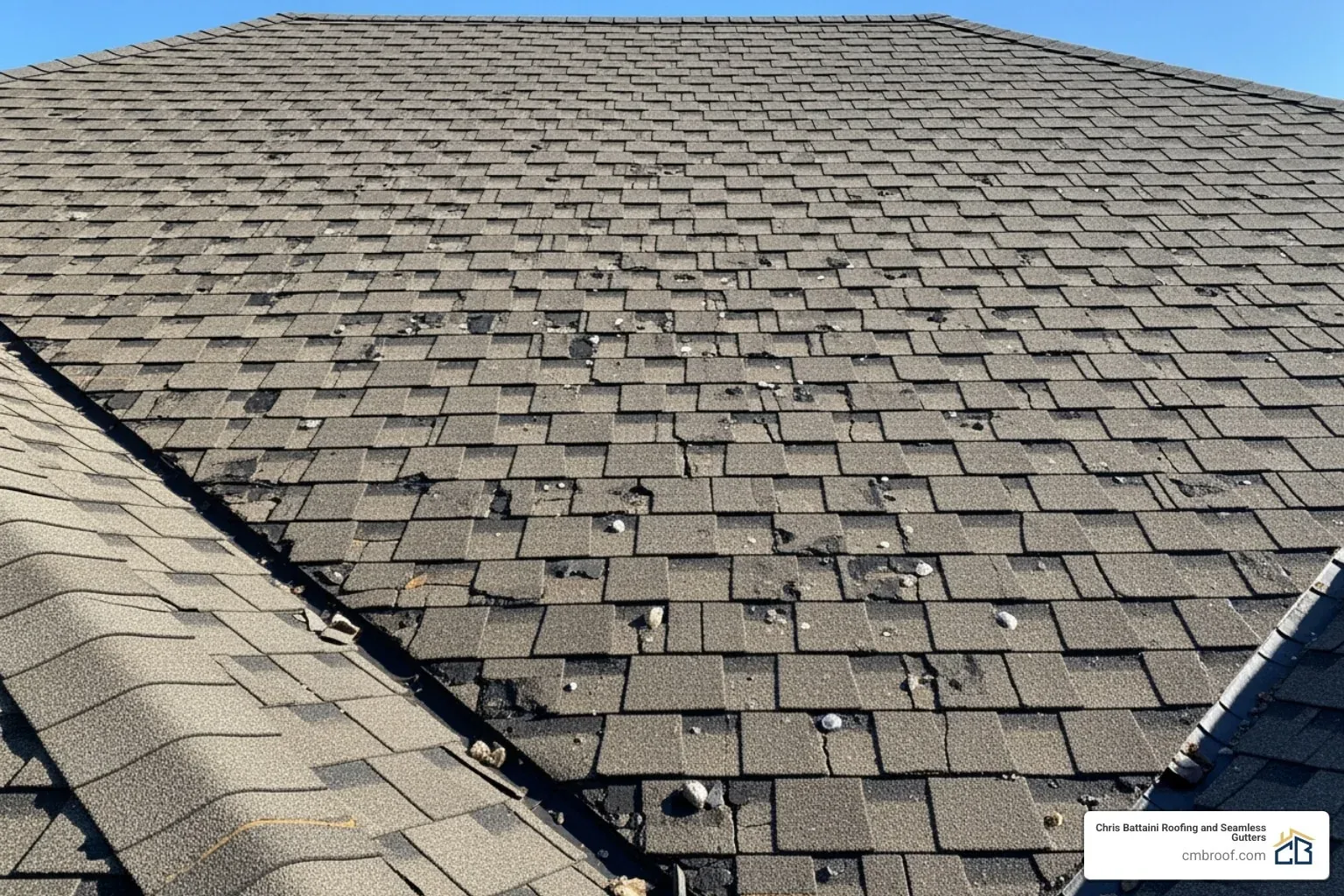
- Asphalt Shingles: As the most common roofing material in the U.S., asphalt shingles have a distinct pattern of hail damage. Look for dark, circular spots or “bruises” where hailstones have impacted the surface. These impacts knock off the protective granules, exposing the underlying asphalt mat to UV radiation. This exposure accelerates the shingle’s aging process, making it brittle and prone to cracking. You might also find an accumulation of these granules in your gutters or at the base of your downspouts, which is a clear indicator of hail impact. In some cases, the shingle may be cracked or even punctured, creating a direct path for water to enter your home.
- Metal Roofing: While known for its durability, metal roofing is not immune to hail. The most obvious sign of damage is denting. Small hailstones may cause minor cosmetic dings, but larger stones can create significant dents that compromise the integrity of the panels. This can lead to issues with water runoff and, over time, may cause the protective coating to crack or flake, exposing the metal to the elements and increasing the risk of rust and corrosion. Look for dents on the flat surfaces of the panels as well as on the ridges and edges.
- Cedar Shake Roofing: Wood shakes, like cedar, are a natural product and react differently to impact than asphalt or metal. Hail can cause the wood to split, often along the grain. These splits will typically appear fresh, with sharp edges and a lighter color than the weathered surface of the shake. You might also see impact marks or gouges where the hail has chipped away pieces of the wood. This damage can compromise the water-shedding capability of the roof and expose the underlayment to moisture.
- Slate Roofing Repair: Slate is an extremely durable but brittle material. While it can withstand smaller hail, larger stones can cause significant damage. Look for chipped corners, cracks, or completely shattered slates. A hard impact can also loosen the nails holding the slate in place, causing it to slide out of position or fall off the roof entirely. Because slate roofs are a specialized system, any damage requires the expertise of a professional for proper slate roofing repair.
- Wood Shingles: Similar to cedar shakes, wood shingles will show signs of splitting or cracking under hail impact. These splits are often random and will not follow a discernible pattern, unlike the more uniform cracking that can occur with age. The color of the wood inside the split will be brighter than the weathered exterior, indicating a fresh break.
Beyond the roofing surface itself, remember to inspect other components of your home’s exterior. Check gutters, downspouts, siding, window screens, and even your air conditioning unit for dents, dings, or chips. Damage to these areas is often a strong indicator that your roof has also sustained damage, even if it’s not immediately visible from the ground. For a visual guide on what to look for, the GAF website provides helpful information on what to do after a storm damages your roof.
Hail Size Matters: When to Be Concerned
The size of the hailstones is a primary factor in determining the potential for damage. While any hail can be a concern, larger stones carry more mass and velocity, resulting in greater impact energy. Here’s a general guide:
- Pea-sized hail (1/4 inch or less): This size of hail is unlikely to cause significant structural damage to most roofing materials. However, it can cause cosmetic issues and, over time, contribute to the gradual erosion of asphalt shingle granules.
- Quarter-sized hail (1 inch): This is generally considered the threshold for potential damage. Hail of this size can cause noticeable dents in metal roofing and siding, and it can bruise or crack asphalt shingles, compromising their ability to protect your home from water intrusion.
- Golf ball-sized hail (1.75 inches or larger): Hail of this size and larger is almost certain to cause significant damage. It can shatter slate tiles, deeply dent metal panels, and create severe bruising or punctures in asphalt shingles. When hail reaches this size, a professional inspection is not just recommended—it’s essential.
It’s not just the size of the hail that matters, but also the wind speed factor. High winds can drive hailstones at a greater velocity and at an angle, increasing their impact energy and the likelihood of damage. The National Oceanic and Atmospheric Administration’s National Severe Storms Laboratory provides extensive research on hailstorms, confirming that hail is a leading cause of property damage across the United States.
Is It Hail or Just Wear and Tear?
Distinguishing between hail damage and normal aging can be challenging for an untrained eye, but it’s a critical distinction, especially when filing an insurance claim. Insurance policies cover damage from specific events like hailstorms, but they do not cover general wear and tear. A professional roofer can help you make this determination, but here are some key differences to look for:
| Characteristic | Hail Damage | Common Wear and Tear – Pattern: Damage is random and scattered across the roof, with no discernible pattern. | Pattern: Wear is often uniform across the roof or concentrated in areas exposed to direct sunlight or water runoff.
- Impact Marks: Look for dents, dings, or “bruises” that have a distinct shape. The asphalt may be pushed in, and the surrounding granules will be missing. | Blistering/Cracking: Blisters are small, raised bubbles on the shingle’s surface caused by trapped moisture during manufacturing. Cracking from age often appears as straight, parallel lines across the shingle.
- Granule Loss: Hail causes localized, often circular, areas of granule loss. | Granule Loss: General aging causes a more uniform, widespread loss of granules over time, often visible in gutters as a fine sediment.
- Splits in Wood: Hail can cause sharp, clean splits in wood shakes or shingles. | Weathering: Wood that is aging naturally will often look gray, weathered, and may have soft, rounded edges or signs of rot.
If you’re unsure, it’s always best to consult with a professional. A qualified roofer can provide an accurate assessment and help you understand the difference between storm damage and normal wear, which is crucial for a successful insurance claim.