


Chimney Leak: Do You Need a Roofer or a Mason?
Learn which chimney leaks call for a roofer, when to involve a mason, and what you can safely check before calling.
The short answer
- Start with a roofer when water appears where the chimney meets the roof and the source is unclear.
- Visible brick, mortar or chimney-crown damage calls for a mason’s evaluation.
- Water inside the fireplace or flue calls for a qualified chimney professional; pause fireplace use until it is evaluated.
- Some leaks need both trades, especially where roof flashing meets damaged masonry.
Choose the first call by where the water appears
A ceiling stain beside a chimney does not automatically mean the chimney needs rebuilding. Water can enter at the roof connection, through damaged masonry, or from the chimney top, then travel before becoming visible indoors.
Use these clues to choose a starting point:
- Water on the ceiling or attic framing near the roof-to-chimney junction: A roofer is often the practical first call, especially if there is no obvious masonry damage.
- Crumbling mortar, cracked brick or pieces falling from the chimney: Have a mason evaluate the masonry. A roofer may still need to check the adjoining flashing.
- Water inside the firebox or flue: Contact a qualified chimney professional who can evaluate the cap, crown and flue-related sources. Leave the fireplace unused until it has been assessed.
If pieces of masonry are falling, keep people and pets away from the area below.
When a roofer is the right starting point
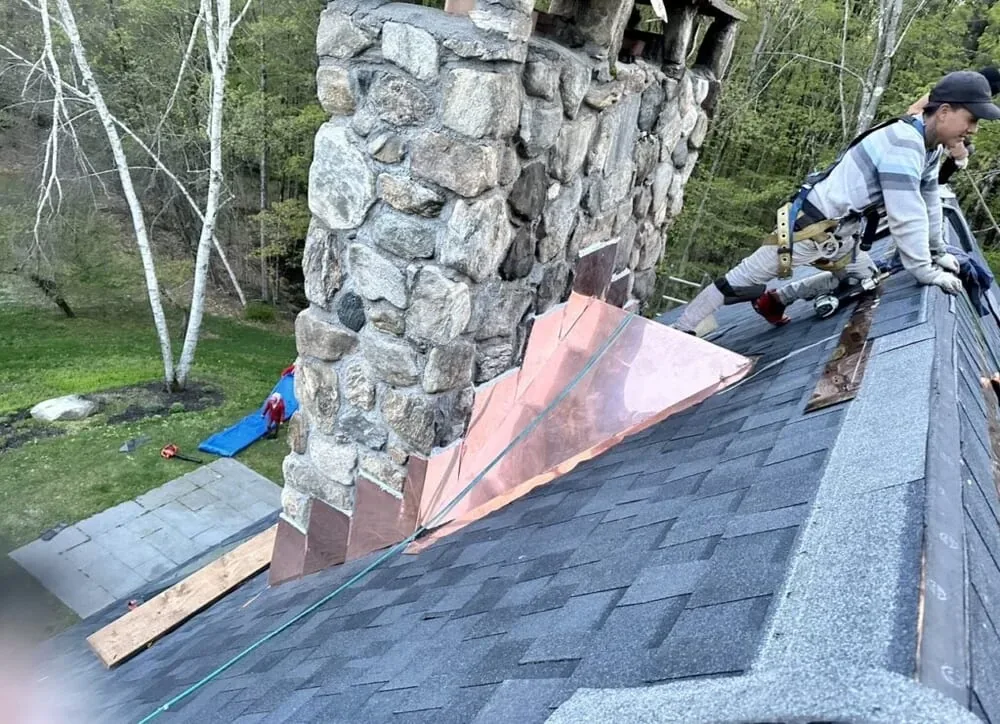
Flashing is the metal system that directs water around the chimney and back onto the roof. On a shingle roof, it typically includes metal across the downhill face, step flashing along the sides, and a detail that handles water arriving from uphill.
Counterflashing covers the upper edges of the roof flashing so water cannot easily run behind it. Where that metal enters or attaches to masonry, the two trades’ work overlaps.
A roofer should look for problems such as:
- Loose, corroded or damaged flashing.
- Flashing pieces that no longer overlap properly.
- Damaged shingles or deteriorated roof decking beside the chimney.
- Old patches hiding an open joint or an incomplete flashing detail.
- Debris holding water against the uphill side of the chimney.
Sealant has legitimate uses in certain details, but a thick coating smeared over the entire junction does not show that the underlying problem has been corrected.
Chris Battaini Roofing & Seamless Gutters provides roof leak and flashing repair for homeowners in Lee, Pittsfield and other Berkshire communities. If the surrounding masonry also needs attention, that portion should be evaluated by a mason.
When masonry or the chimney top needs attention
A chimney extends above the roof, exposing its brick, mortar and top surface to weather. Cracked mortar joints, damaged bricks and openings at the top can admit water even when the roof flashing is intact.
Two parts are easy to confuse:
- The crown is the sloped top surface around the flue opening. Cracks or deteriorated edges can allow water into the masonry below.
- The cap is a cover above a flue opening that helps keep out rain and debris. A missing or damaged cap deserves attention from a chimney professional.
A mason can evaluate deteriorated mortar, cracked crowns and spalling brick—the flaking or breaking away of brick faces. Avoid assuming that every crack needs the same treatment; the condition of the surrounding masonry matters.
Water inside a chimney can also involve flue or condensation problems. Describe exactly where you see moisture when calling, and ask whether the professional handles that type of investigation. Masonry repair, roof repair and flue work are distinct scopes, even when one company offers more than one.
Gather useful clues without climbing onto the roof
You can help narrow the investigation with a few observations made from safe, accessible locations. Do not climb a ladder, walk on the roof, lean out a window or run a hose test yourself.
- Photograph the indoor evidence. From a dry, stable floor, capture the stain’s location relative to the chimney. Note whether it is on the ceiling, chimney face or inside the fireplace.
- Record the weather pattern. Does moisture appear during steady rain, wind-driven rain, or thawing snow? Does it begin immediately or several hours later?
- Look from the ground. Binoculars or a phone’s zoom may reveal missing pieces, displaced metal or crumbling masonry. Stay clear of areas beneath loose materials.
- Share the repair history. Mention previous chimney work, roof replacement or recurring sealant patches, and provide any available photos.
You do not need to enter an unfinished attic to collect evidence. Leave roof access and concealed-area investigation to the professional. Keep away from bulging ceilings and wet electrical fixtures; those conditions need appropriate professional help before anyone works nearby.
A weather log and a few well-located photos are more useful than a homeowner’s attempt to recreate the leak.
If both trades are involved, make the handoff explicit
A common coordination problem occurs when a roofer identifies failed counterflashing while a mason finds deteriorated mortar around it. Repairing only one part may leave a path for water.
Ask each professional to explain what they found and identify the limits of their work. A useful written scope should answer:
- Which parts will be removed or replaced? “Repair chimney leak” is too vague to distinguish shingle work, flashing replacement and masonry repair.
- Who handles the counterflashing? Establish who removes it, who reinstalls it, and who repairs the masonry connection.
- What is the work sequence? Some masonry work must happen before the final flashing detail can be completed.
- How will the roof be protected? Ask how masonry work and debris will be kept from damaging shingles or other roofing.
- How will the completed repair be documented? Photos can show details that are difficult to see from the ground.
When you request a roof assessment, explain that the leak is near the chimney and include any findings from a mason or chimney professional. Sharing the same photos and written findings helps everyone work from the same information.
Make a practical cold-weather repair plan
If the chimney is leaking in late fall or winter, arrange an assessment rather than assuming the whole repair must wait until spring. The available approach depends on roof access, surface conditions, the needed materials and the repair itself.
Masonry products and roofing sealants have application and curing requirements. Ask the professional whether current conditions allow a permanent repair or whether professional temporary protection is appropriate while the remaining work is scheduled. Keep a record of anything deferred.
Be cautious about exterior waterproofing presented as a complete answer before the source is established. A masonry treatment cannot rebuild an open mortar joint or correct improperly arranged roof flashing.
After repairs, monitor the same indoor location during comparable weather from a safe place. Photograph any new moisture and note its timing. An old stain can remain after a successful repair, so changes in the stain or renewed dampness are more informative than its continued presence alone.
Common questions
Does a chimney leak mean I need a new roof?
No. A localized flashing problem may be repairable without replacing the entire roof. The decision depends on the surrounding roofing, decking and overall roof condition, so ask what evidence supports a repair or replacement recommendation.
Will waterproofing the brick stop a chimney leak?
A suitable masonry water-repellent treatment may help in some situations, but it cannot correct failed flashing, open joints or a damaged crown. Have the source identified first, and let a masonry professional determine whether a treatment is appropriate for the chimney.
Can an unused chimney still cause a roof leak?
Yes. An unused chimney still has exposed masonry, a top opening or closure, and a connection to the roof. Tell the professional that it is unused, but do not assume sealing every opening is a safe solution; the chimney may still serve equipment or need an appropriate ventilation arrangement.