

Do You Need Snow Guards on a Metal Roof? A Berkshire Homeowner’s Guide
A practical look at why metal roofs drop snow in slabs and how snow guards keep it up on the roof where it can melt off slowly.
The short answer
- If a metal roof sheds onto steps, a deck, a driveway, a lower roof or gutters, snow guards are usually worth adding.
- Guards work best in continuous rows along the full eave of each problem slope, with more rows on long or steep runs.
- Clamp-on guards suit standing seam panels; exposed-fastener panels need guards screwed into solid structure and sealed.
- Until guards go on, avoid the area under a loaded eave and leave all roof work to a professional.
Why snow comes off a metal roof all at once
Metal roofing sheds snow very well, which helps the roof but can be hard on anyone standing on the front step. Shingle granules give snow something to grip. A smooth, painted metal panel gives it almost nothing.
When sun warms the panels, or heat from the house reaches the underside of the snowpack, a thin layer of water forms between snow and metal. Once gravity overcomes the last bit of grip, the whole slab can release together, sometimes along the full length of the roof.
Berkshire winters set this up over and over. A heavy, wet storm rolls through, a cold night puts a crust on top, and a bright morning follows. Homes on higher ground can hold snow longer, which means more weight builds before it lets go. A sheet of wet, partly frozen snow can bend railings, flatten shrubs and dent a car.
Snow on a metal roof can release with no warning, so treat the ground under a loaded eave as off limits for people, pets and cars.
Signs your roof needs snow guards
Snow guards are small brackets, pads or rails fastened to the roof. They hold snow in place so it melts off gradually or breaks up in smaller pieces. You probably need them if any of these sound familiar:
- A roof edge sits above an entry door, steps or a walkway.
- Snow lands on a deck, patio or porch you use in winter.
- The roof drains toward the driveway or where cars park.
- A higher roof dumps onto a lower roof, a porch roof or a bump-out.
- Gutters come through winter bent, pulled loose or torn off.
- Plumbing vents or flue pipes have been bent by moving snow.
- Snow crushes shrubs, an air conditioning unit or a meter, or piles against siding and windows.
If a slope only drops snow onto open lawn nobody crosses, skipping guards there can be reasonable. Many homes end up with guards on one or two slopes, and that's a sensible outcome.
Chris Battaini Roofing lists metal roofing among its services, and you can read about it on the metal roofing page. Whoever evaluates your roof for guards should walk the ground below each slope with you and note what sits in the landing zone.
The main types of snow guards
Pad-style guards
Individual clips or pads set across the roof in a staggered pattern. Each holds back a small portion of snow, and together they keep the pack from moving as one unit. They're common on exposed-fastener panels and appear on some standing seam roofs.
Rail or bar systems
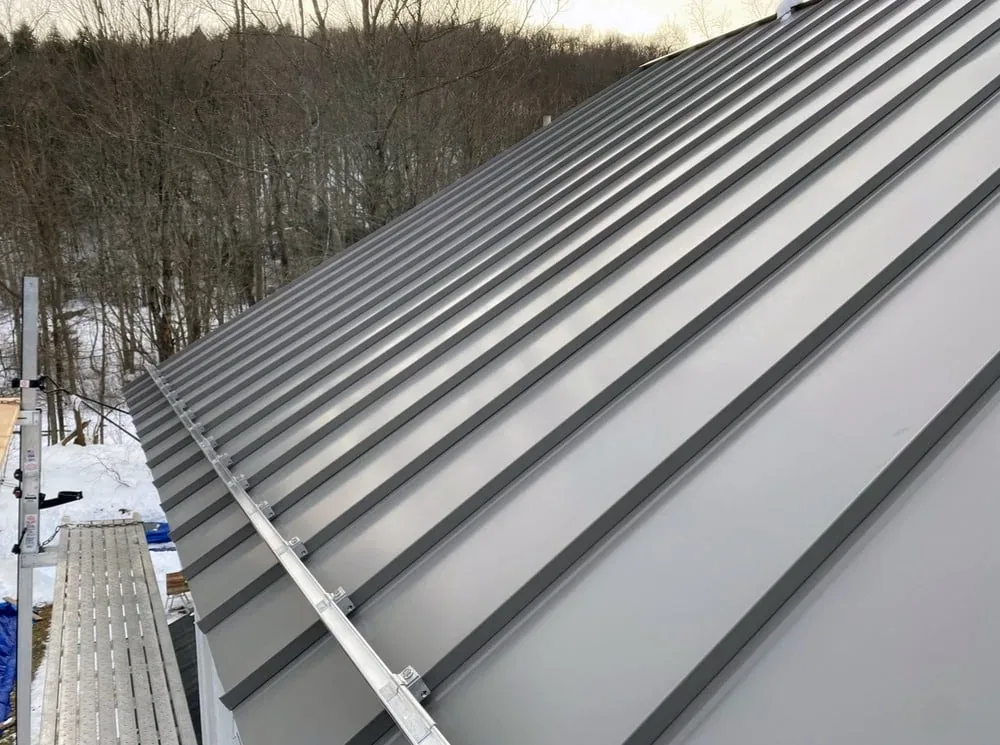
Continuous rails, often one or two bars, mounted on brackets across the slope. On standing seam roofs the brackets usually clamp onto the raised seams with set screws, so nothing is drilled through the panels. Many homeowners like the clean line a rail makes along the eave.
Attachment matters most
- Clamp-on: Grips the standing seam ribs. No new holes go through the weather surface.
- Through-fastened: Used on exposed-fastener panels. Each guard is screwed through the panel into solid structure, with sealing washers or sealant at every fastener. Careless work can leave any screw as a possible leak.
- Adhesive-mounted: Holding power depends heavily on surface prep and install-day conditions, so ask plenty of questions before going this route.
Guards should also be compatible with your panel metal, because some dissimilar metals corrode where they touch. Many come in colors that match the roof.
Before anything is fastened through your panels, check the panel manufacturer's guidance on accessories and attachments.
Where snow guards should go
The usual first instinct is a few guards right over the front door. That rarely works. If only a short section is held, the rest of the slab still slides, and snow can shear around the ends and land on the steps anyway. It also concentrates stress on those few guards.
A sounder plan follows a few principles:
- Run guards along the full eave of any slope that drops onto something you care about.
- Start low. The first row usually sits a short way up from the edge so the load is held near the eave.
- Add rows on long or steep slopes, where more snow builds up and slides with more force.
- Protect penetrations by placing guards upslope of plumbing vents, flues and chimneys.
- Watch valleys and dormers, where snow from two directions collects.
An example layout
Picture a Lenox cape with a standing seam roof. The front slope runs the width of the house above a covered porch and the front steps. The back slope drops onto lawn, but a plumbing vent pokes through it halfway up. The driveway runs along one gable end, where no snow falls.
A reasonable plan puts a continuous clamp-on rail along the entire front eave, with a second row higher up if the guard manufacturer's guidance calls for it at that pitch and slope length. The porch roof below gets its own look, since it would otherwise catch whatever comes off above. On the back, the open lawn doesn't need protection, but a short section of guards just upslope of the vent keeps moving snow from snapping it. The gable side needs nothing.
Exact spacing and row count depend on pitch, slope length, panel profile and the snow your area sees. Guard manufacturers publish layout guidance, and a qualified roofer or your local building department can speak to snow loads for your location.
Guards clustered over one door often let the rest of the slab slide around them, so plan for the whole slope.
What snow guards will and won't do
Guards keep snow on the roof longer, and that brings trade-offs.
- The roof carries the load longer. Many roofs handle this, but on an older home, an addition or a converted outbuilding, have someone qualified look at the framing if you have doubts.
- Held snow still melts onto whatever is below. A guarded slope over the front steps will drip for days after a storm, and that water can refreeze into a glaze on the steps overnight. Plan on sanding or salting those steps, and make sure gutters and downspouts there are clear and carry water away from the walk.
- They don't fix ice dams. Snow held near the eave can sit over a cold overhang, and if attic heat is escaping, ice builds at the edge. The post on preventing ice dams explains the heat-loss and ventilation side.
- Some snow still falls. Small chunks and icicles can drop in a fast thaw. Guards cut down the big releases, but the eave is still a place to avoid.
Expect slow dripping over guarded entries after every storm, and keep ice melt or sand by that door.
What to do if your roof has no guards yet
The ideal time for snow guards is before the first heavy snow, on a clear, dry roof. If snow is already up there, don't climb up. Installers need a bare, dry surface to set clamps or fasteners properly, so the work may have to wait for a clear stretch. Meanwhile:
- Mark the slide zone. Without walking under the eave, rope or cone off the approaches to the area below each shedding slope.
- Change your traffic pattern. Use a door that isn't under a sliding slope, and park elsewhere.
- Move what you can. Grills, furniture and trash bins shouldn't sit under the eave.
- Stay off the roof. Metal is slick even when dry, and frost or a thin glaze makes it treacherous.
- Be careful with roof rakes. If you use one, work only from the ground, stand well outside the snow's path, and keep clear of power lines. Rakes can scratch painted panels. The guide to safe snow removal from roofs has more, and heavy or high loads belong to a pro.
- Clear steps after the roof above is bare, approaching from the side.
Sometimes the snow doesn't slide at all. A crusted pack can hang at the eave for days, leaving the entry under it unsafe the whole time. Keep using another door. If that entry is your only practical way in and out, have a professional remove the load rather than waiting it out or knocking it loose yourself.
If you're in Pittsfield, Lenox, Lee, Dalton, North Adams or Great Barrington, you can contact Chris Battaini Roofing with questions about your metal roof. The company also lists roof inspections, which can tell you what condition your roof is in before the next winter.
Questions to ask before snow guards go on
A good snow guard job is mostly planning. These questions help you check that a proposal fits your roof:
- Which slopes get guards, and why? Each answer should tie to what sits below.
- How will they attach? For standing seam, ask whether they clamp to the seams. For exposed-fastener panels, ask what the screws go into and how each is sealed.
- How was the layout decided? Spacing and rows should follow the guard manufacturer's guidance for your pitch and slope length.
- Are the guard materials compatible with my roof metal?
- What about vents, chimneys, valleys and lower roofs?
- Where will meltwater go? Especially over entries, ask how gutters and downspouts will handle the slow drip.
- Will held snow cause ice at my eaves? If you've had ice dams before, look at attic insulation and ventilation too.
Each spring, scan the roof from the ground with binoculars for bent rails, missing pads or brackets that have shifted along a seam. Small problems caught in warm weather are easy to correct before the next round of Berkshire storms tests the system again.
Common questions
Can I install snow guards myself?
It's best left to a professional. The work happens at height on a slick metal surface, and poorly placed fasteners can cause leaks or let guards fail under load. Your part is pointing out where snow lands and what needs protecting.
Do snow guards cause ice dams?
Not on their own. Ice dams form when heat escaping from the house melts snow that refreezes at the colder eave. Because guards hold snow near the edge longer, homes with heat-loss problems may see more ice, so address insulation and ventilation too.
Can snow guards be added to a metal roof that's already installed?
Yes, guards are often added after the roof goes on. Clamp-on styles for standing seam are well suited to retrofits because they don't require drilling through panels. The roof needs to be clear and dry for the work.
Do asphalt shingle roofs need snow guards?
Shingles grip snow much better than smooth metal, so big slides are less common. Guards sometimes appear on steep shingle roofs over entries, but they're far more common on metal.
Will snow guards look out of place on my house?
Many rails and pads come in colors that match the roof and blend in from the ground. A neat, continuous row along the eave usually looks more deliberate than a few scattered pieces.