

Why Cedar Shake Siding Brings Timeless Beauty to Your Home
Installing cedar shakes is a rewarding way to transform your home’s exterior with timeless charm. While it’s a labor-intensive siding choice, the rustic appeal adds character to any home, from coastal cottages to mountain retreats. Beyond beauty, cedar provides natural insulation to help lower energy bills and can last 30-50 years with proper care.
Quick Answer: Key Steps for Installing Cedar Shakes
- Prepare the wall – Apply weather-resistant barrier and flashing
- Install starter strip – Create a level foundation at the bottom
- Apply first course – Double-layer the bottom row for water protection
- Work upward in courses – Leave 1/8″ gaps, stagger joints by 1.5″+
- Nail correctly – Two stainless steel nails per shake, 3/4″ from edges
- Handle corners and trim – Weave corners or use trim boards
- Apply finish – Stain, seal, or allow natural weathering
Before you start, it’s important to understand the distinction between cedar shakes and cedar shingles. Here’s how they compare:
| Feature | Cedar Shakes | Cedar Shingles |
|---|---|---|
| Appearance | Rough, textured, hand-split look | Smooth, uniform, machine-cut surface |
| Thickness | Thicker (3/4″ butt) with uneven taper | Thinner with consistent taper |
| Installation | More labor-intensive, requires precise spacing | Faster to install, more uniform |
| Cost | Higher material and labor costs | Generally more affordable |
| Style | Rustic, traditional, dimensional | Clean, refined, cottage-style |
The installation process requires attention to detail, from calculating materials with the triple coverage rule to ensuring proper nail placement and joint offset. Each shake must be spaced to allow for expansion, and courses must overlap correctly to prevent water infiltration.
I’m Christopher Battaini, owner of Chris Battaini Roofing & Seamless Gutters. With over two decades of experience installing cedar shakes throughout Berkshire County, MA, and Southern Vermont, I’ve created this guide to walk you through every step of a professional-quality installation.

To learn more about the benefits this material offers, including its natural resistance to rot and insects, explore our resources on Are Cedar Shake Roofs Good?. We also offer information on various types of cedar, including Alaska Yellow Cedar Shingles.
Preparation is Key: Tools, Materials, and Wall Prep
Proper preparation is the most critical part of installing cedar shakes. What happens before the first shake touches the wall determines whether your siding lasts for decades or fails within a few years. This invisible foundation of weather barriers and flashing protects your home and keeps your cedar looking great.
Essential Tools & Materials
Gathering the right equipment is essential. Key tools include a hammer or nail gun, a chalk line and level for straight courses, and a utility knife and saw for cuts. For materials, you’ll need your cedar shakes, non-negotiable stainless steel nails, a quality weather-resistant barrier, and flashing for corners and openings. A measuring tape, story pole, and ledger board will ensure consistency and support.
Calculating Materials
When calculating materials, order 10-15% more than you think you need to account for cuts, waste, and adjustments. The math for cedar shake installation follows the triple coverage rule: at any point on the wall, three layers of shakes should overlap. For standard 16-inch shakes, this typically means an exposure of about five inches per course, as the exposure should always be slightly less than one-third of the shake’s length.
Wall Surface Preparation
This is the foundation of your project. First, inspect your sheathing (boards, plywood, or OSB), ensuring it’s solid, clean, dry, and smooth. Address any damage or protruding nails.
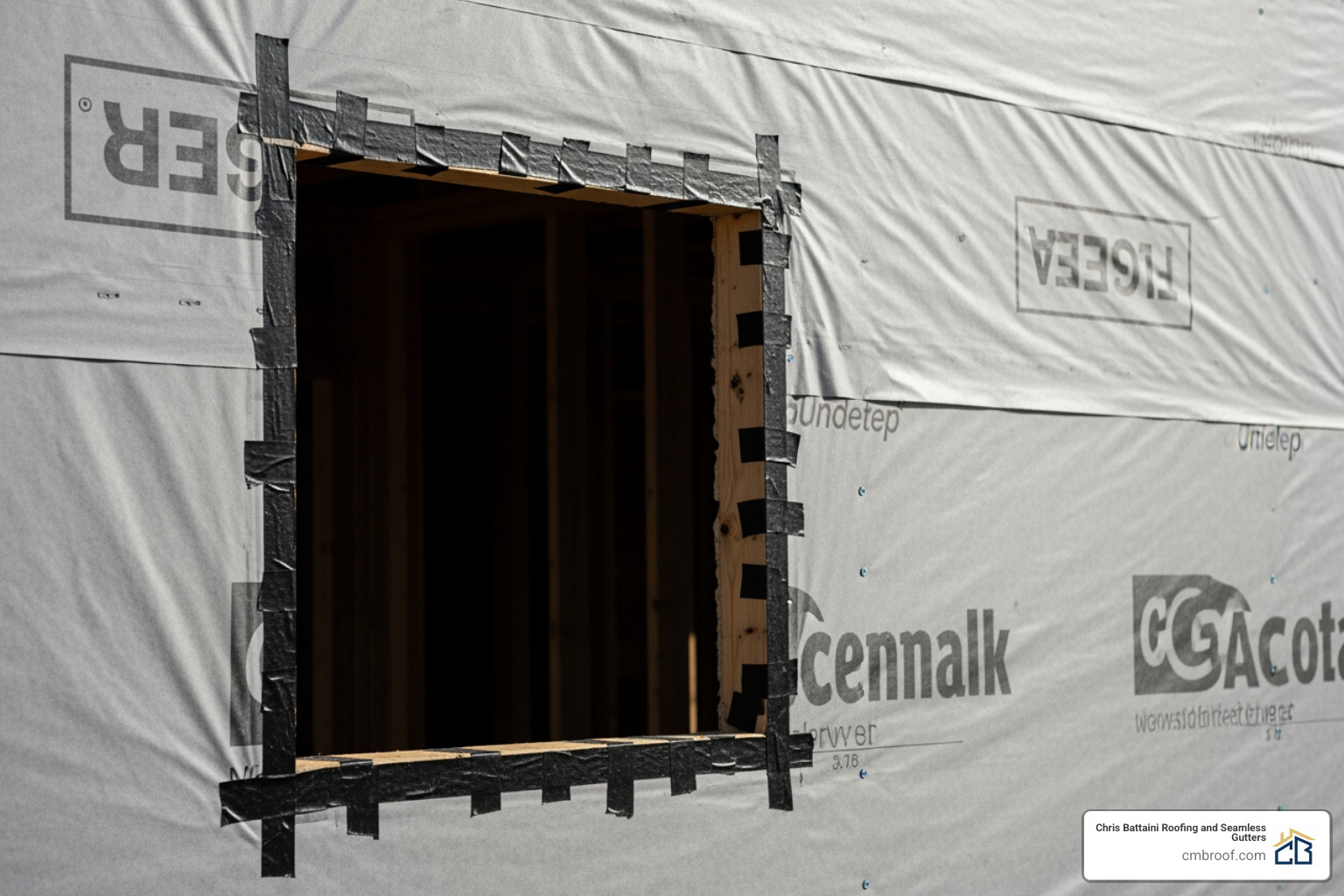
Next, apply a high-quality weather-resistant barrier (WRB) over the entire sheathing surface. This is your home’s raincoat and a critical second line of defense against water. Consider a breathable membrane that allows moisture to escape while keeping water out.
Finally, install flashing carefully around every window, door, and penetration using self-adhesive flashing tape. This creates watertight seals around the most vulnerable spots on your wall and is a step that cannot be rushed.
Laying the Groundwork: Snapping Chalk Lines and Installing the Starter Strip
With your wall protected, it’s time to establish the layout. Snapping chalk lines ensures precision. Start with a perfectly level line at the base of the wall for the first course. An error here will be amplified on every subsequent course. Mark lines for the courses above, typically 5-6 inches apart, depending on your planned exposure.
The story pole method is an excellent technique for consistency. Mark a straight piece of wood with the exact spacing of your shake exposures, then transfer those marks to the wall. It’s faster and more accurate than measuring each course individually.
Finally, install the starter strip—a level foundation piece at the bottom of the wall. It must be perfectly level to create the necessary kick-out angle for your first course, ensuring proper water shedding from the start. This groundwork makes installing cedar shakes a smooth, rhythmic process.
The Complete Guide to Installing Cedar Shakes
With the wall prepped, you can begin the installation. The starter course is the foundation of the siding project.
Starter Course Installation
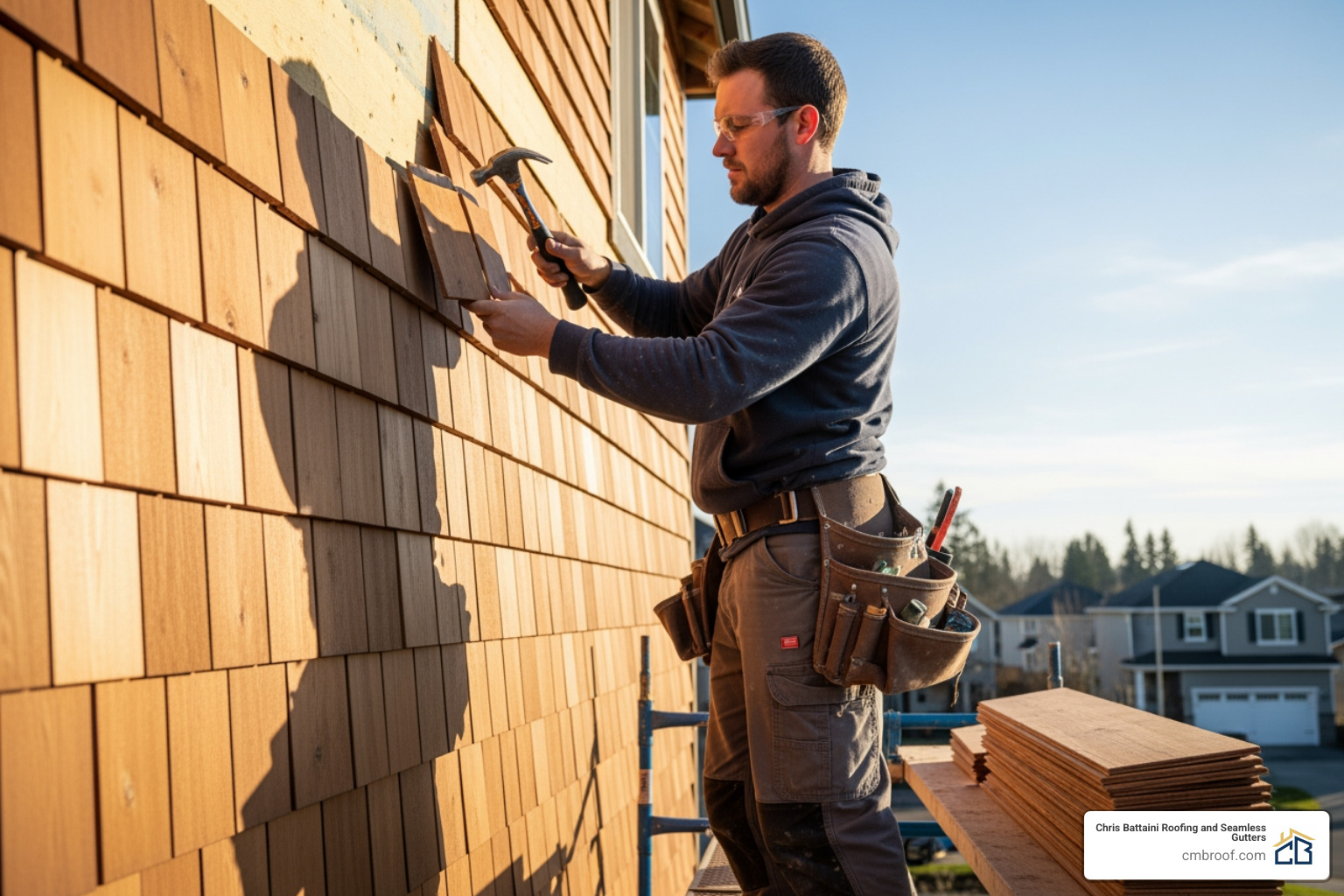
The starter strip creates a level starting point and tilts the first course to shed water. We always install a double layer for the starter course. The first, hidden layer extends at least one inch below your foundation line (keeping shakes six inches above ground level). The second layer sits on top, extending about half an inch beyond the first. This double layer provides exceptional protection against moisture at the base of the wall. You can use lower-grade shakes for the hidden first layer.
The Correct Method for Installing Cedar Shakes Row by Row
When installing cedar shakes row by row, start at an exterior corner and work horizontally. Use a ledger board to hold each shake, ensuring every row is perfectly straight. Each new row must overlap the one below by at least 1.5 inches to ensure triple coverage and prevent water infiltration.
Since cedar expands and contracts, leave a 1/8-inch gap between each shake. To create the classic look and prevent water pathways, stagger vertical joints by at least 1.5 inches between courses. A critical rule is that no three consecutive courses should have aligned joints.
Best Practices for Nailing When Installing Cedar Shakes
We use stainless steel nails exclusively when installing cedar shakes. Galvanized nails will eventually cause black streaks. For coastal areas, 316 stainless steel is best. Nails should penetrate at least one inch into framing or sheathing. For more on fasteners, see our guide on Can You Use Roofing Nails for Cedar Shakes?
Nail placement is critical. Each shake gets two nails, positioned about ¾ inch from each edge and 1 inch above the butt line of the next course. This hides the nails while allowing for natural wood movement. Shakes wider than 7-8 inches get two additional fasteners near the center to prevent cupping.
A nail gun can speed up the process, but use low pressure settings to keep the nail head flush with the wood, not overdriven. The Official sidewall nail guide from the Cedar Bureau offers comprehensive specifications.
Handling Corners, Obstacles, and Trim
Craftsmanship shows in the details. For outside corners, woven corners create a seamless, integrated look by alternating the overlap of shakes from adjoining walls. Alternatively, corner boards offer a quicker installation where shakes simply butt against them.
For inside corners, we typically install corner trim first and caulk the seam. Cutting around windows and doors requires precision. Ensure no vertical joint is closer than one inch to an opening’s corner.
For exterior spigots, remove the fixture, cut a neat hole in the shake with a hole saw (leaving a ¼-inch gap around the pipe), caulk the gap, and reinstall the spigot. When cutting, always “go with the grain” with a utility knife to prevent accidental splits.
Finishing Touches, Maintenance, and Longevity
The finishing touches you apply after installing cedar shakes will protect your investment and determine its final look and longevity.
Finishing Options
Stain is a popular choice, with semi-transparent options enhancing the natural grain while providing UV and moisture protection. Paint offers a uniform look but requires two coats of primer for proper adhesion. A clear sealant guards against moisture and UV damage without altering the wood’s initial color. Many prefer natural weathering, which allows the cedar to transform into a stunning, low-maintenance silvery-gray patina over about 1.5 years.
Finishes are typically applied after installation, but pre-finishing is also an option for maximum protection. Always touch up cut ends on factory-finished shakes.
Expected Lifespan
Properly installed and maintained cedar shake siding can last 30-50 years, making it a durable, long-term investment.
Maintenance Routine
To reach that 50-year mark, a simple maintenance routine is key. Perform annual inspections to look for loose shakes or signs of wear. Address mold or mildew promptly with a gentle cleaner and a low-pressure wash—never use a high-pressure washer. If you’ve applied a finish, plan to re-seal or re-stain every few years as needed. For more details, see our Cedar Shake Replacement Guide 2025.
Common Mistakes to Avoid
Avoid these common mistakes: Improper staggering (failing to offset joints by at least 1.5 inches), overdriving nails (which can split the shake), insufficient spacing (not leaving a 1/8-inch gap for expansion), and installing in wet weather (which causes shrinkage and gaps). Always check your local building codes, as requirements can vary. The Official installation resources from the Cedar Bureau are an excellent reference for best practices.
At Chris Battaini Roofing and Seamless Gutters, we’ve spent over two decades perfecting our cedar shake installation techniques throughout Berkshire, Hampden, Hampshire, and Franklin Counties in Massachusetts, as well as Southern Vermont. We’re always happy to share our knowledge with homeowners who want to understand the craft.
Follow us on Facebook to see more of our cedar shake projects and get tips on maintaining your home’s exterior.
Frequently Asked Questions about Cedar Shake Installation
Here are answers to the most common questions we receive about cedar shake installation.
How long can cedar shake siding last?
With proper installation and regular maintenance, cedar shake siding typically lasts 30-50 years. Key factors influencing longevity include local climate, sun exposure, and the quality of the installation and upkeep. In the Berkshires, proper flashing and ventilation are crucial for maximizing lifespan.
Can you install cedar shakes with a nail gun?
Yes, and we frequently use them. A pneumatic siding nailer significantly speeds up the process of installing cedar shakes. The key is to use a low air pressure setting to ensure the nail head sits flush with the wood, not overdriven, which can cause splitting. Practice on scrap pieces first to find the right pressure. For more on fasteners, see our article on Can You Use Roofing Nails for Cedar Shakes? and the Official sidewall nail guide from the Cedar Bureau.
Should you caulk between cedar shakes?
No, you should not caulk between individual cedar shakes. Cedar needs to expand and contract with humidity changes. The 1/8-inch gap between shakes allows for this natural movement. Caulking these gaps traps moisture and can lead to buckling, splitting, and rot. Caulk should only be used at trim joints and around penetrations like windows, doors, and pipes. Our Cedar Shake Replacement Guide 2025 offers more maintenance insights, and the Official installation resources from the Cedar Bureau provide further best practices.
If you have more questions about installing cedar shakes or want to discuss your specific project, don’t hesitate to reach out. Follow us on Facebook to see examples of our recent cedar shake projects and get helpful maintenance tips throughout the year.
Conclusion: Achieving a Flawless Cedar Shake Finish
Installing cedar shakes transforms a home, but it’s a labor-intensive craft that demands precision. From wall prep and the triple coverage rule to proper nailing and finishing, every step is crucial for a durable, beautiful finish that can last 30-50 years. A single mistake like improper flashing or insufficient overlap can compromise the entire system, which is why many homeowners partner with experienced professionals.
At Chris Battaini Roofing & Seamless Gutters, cedar shake installation is a craft we’ve perfected over two decades. Our commitment to owner-led, on-site service means you work directly with me and my team. We stand behind our work with exceptional workmanship warranties.
We proudly serve homeowners and businesses throughout Berkshire, Hampden, Hampshire, and Franklin Counties in Massachusetts, as well as Southern Vermont. Whether you’re in Pittsfield, Great Barrington, North Adams, Bennington, or Brattleboro, we bring the same dedication to every project.
If you’re ready for the timeless beauty of professionally installed cedar shake siding, learn more about our expert cedar shake roofing services.
Follow us on Facebook to see our latest projects and customer testimonials!
