-
10 Wendell Ave Extension Pittsfield, MA 01201
-
210 Columbia St., Lee, MA 01238

Commercial TPO roofing is the most widely installed single-ply membrane in North America — and it’s not hard to see why. It’s reflective, durable, heat-weldable, and hits a sweet spot between performance and cost that few other systems can match.
Here’s a quick summary of what you need to know:
| Feature | Details |
|---|---|
| Material | Thermoplastic polyolefin (ethylene-propylene rubber + polypropylene) |
| Best for | Flat and low-slope commercial roofs |
| Thickness options | 45 mil, 60 mil, 80 mil |
| Colors | White (most common), gray, tan |
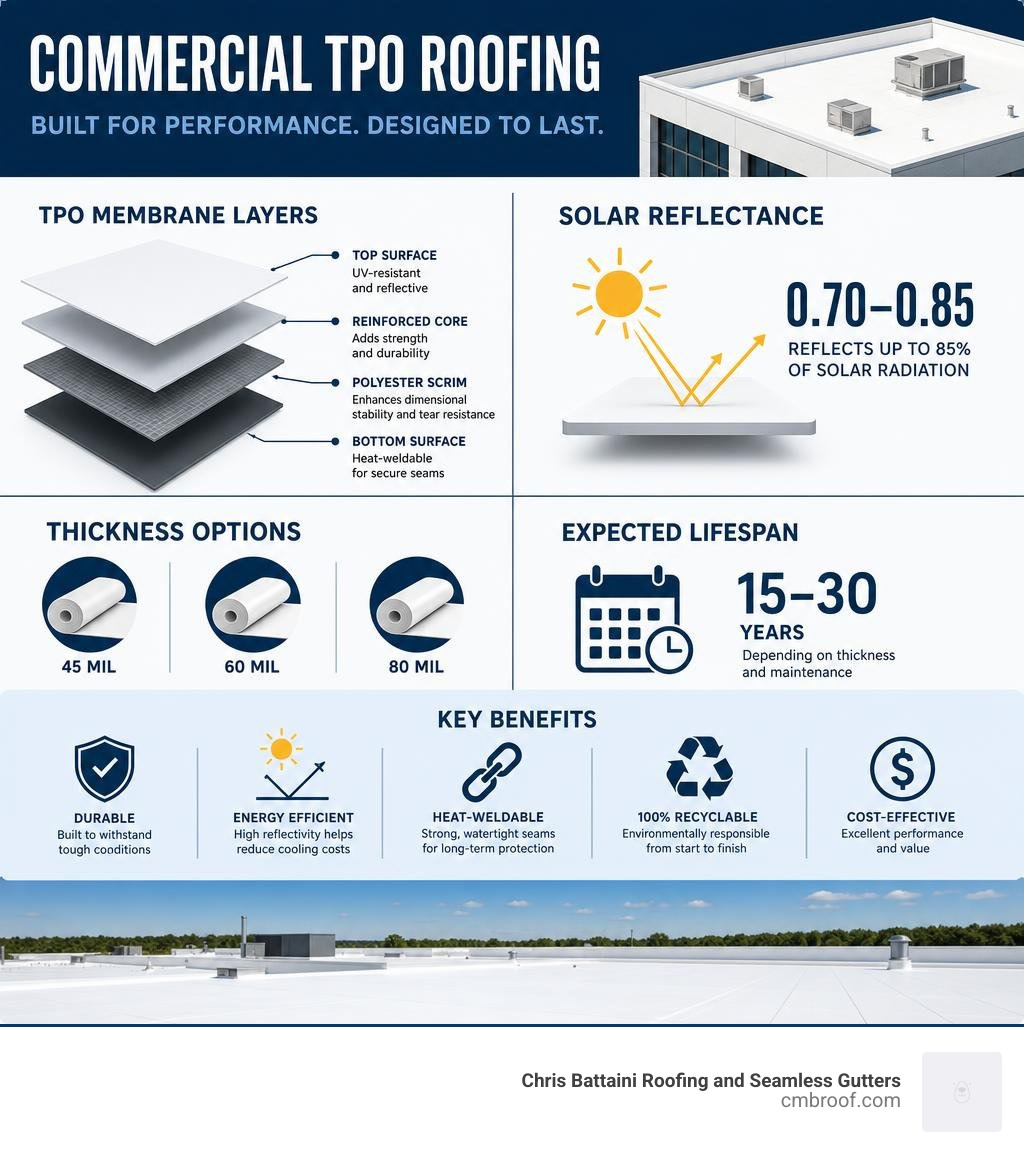
| Solar reflectance | 0.70–0.85 (reflects up to 85% of solar radiation) |
| Expected lifespan | 15–30 years depending on thickness and maintenance |
| Installed cost | Varies widely — consult your contractor for accurate quotes |
| Installation methods | Mechanically fastened, fully adhered, induction welded, self-adhered |
| Recyclable? | Yes — 100% recyclable at end of life |
| Warranty | Up to 30 years with qualifying systems |
TPO has been growing fast for good reason. Building owners across Massachusetts — from Pittsfield to Lenox and Dalton — are choosing it for new construction, re-roofing, and recover projects alike.
But there’s a lot to understand before you spec a system or sign a contract. This guide breaks it all down in plain language — what TPO is, how it performs, how it compares to EPDM and PVC, what installation costs look like, and how to protect your investment with the right maintenance and warranty.
I’m Christopher Battaini, owner of Chris Battaini Roofing and Seamless Gutters, and I’ve spent over two decades working on roofing projects across the North Shore and Greater Boston area, including commercial TPO roofing installations that demand precision, quality materials, and lasting results. If you’re evaluating TPO for a flat or low-slope roof, this guide is the place to start.
Quick Commercial TPO roofing terms:

To understand why TPO is dominating the commercial flat roof landscape, we have to look at what it is actually made of. TPO stands for Thermoplastic Polyolefin. Despite the complex chemical name, the concept is straightforward: it is a single-ply, sheet-applied roofing membrane designed specifically for low-slope and flat roof surfaces.
The membrane itself is manufactured in wide rolls (typically ranging from 5 to 12 feet in width and 100 feet in length). Structurally, it consists of three primary layers:
The magic of TPO lies in its blend of materials. By combining the durability and weathering resistance of ethylene-propylene rubber with the hot-air weldability of polypropylene, manufacturers have created a sheet that resists cracking and splitting while remaining highly flexible.
When we install a commercial TPO roofing system in towns like Pittsfield MA or nearby Dalton MA, we lay these sheets out across the roof deck and overlap them. We then use specialized hot-air welding equipment to heat the overlapping edges to between 900°F and 1100°F. This high heat melts the thermoplastic material, fusing the two sheets together at a molecular level. The resulting heat-welded seams are actually stronger than the membrane sheet itself, creating a continuous, monolithic waterproof barrier across your entire commercial facility.
To learn more about how flat roof systems function and which options suit different building designs, check out our guide on Commercial Flat Roofing. For a broader perspective on single-ply systems, you can also reference the comprehensive TPO Roofing Guide for Building Owners | Flat Roof Report .
Commercial property owners choose TPO because it delivers exceptional performance across several key categories:
TPO membranes are engineered to meet and exceed strict ASTM D6878 standards for weathering, tensile strength, and tear resistance. Some premium membranes, such as the Siplast Parasolo TPX, exceed standard ASTM requirements by a wide margin, offering a breaking strength of 365 lbf compared to the standard TPO requirement of 220 lbf.
When designing a roof system in Lenox MA or Cheshire MA, choosing the right membrane thickness is one of your most important decisions. To help you understand your choices, we have compiled a comparison table based on technical specifications, including those found in the TPO-C Membrane (Standard, FR & Clean Film) data sheet.
| Specification / Feature | 45 Mil Membrane | 60 Mil Membrane | 80 Mil Membrane |
|---|---|---|---|
| Primary Use Case | Budget-conscious projects, temporary structures, or simple recover applications | The standard choice for commercial properties and NDL warranties | Premium protection for high-traffic roofs or hail-prone areas |
| Typical Lifespan | 15 to 20 years | 20 to 25 years | 25 to 30+ years |
| Puncture Resistance | Standard (approx. 250 lbf) | High (approx. 300 lbf) | Extreme (approx. 400 lbf) |
| Breaking Strength | 225 lbf minimum | 250 lbf minimum | 350 lbf minimum |
| Warranty Options | Typically up to 15 years | Up to 20 years (standard NDL) | Up to 30 years (premium NDL) |
Investing in a thicker membrane like a 60 mil or 80 mil system pays off in terms of long-term durability and peace of mind. For more details on choosing the right system for your property, read our main Commercial Roofing page.
When upgrading a commercial flat roof, you will likely compare TPO to other single-ply options like PVC (Polyvinyl Chloride), KEE (Ketone Ethylene Ester), and EPDM (Ethylene Propylene Diene Monomer). Each material has its place, but TPO has quickly become the industry favorite. To see how these materials match up in detail, you can read our in-depth article, The Great Debate: TPO vs EPDM Roofing Showdown.
PVC and KEE are both thermoplastic membranes that use hot-air welded seams, similar to TPO. However, PVC relies on added chemical plasticizers to remain flexible. Over years of exposure to intense sun and temperature swings, these plasticizers can slowly leach out, causing the PVC membrane to become brittle and prone to cracking. TPO, on the other hand, is inherently flexible and contains no added plasticizers, meaning it retains its flexibility throughout its entire lifespan.
While PVC and KEE offer superior chemical resistance against animal fats and cooking oils—making them the go-to choices for restaurants and food processing plants—TPO is much more cost-effective for standard commercial warehouses, retail centers, office buildings, and schools.
EPDM is a synthetic rubber membrane that has been used in commercial roofing for decades. It is highly durable and handles extreme temperature swings incredibly well. However, EPDM is a black membrane, meaning it absorbs heat rather than reflecting it, which can drive up your summer cooling costs.
Additionally, EPDM seams must be joined using adhesive tapes and primers rather than being welded. Over time, these adhesive chemical bonds can degrade, leading to seam separations and leaks. TPO’s heat-welded seams form a physical, fused bond that is significantly more reliable over the long run, making TPO the preferred choice for the freezing winters and warm summers we experience in Berkshire County.
Installing a commercial TPO roofing system requires specialized equipment and trained commercial roofing crews. There are three primary ways to secure a TPO membrane to your building:
When it comes to pricing, we want to provide some clear guidance based on public, online market data.
Disclaimer: The pricing ranges listed below represent average commercial roofing costs compiled from publicly available internet data. They do not reflect the actual rates of Chris Battaini Roofing and Seamless Gutters. Every commercial flat roof is unique, and actual estimates depend on building height, deck material, insulation requirements, access, and tear-off complexity.
According to industry averages and online data, a complete commercial flat roof replacement with TPO can range from $16.00 to $50.00 per square foot for highly complex projects, including the removal of old roofing materials, adding code-compliant R-30 insulation, and installing a high-quality 60 mil or 80 mil membrane.
For business owners in Pittsfield MA and Dalton MA, choosing a professional installation ensures your roof complies with local Massachusetts building codes and qualifies for manufacturer warranties. You can learn more about flat roof replacement steps and options on our Commercial Roofing Installation page, or read about regional installation projects in this guide to TPO Roof Installation | Commercial Roofing | Holden, MA .
While TPO is a low-maintenance roofing material, “low maintenance” does not mean “no maintenance.” To protect your investment and ensure your roof reaches its full 20- to 30-year lifespan, you should establish a proactive care plan.
The most critical maintenance task for a TPO roof is checking the seams. Over years of thermal expansion and contraction, seams can occasionally stress and separate. We recommend scheduling semi-annual inspections—once in the spring and once in the fall—to probe the seams, clear organic debris from drains, and check for any physical punctures or storm damage.
Additionally, chronic ponding water (water that sits on the roof for more than 48 hours without evaporating) can degrade the membrane and void your manufacturer warranty. Utilizing tapered insulation systems during installation ensures proper drainage and prevents ponding. If your roof already has low spots, applying specialized Commercial Roof Coatings as a Solution for Ponding Water can help restore and protect those vulnerable areas.
When you invest in a commercial TPO roof, you can secure exceptional warranty protection:
To qualify for an NDL warranty, the roof must be installed by a manufacturer-certified contractor using 100% branded system components. Business owners in Lenox MA and Cheshire MA can explore our Commercial Roofing Maintenance Near Me services to keep their roofs in peak condition. For more details on top-tier single-ply systems and accessories, you can review the technical catalog for TPO Roofing Systems | Johns Manville .
A professionally installed and properly maintained TPO roof typically lasts between 20 and 30 years. The actual lifespan depends heavily on the membrane thickness you select (with 80 mil membranes lasting significantly longer than 45 mil sheets), the quality of the initial seam welding, and how consistently the roof is inspected and cleared of debris.
Yes, in many cases, TPO can be installed directly over an existing flat roof in what is called a “recover” or “overlay” application. This allows you to avoid the labor and disposal costs of a complete roof tear-off. However, building codes only allow a maximum of two roofing layers. Before proceeding with a recover, we must perform a professional moisture scan to ensure the existing insulation and structural deck are completely dry and structurally sound.
Yes, TPO is one of the most eco-friendly commercial roofing materials available. Its high solar reflectance directly reduces building energy consumption and helps combat the urban heat island effect. Additionally, TPO is 100% recyclable at the end of its lifespan; old membranes can be melted down and ground up to be used in the manufacturing of new TPO sheets. It is also completely plasticizer-free and chlorine-free, helping your building earn valuable LEED credits.
Commercial TPO roofing has earned its place as the top flat-roofing solution in North America by delivering exceptional energy efficiency, reliable heat-welded seam strength, and outstanding long-term value. Whether you run a retail store, a manufacturing facility, or a school, TPO offers a dependable shield against the harsh, changing weather of Berkshire County.
At Chris Battaini Roofing and Seamless Gutters, we deliver top-tier commercial roofing solutions with a personal touch. We pride ourselves on owner-led, on-site service, ensuring that Christopher Battaini is directly involved in your project from the initial consultation to the final quality inspection. We combine industry-leading materials with exceptional workmanship warranties to give your business absolute peace of mind.
If you are ready to protect your commercial property with a durable, energy-efficient TPO roof, we are here to help.
Need a reliable roofer? CMB Roofing provides licensed, insured, and professional roofing services for homeowners and businesses.
We stand by a simple promise: Clear estimates. Quality workmanship. Clean job sites.
From roof repairs and full replacements to storm damage restoration, our team delivers dependable results with durable materials, expert installation, and complete site cleanup.