-
10 Wendell Ave Extension Pittsfield, MA 01201
-
210 Columbia St., Lee, MA 01238

Commercial flat roofing systems protect millions of square feet of business space across America, from warehouses and retail stores to office buildings and manufacturing facilities. These low-slope roofing solutions offer practical advantages that make them the go-to choice for commercial construction.
Key Commercial Flat Roofing Options:
– EPDM (Rubber) – 40-50 year lifespan, cost-effective
– TPO (Thermoplastic) – Energy-efficient, heat-welded seams
– PVC – Chemical resistant, ideal for restaurants
– Built-Up Roofing – Multi-layer protection, heavy traffic areas
– Modified Bitumen – Flexible installation, torch or cold-applied
– Metal – 50+ year durability, recyclable
– Green Roofs – Stormwater management, urban cooling
TPO holds 40% of the new construction market and 30% of reroofing projects, while EPDM captures 22% of new builds and 26% of replacements. This popularity stems from flat roofs’ efficiency on large building footprints and their ability to accommodate HVAC equipment, solar panels, and other rooftop installations.
Unlike residential steep-slope roofs, commercial flat roofing systems use a pitch of less than 10 degrees and rely on specialized drainage design. Most systems break down into three essential components: weatherproofing (the membrane), reinforcement (the structure), and surfacing (protection from elements).
Basic commercial flat roofing terms:
– commercial roof installation
– commercial roof repair solutions
– skylight installation commercial
A commercial flat roof isn’t actually flat – these systems maintain a pitch of 10 degrees or less to ensure proper drainage. The real difference from residential roofs lies in the engineering approach: flat roofs use continuous membrane systems that create watertight seals across entire surfaces.
Successful flat roofing comes down to proper drainage design that prevents water pooling and a membrane system that provides reliable weather protection. Modern Types of Flat Roofs can support HVAC equipment, solar panels, and regular maintenance traffic while meeting strict building codes.
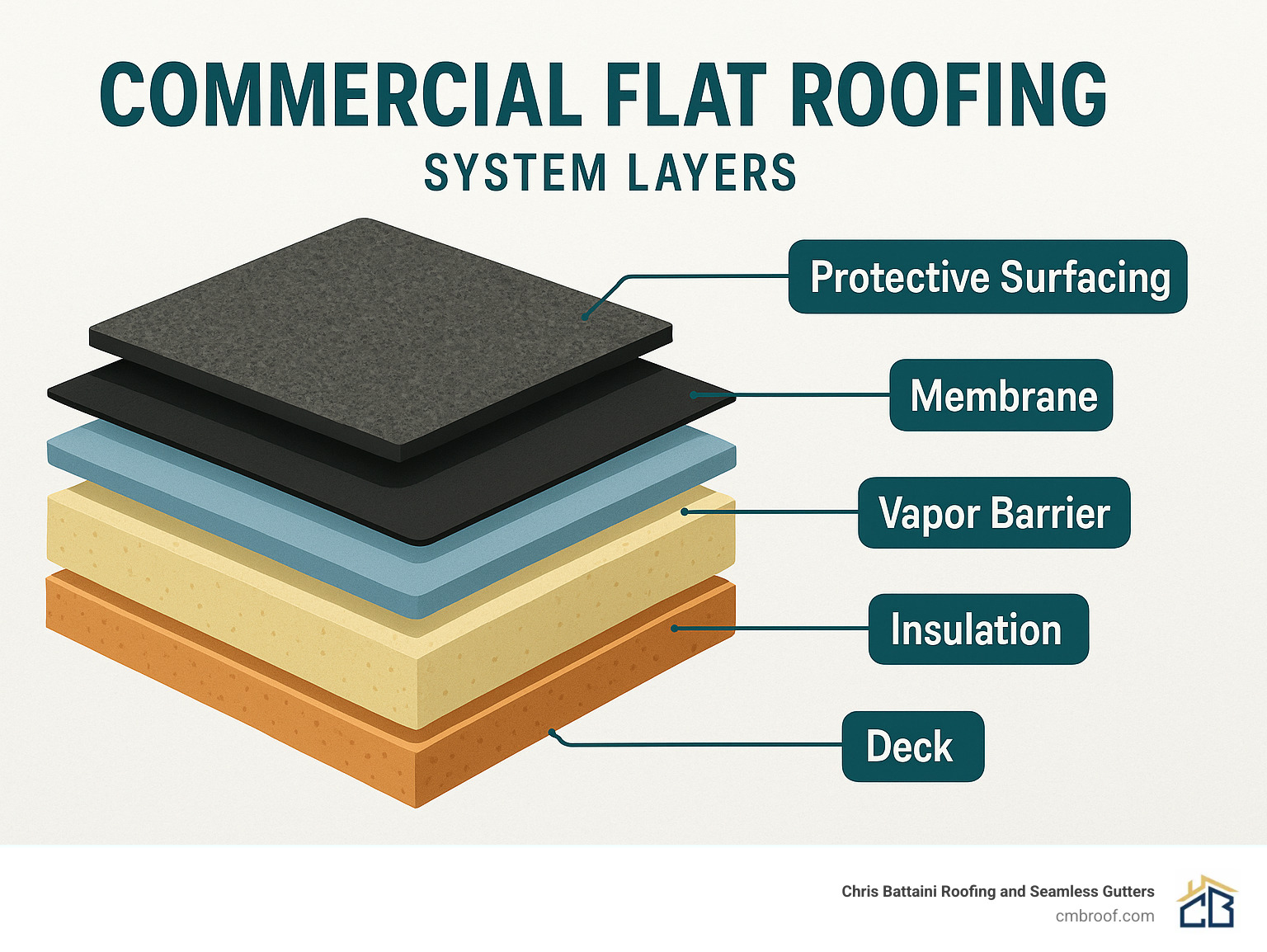
A commercial flat roof functions as an engineered system where each layer plays a vital role:
The structural deck provides the foundation – typically concrete, metal, or wood designed to handle roof weight, snow loads, and equipment. The insulation layer provides thermal resistance while helping create proper drainage slope. Most systems use rigid foam boards like polyisocyanurate.
The vapor barrier prevents warm, humid interior air from condensing within the roof assembly – skip this and face expensive moisture damage. Your membrane system is the waterproof layer that determines longevity, whether EPDM rubber, TPO thermoplastic, or built-up asphalt.
Flashing and edge details seal penetrations and transitions – often the weak points in flat roofing systems. Finally, drainage components including drains, scuppers, and edge metal channel water off safely. We recommend installing more drainage capacity than code requires.
The commercial flat roofing market offers numerous options, each with distinct advantages. Built-Up Roofing (BUR) provides proven durability, Modified Bitumen brings modern polymer science to asphalt systems, while single-ply membranes offer faster installation.
| System Type | Typical Lifespan | Maintenance Level | Best Applications |
|---|---|---|---|
| EPDM | 40-50 years | Low | Large, simple roofs |
| TPO | 20-30 years | Low | Energy-conscious projects |
| PVC | 20-30 years | Low | Chemical exposure areas |
| Modified Bitumen | 20-30 years | Medium | Heavy foot traffic |
| BUR | 20+ years | Medium | Fire-rated requirements |
| Metal | 50+ years | Low | Long-term durability |
Built-Up Roofing systems use multiple layers – typically three to four plies of reinforcing felts embedded in hot asphalt, topped with protective surfacing. This redundancy means even if one layer fails, others continue protecting your building. The fire resistance makes BUR popular for schools, hospitals, and government buildings.
Modified Bitumen improves traditional asphalt with polymer modifiers (APP or SBS), dramatically improving flexibility and temperature resistance. Installation options include torch-applied, cold-applied, or self-adhering systems. Both typically last 20-30 years. Average costs based on internet data range from $6-$18 per square foot, though complex projects can reach $25+ per square foot.
EPDM rubber membranes offer proven durability with over 50 years of field performance. The synthetic rubber construction provides exceptional UV, ozone, and temperature resistance. EPDM comes in black (cost-effective) and white (energy-efficient) formulations.
Installation methods include ballasted (held with gravel), mechanically attached (fastened with special fasteners), or fully adhered (bonded with adhesive). The 40-50 year lifespan comes with low maintenance requirements. Average costs based on internet data range from $4-$15 per square foot, though premium installations can reach $20+ per square foot.
Learn more about Thermoset EPDM roofing membranes.
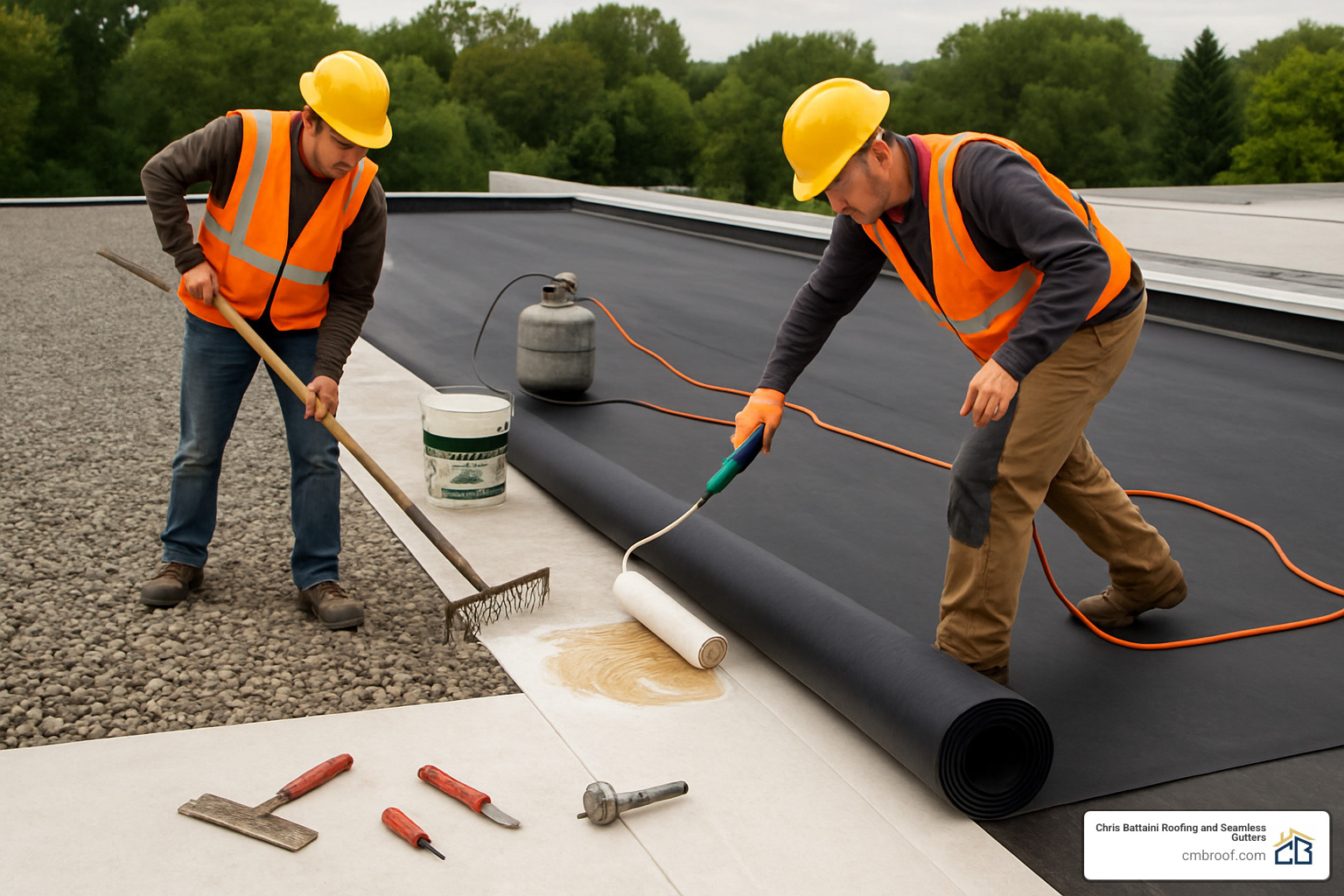
Thermoplastic membranes feature heat-welded seams that create monolithic assemblies. TPO dominates the market with bright white surfaces reflecting up to 87% of solar energy, dramatically reducing cooling costs. However, TPO quality varies between manufacturers – choose reputable brands for long-term performance.
PVC membranes excel in challenging environments like restaurants and chemical facilities due to superior resistance to grease, oils, and aggressive chemicals. Both systems achieve 20-30 year lifespans with skilled installation. Average costs based on internet data range from $5-$17 per square foot, with complex projects reaching $25+ per square foot.
Find more about TPO roofing.
Spray Polyurethane Foam (SPF) creates seamless, monolithic surfaces perfect for complex shapes. The foam provides excellent insulation (R-6 to R-7 per inch) while creating the waterproof barrier. Protective coatings applied over foam shield from UV degradation. Recoating every 10-15 years maintains integrity for 30-50 year lifespans. Average costs based on internet data range from $7-$21 per square foot.
Metal roofing offers best durability at 50+ years with minimal maintenance. Standing-seam systems provide excellent energy efficiency and full recyclability. Green roof systems combine waterproof membranes with vegetation for stormwater management and urban heat reduction, lasting up to 40 years. The EPA recognizes green roofs as effective tools to reduce urban heat island effect.
Choosing the right commercial flat roofing system requires evaluating multiple factors specific to your situation. The “best” roof fits your specific needs perfectly, not necessarily the most expensive or popular option.
Your local climate should drive decisions. In New England’s harsh conditions with freeze-thaw cycles and heavy snow loads, EPDM rubber handles temperature swings excellently, while TPO’s reflective surface provides energy savings. Building use matters significantly – restaurants need PVC’s chemical resistance for grease-laden exhaust, while warehouses might do well with cost-effective EPDM.
Consider roof traffic honestly. Built-up roofing handles frequent foot traffic from maintenance crews, while single-ply membranes need walkway pads. Budget conversations must include lifecycle costs – a $12,000 roof lasting 45 years beats an $8,000 roof needing replacement in 15 years.
Wind uplift resistance becomes critical in exposed locations. Check with insurance agents about discounts for premium roofing systems – many carriers reduce rates enough to offset extra material costs.
For expert guidance, consider professional Commercial Roof Installation consultation.
Create a systematic approach weighing all factors specific to your situation to avoid costly mistakes.
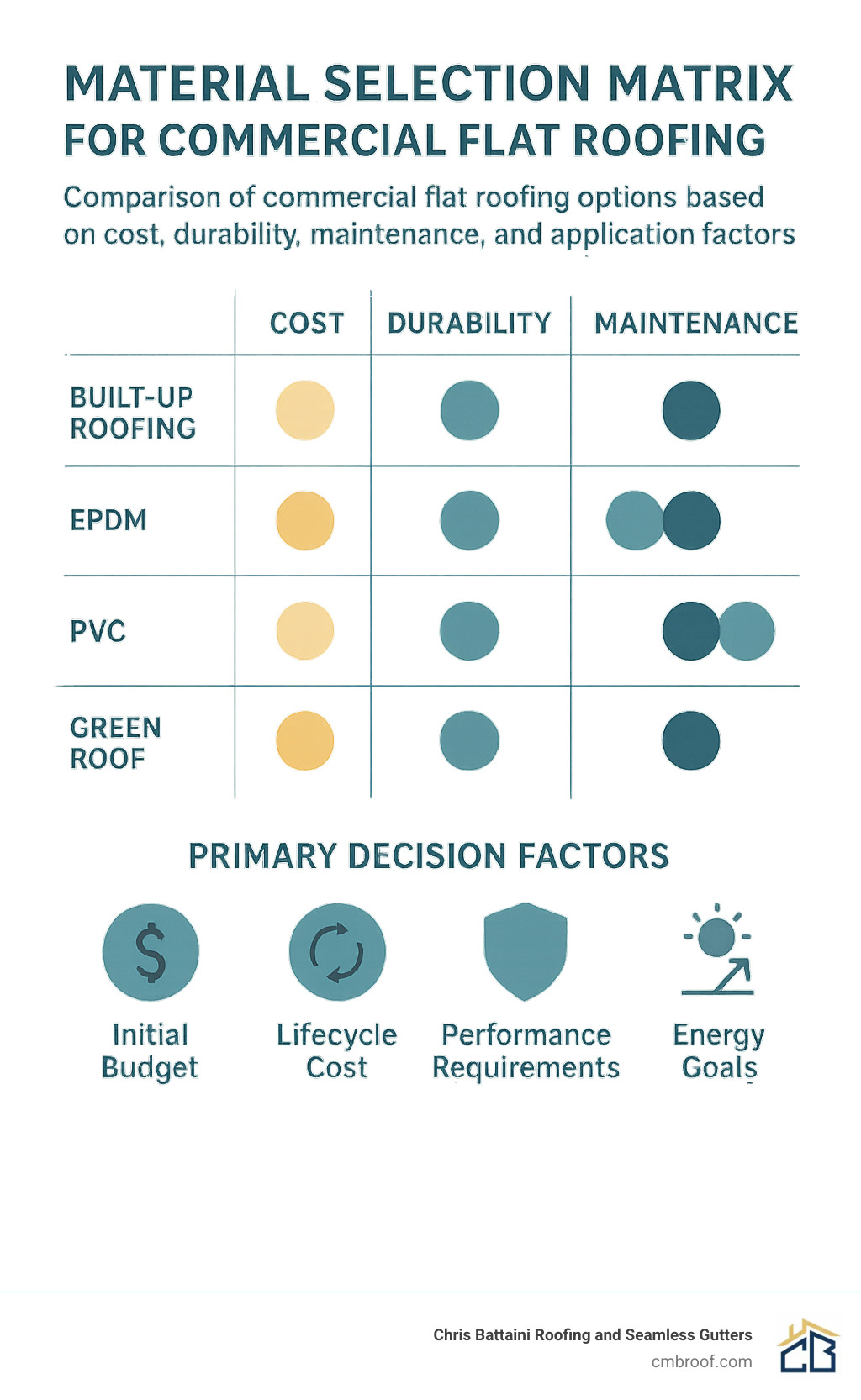
Start with initial budget versus lifecycle costs – calculate total expense over the roof’s expected life including maintenance and energy impacts. Performance requirements like fire ratings and wind resistance are non-negotiable factors that narrow options immediately.
Energy goals increasingly drive material selection as utility costs rise. Cool roof rebates and LEED requirements often justify premium materials. Be realistic about maintenance capacity – green roofs offer benefits but require ongoing care many owners can’t provide.
Timeline pressures sometimes force compromises, as single-ply installations happen faster than built-up systems. Tax incentives and utility rebates can completely change economics, making premium options surprisingly affordable.
The contractor determines whether your roofing system performs as expected or becomes costly headache. Start with experience verification – how many commercial flat roofing projects has this contractor completed recently? Ask for local references and actually call them.
Manufacturer certifications matter enormously. Certified contractors receive better technical support, extended warranties, and priority material access. Dig into warranty details beyond basic terms – what’s covered, how long, and what voids coverage?
Safety protocols can’t be overlooked. Ask about safety records, insurance coverage, and OSHA compliance. Get clarity on project scope and potential extras, weather delay policies, and coordination with other trades on occupied buildings.
For comprehensive evaluation, professional Roof Inspection Services can identify existing conditions and refine project scope.
Commercial flat roofing maintenance isn’t rocket science, but requires consistency. We’ve watched 20-year TPO systems reach 30+ years with regular care, while expensive roofs fail early due to neglect.
Ponding water tops our list of roof killers. Water sitting over 48 hours after rain indicates drainage problems needing immediate attention. Seam failures come second – these connection points bear the brunt of thermal expansion and weather extremes. Punctures often result from maintenance crews who don’t understand membrane vulnerability.
UV degradation works slowly but relentlessly, especially on unprotected areas. Flashing failures around equipment and penetrations often cause problems before main membranes show issues.
Regular professional inspections catch issues while manageable. We recommend twice-yearly checkups plus post-storm inspections.
For immediate attention to problems, explore our Commercial Roof Repair Solutions.

Proactive maintenance costs pennies compared to emergency repairs. Smart building owners double roof lifespans through consistent care.
Debris removal prevents moisture trapping and drain clogs. Monthly cleaning, especially after storms, prevents most debris-related problems. Drain maintenance deserves special attention – clogged drains cause ponding water that destroys more roofs than any other factor.
Seam inspections should happen annually. Walk systematically looking for lifted edges or separations. Vegetation control becomes critical when plants appear – they indicate moisture problems and can cause serious root damage.
Reflective coatings can extend aging membrane lifespans by 10-15 years at replacement fractions. Insulation upgrades improve energy efficiency while reducing thermal stress on membranes.
Commercial flat roofing warranties split into manufacturer warranties (covering material defects, typically 10-30 years) and workmanship warranties (covering installation defects, typically 5-10 years).
Read warranty details carefully – what’s covered versus excluded, required maintenance, transferability to new owners, and geographic service limitations. Required maintenance often determines claim approval – many manufacturers require documented semi-annual inspections.
Proper documentation makes the difference between successful claims and frustrating denials. Keep installation photos, material certifications, inspection reports, and maintenance records organized and accessible.
The future of commercial flat roofing focuses on sustainability and energy efficiency. Building owners find that sustainable roofing benefits both planet and bottom line.
Cool roof technology has moved from nice-to-have to must-have. Highly reflective surfaces bounce back up to 90% of solar energy, dramatically cutting cooling costs. Energy codes increasingly require cool roof performance for new construction.
Solar-ready surfaces represent smart future planning. Even without immediate solar installation, designing roofs to accommodate panels later protects investments through proper structural calculations and membrane selection.
Smart sensor technology continuously monitors moisture, temperature, and structural movement – your roof’s early warning system catching problems weeks before visible leaks. Recycled content now appears in membranes and insulation without compromising performance.
Low-VOC adhesives improve air quality during installation while reducing environmental impact. The ultimate goal for many owners is net-zero energy consumption, where commercial flat roofing plays crucial roles in minimizing heat loss and maximizing solar potential.
For sustainable options, explore our High Quality Flat Roofing solutions.
The next decade promises exciting developments. Self-healing polymers automatically seal small punctures as they occur. Composite membrane systems combine different materials’ best features into hybrid solutions optimizing multiple characteristics.
Modular green roof systems make vegetated roofs more practical through pre-grown modules that install quickly. Drone inspection technology reveals problems invisible from ground level while eliminating safety risks.
Wireless monitoring networks enable predictive maintenance strategies, providing real-time alerts about developing problems rather than scheduled inspections. This prevents most emergency repairs by catching issues early.
Metal roofing systems consistently top longevity charts. Well-installed standing-seam metal roofs can protect buildings for 50-70 years. EPDM rubber membranes earn second place with 40-50 year lifespans, with some 1960s installations still performing today.
However, “longest-lasting” isn’t always straightforward. Built-Up Roofing might “only” last 30+ years but handles constant foot traffic that would damage single-ply membranes. Green roofs reach 40+ years while providing stormwater management benefits.
The honest truth: proper installation matters more than material. We’ve seen premium systems fail in 15 years due to poor workmanship, while basic systems installed expertly exceed expected lifespans.
Commercial flat roofing costs depend on numerous factors. Based on internet data averages (general market figures, not specific pricing for our services):
Budget options like EPDM typically range $4-$15 per square foot (premium installations up to $20+). TPO systems cost $5-$17 per square foot (complex projects to $25+).
Mid-range systems include PVC at $6-$18 per square foot (specialized applications to $27+) and Modified Bitumen at $6-$18 per square foot (torch-applied to $25+).
Premium options include Built-Up Roofing at $7-$21 per square foot (multi-ply to $30+), metal roofing at $8-$25 per square foot (standing-seam to $35+), and SPF at $7-$21 per square foot (complex applications to $30+).
Specialty systems like green roofs range $15-$50+ per square foot (intensive systems to $80+).
Factors affecting costs include roof accessibility, existing roof removal, insulation upgrades, and drainage modifications. Larger projects typically enjoy lower per-square-foot costs.
Smart building owners schedule professional inspections twice yearly – spring and fall – plus post-storm checks. This catches small problems before expensive emergencies.
Spring inspections assess winter damage including membrane stress from ice dams, seam separations from freeze-thaw cycles, and blocked drains. Fall inspections prepare for winter by removing debris, cleaning drains, and securing equipment.
Post-storm inspections within 48 hours catch hail punctures, wind damage, and debris impacts. Between professional visits, monthly visual checks for ponding water, vegetation, or visible damage help catch developing problems.
Many contractors offer annual maintenance contracts bundling inspections with minor repairs and priority emergency service. These programs typically pay for themselves by extending roof lifespans and preventing costly failures.
Making the right commercial flat roofing choice becomes clearer when you focus on what matters most for your specific building and business. There’s no single “best” system – only the best system for your situation.
A restaurant needs PVC’s chemical resistance more than a warehouse values TPO’s energy efficiency. A school prioritizes fire safety differently than manufacturing facilities focus on durability. Our New England climate adds another consideration – freeze-thaw cycles that make seasons beautiful can be brutal on roofing systems.
The contractor you choose matters as much as materials. We’ve seen expensive systems fail in 10 years due to poor installation, while basic EPDM roofs installed with care protect buildings after 40+ years.
Yes, quality roofing costs more upfront, but the math works over time. Spending 30% more for a roof lasting twice as long isn’t just smart economics – it saves business disruption from premature replacement.
Regular maintenance remains the secret weapon for extending any roof’s lifespan. Semi-annual inspections might seem like unnecessary expenses, but they’re insurance policies preventing small problems from becoming disasters. A $500 seam repair beats a $50,000 emergency replacement.
The industry keeps evolving with innovations like self-healing membranes and smart monitoring, but fundamentals never change. Proper drainage prevents ponding water. Quality installation creates lasting performance. Prompt maintenance catches problems early.
Whether dealing with emergency leaks, planning renovations, or designing new construction, work with professionals who understand both technical aspects and practical realities of commercial flat roofing in our region.
For comprehensive guidance on your commercial roofing needs, explore our Commercial Roofing services.
Chris Battaini Roofing and Seamless Gutters proudly serves Berkshire, Hampden, Hampshire, and Franklin Counties in Massachusetts, bringing owner-led service and genuine expertise to every commercial flat roofing project we undertake.
Need a reliable roofer? CMB Roofing provides licensed, insured, and professional roofing services for homeowners and businesses.
We stand by a simple promise: Clear estimates. Quality workmanship. Clean job sites.
From roof repairs and full replacements to storm damage restoration, our team delivers dependable results with durable materials, expert installation, and complete site cleanup.