-
10 Wendell Ave Extension Pittsfield, MA 01201
-
210 Columbia St., Lee, MA 01238

Built up roofing installation is the process of layering multiple plies of reinforcing felt with bitumen (asphalt or coal tar) to create a thick, seamless waterproof membrane on flat or low-slope roofs.
Here’s a quick overview of how it works:
BUR systems have protected commercial and residential flat roofs for over a century. The reason they’ve lasted this long is simple: redundancy. If one layer is damaged, the layers beneath still keep water out.
Modern systems have also evolved. Low-fuming asphalts and cold-applied adhesives have made installation safer and more flexible — without sacrificing the core strength of the multi-ply design.
That said, BUR installation isn’t a DIY project. Precise temperature control, correct ply alignment, and proper flashing details all determine whether a roof lasts 20 years — or 40.
I’m Christopher Battaini, owner of Chris Battaini Roofing and Seamless Gutters, with over two decades of hands-on experience in built up roofing installation across the North Shore and Greater Boston area. In this guide, I’ll walk you through exactly how a professional BUR installation is done — and what separates a lasting system from one that fails early.
Built up roofing installation word guide:
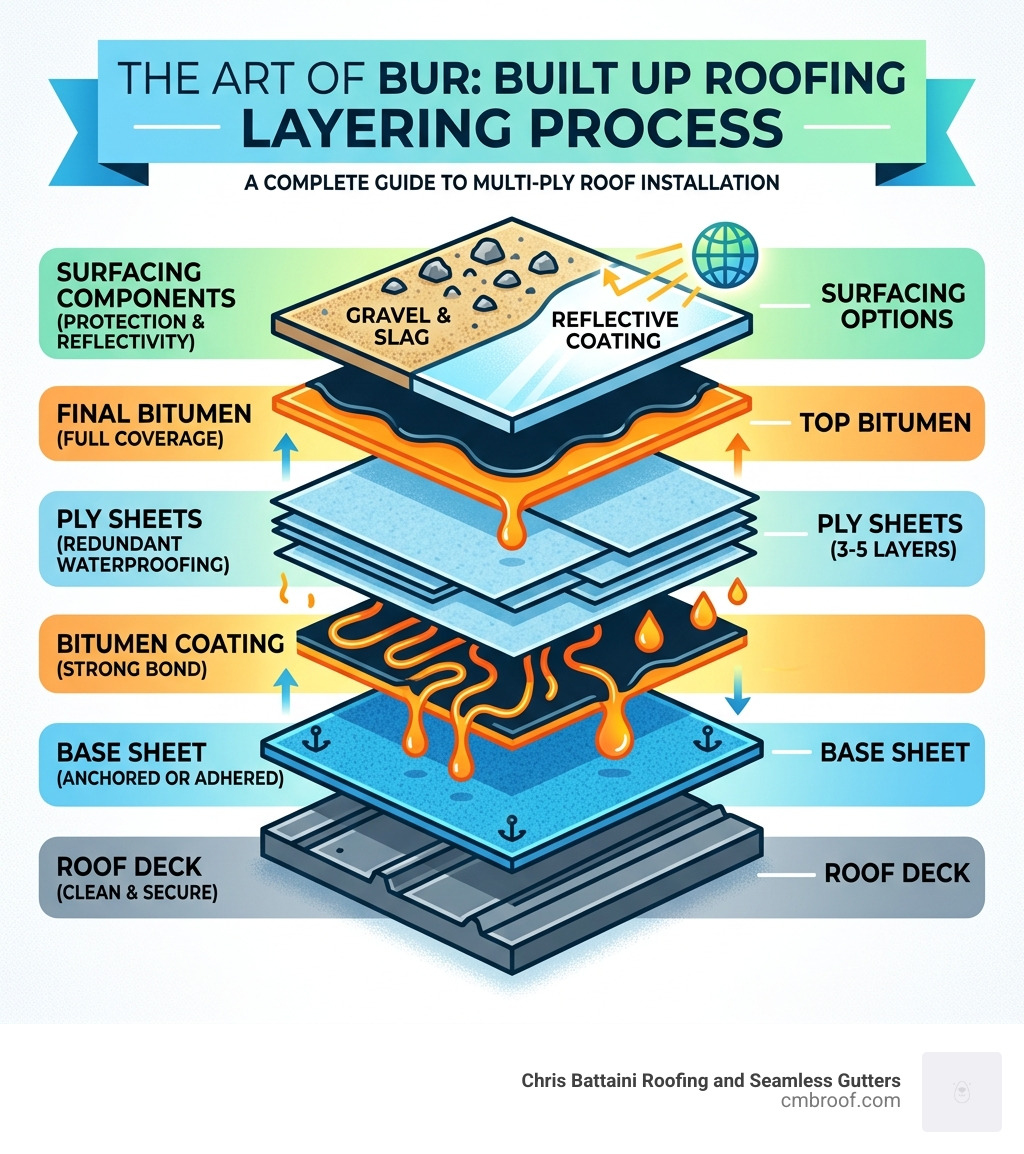
When we talk about the “art” of built up roofing installation, we are really talking about the harmony of high-quality materials working together. A BUR system is only as strong as its weakest layer. For property owners in Berkshire County, understanding these Flat Roofing Materials is the first step in ensuring a successful project.
The foundation of any BUR system is the substrate. We carefully evaluate whether we are working with nailable decks (like wood or plywood) or non-nailable decks (like concrete or steel). Each requires a specific preparation method. For instance, concrete decks often need a primer to ensure the bitumen bonds correctly, while steel decks typically require two layers of insulation to prevent “picture framing” and provide a stable base.
The core of the system consists of:
As noted in this comprehensive guide to BUR roofing, the combination of these elements creates a “monolithic” structure. This means the roof behaves as one single, solid piece, which is why it offers such incredible resistance to wind uplift and water penetration.

Choosing the right asphalt isn’t just about grabbing a bucket from the shop. It requires a deep understanding of ASTM standards and climate-specific grades. In Massachusetts, where we deal with everything from summer heatwaves to sub-zero winters, the softening point of the asphalt is critical.
We use the concept of Equiviscous Temperature (EVT) to ensure precision. The EVT is the temperature at which the asphalt reaches the perfect viscosity for application—usually 125 centistokes for mop application and 75 centistokes for machine application. Applying asphalt within ±25°F of the EVT ensures we get the nominal 23–25 pounds of asphalt per 100 square feet needed for a perfect bond. If the asphalt is too cold, it won’t adhere; if it’s overheated (known as “cracking”), it loses its essential oils and becomes brittle.
The actual Flat Roofing Installation is a rhythmic, meticulous process. It begins with a clean slate. We remove all debris, old materials, and moisture-damaged sections. Any area where water ponds for more than 24 hours is addressed during this phase, as standing water is the enemy of a long-term guarantee.
Once the deck is prepped, we move to the base sheet. Depending on the building type and local regulations, we might use mechanical fasteners or hot asphalt to secure this first layer. From there, the “mopping” begins.
| Feature | Hot-Applied Asphalt BUR | Cold-Applied Adhesive BUR |
|---|---|---|
| Application Method | Melted in a kettle and mopped on | Squeegeed or sprayed at ambient temp |
| Odor/Fumes | High (traditional “tar” smell) | Low to negligible |
| Safety | Requires high-heat precautions | No open flames or kettles |
| Cure Time | Immediate as it cools | Requires set time for solvent release |
| Best For | Maximum bond strength | Hospitals, schools, occupied buildings |
This step-by-step process guide highlights that when using hot asphalt, we never apply materials more than 6 feet in front of the roll. This ensures the asphalt is still at the optimal temperature when the felt hits it.
The strength of a BUR system lies in its layers. Most systems use 3 to 5 ply sheets. We use a “shingling” method, where each sheet overlaps the previous one to ensure water always flows over a seam rather than into it.
Alignment is everything. We use 4-inch overlaps as a standard to create a watertight seal. To eliminate air pockets—which can turn into nasty blisters later—we often use weighted rollers to press the felts firmly into the hot bitumen. This ensures 100% contact across the entire surface. If we are working on steep slopes (anything over 2:12), we implement “backnailing,” which involves securing the plies to wood nailers to prevent the entire system from sliding down the roof in the summer heat.
The final step in built up roofing installation is the surfacing. This is the armor that protects your investment from the elements. While many people think of “tar and gravel,” there are several ways to finish a BUR system depending on the building’s needs.
Aggregate Surfacing (Gravel or Slag): This is the classic choice for Commercial Flat Roofing. We apply a heavy “flood coat” of asphalt (usually 60 lbs per square) and immediately embed the aggregate.
Reflective Coatings and Cap Sheets: For those looking for energy efficiency, we can finish the roof with a mineral-surfaced cap sheet or a reflective coating. Aluminum or white elastomeric coatings can reduce cooling costs by up to 30% by reflecting solar radiation away from the building. These “cool roof” options are becoming increasingly popular in Massachusetts to meet modern energy codes.
At Chris Battaini Roofing and Seamless Gutters, we don’t just “slap on a roof.” We hold ourselves to the highest possible standards. Chris Battaini Roofing and Seamless Gutters is an Owens Corning Platinum Preferred Contractor. This earned, elite designation is limited to the top tier of roofing professionals nationwide. It means our team has been vetted for financial stability, customer service, and, most importantly, technical mastery.
Even the best-installed BUR system needs a little love. Our guide to flat roof care emphasizes the importance of annual inspections. In Berkshire County, we have to deal with heavy snow loads and autumn leaves that can clog drains. We recommend checking your roof at least twice a year—once in the spring and once in the late fall.
Key maintenance steps include:
As this 2026 installation guide notes, a well-maintained BUR system can easily last 30 to 40 years, far outlasting many single-ply alternatives.
When budgeting for your project, it is important to look at the long-term Return on Investment (ROI). Based on publicly available internet data, the average cost for built up roofing installation in 2026 typically falls into a wide range of $4.00 to $18.00 per square foot.
Please note: These are average costs based on general market research and do not represent the actual pricing of Chris Battaini Roofing and Seamless Gutters. Every roof is unique, and factors like height, accessibility, and the number of plies will influence the final quote.
While the upfront cost of a multi-ply BUR system might be higher than a thin single-ply membrane, the durability and ease of repair often make it the more economical choice over the building’s lifespan.
A properly installed BUR system typically lasts between 20 and 40 years. The lifespan is heavily influenced by the number of plies (more plies generally mean a longer life) and how well the drainage and surfacing are maintained. Because of the redundant layers, even if the top surface wears down, the underlying plies continue to provide a waterproof barrier.
In many cases, yes. This is known as a “re-roof” or “overlay.” However, we must first conduct a moisture scan to ensure the existing insulation isn’t wet. We also have to verify the building’s structural load capacity, as BUR systems are significantly heavier than other roofing types. Local building codes in Berkshire County generally limit the number of roof layers allowed on a single structure.
Absolutely. This is one of the biggest advantages of BUR. Because it is a thick, multi-layered system—especially when surfaced with gravel—it is highly resistant to punctures. This makes it an ideal platform for buildings with heavy mechanical equipment, solar arrays, or areas that require frequent foot traffic for maintenance.
Built up roofing installation remains a gold standard for a reason. Its time-tested durability, redundant waterproofing, and high resistance to the harsh Massachusetts elements make it a premier choice for commercial and residential flat roofs alike.
When you choose Chris Battaini Roofing and Seamless Gutters, you aren’t just getting a crew; you’re getting owner-led, on-site service. I personally oversee our projects to ensure that every ply is aligned and every mop stroke is perfect. We back our work with exceptional workmanship warranties, giving you peace of mind that your property is protected by the best in the business. For more information on finding the right partner for your project, check out our Flat Roofing Contractor Ultimate Guide.
Chris Battaini Roofing and Seamless Gutters is an Owens Corning Platinum Preferred Contractor. This earned, elite designation is limited to the top tier of roofing professionals nationwide.
The company services Berkshire County, Massachusetts.
Follow us on Facebook — https://www.facebook.com/chrisbattainiroofing
Need a reliable roofer? CMB Roofing provides licensed, insured, and professional roofing services for homeowners and businesses.
We stand by a simple promise: Clear estimates. Quality workmanship. Clean job sites.
From roof repairs and full replacements to storm damage restoration, our team delivers dependable results with durable materials, expert installation, and complete site cleanup.