• 10 Wendell Ave Extension Pittsfield, MA 01201
  • 210 Columbia St., Lee, MA 01238

A Practical Guide to Slate Roof Repairs

Chris Battaini Roofing in Berkshire County, Massachusetts and Beyond

Why Slate Roofs Deserve Expert Care

Slate Roof Repairs require specialized knowledge and careful execution to preserve one of the most durable and beautiful roofing materials available. When properly maintained, slate roofs can last 75 to 200+ years, making repair almost always a better investment than replacement.

Quick Guide to Slate Roof Repairs:

  • When to Repair: If less than 20-30% of slates are damaged, cracked, or missing
  • Common Damage Causes: Fallen tree limbs, heavy snow/ice, foot traffic, rusted fasteners, natural weathering
  • Key Repair Steps: Remove damaged slate with a slate ripper, match replacement slate exactly (type, color, size, texture), secure with copper fasteners and proper flashing
  • Materials Needed: Slate ripper, copper nails, copper flashing strips or slate hooks, replacement slates that match existing ones
  • Why Professional Help Matters: Specialized tools required, safety risks on steep/slippery surfaces, long-term consequences of improper repairs
  • Repair vs. Replace Rule: Replace the entire roof if 20% or more slates are damaged; otherwise, repair individual slates

Unlike asphalt shingles (20-30 years), slate is genuine stone that has protected buildings for centuries. With many 19th-century slate roofs still in service, their remarkable longevity means repairing a few damaged slates preserves decades of remaining service life.

The challenge is that slate roofs are unique. They’re heavier (800 to 1,500 pounds per roofing square), fragile underfoot, and require specialized tools like slate rippers that most general roofers don’t carry. A poor repair, such as using roofing cement instead of copper fasteners or installing mismatched slates, can accelerate deterioration and compromise the roof’s integrity.

The stakes are high because the wrong approach can turn a simple repair into a costly replacement. When flashings fail or fasteners rust, water can rot the underlying wood sheathing and cause structural damage. Yet with the right materials and expertise, most slate roof damage is completely repairable, extending its life for decades.

I’m Christopher Battaini, and over my 20+ years in the roofing industry, I’ve worked extensively with slate roofs throughout the North Shore and Greater Boston area, understanding their durability and the craftsmanship required for proper Slate Roof Repairs. This guide will walk you through everything you need to know.
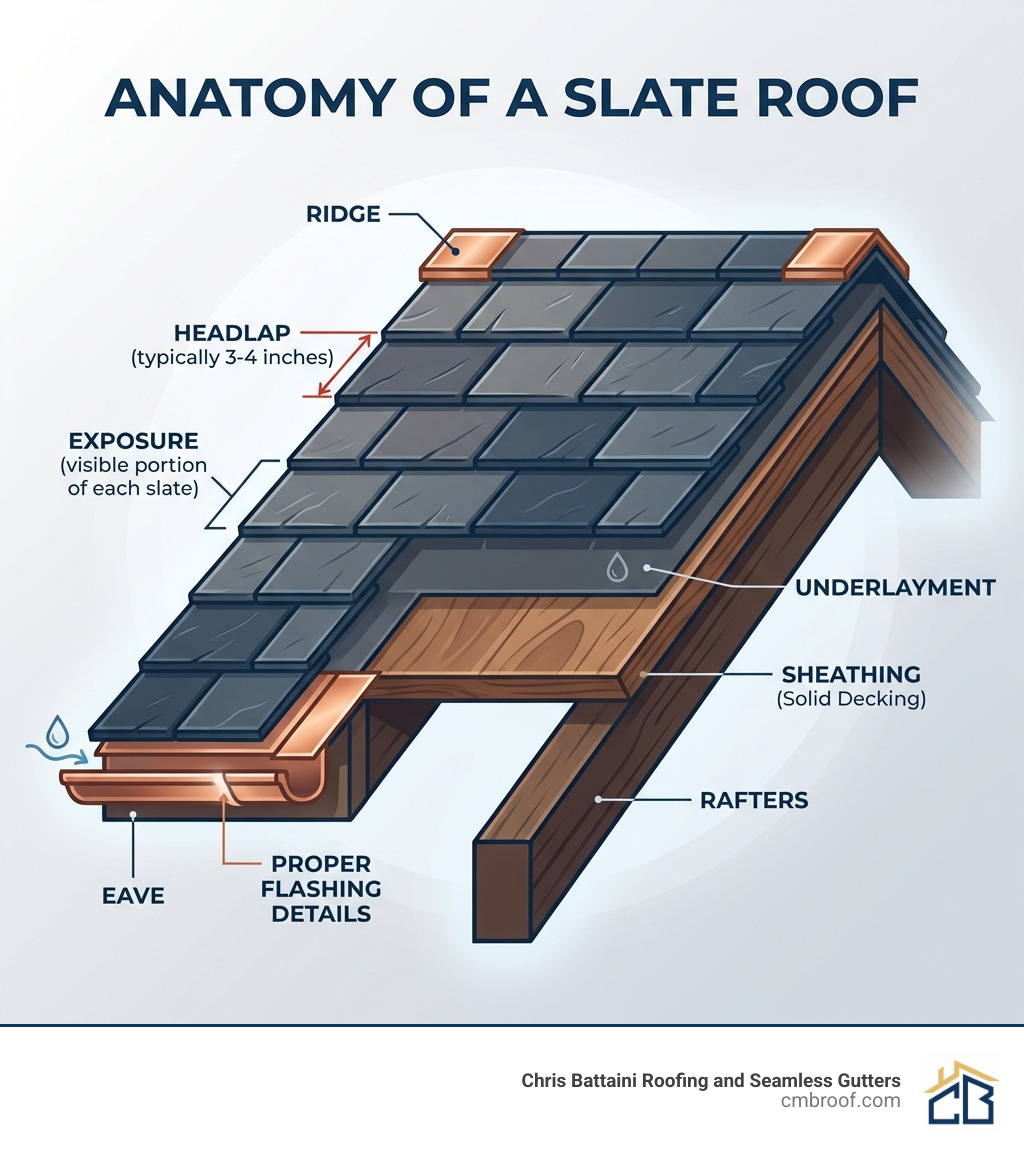
infographic showing the anatomy of a slate roof with labeled components including ridge, headlap (the overlap between slate courses typically 3-4 inches), exposure (the visible portion of each slate), underlayment, sheathing, rafters, and eave with proper flashing details - Slate Roof Repairs infographic

Identifying Slate Roof Damage: When to Repair or Replace

One of the most critical aspects of maintaining a slate roof is knowing when to repair a few slates versus when to consider a larger intervention. Because slate roofs are designed to last for generations (soft slate for 50-125 years, hard slate for 75-200+ years), most issues should be addressed with targeted Slate Roof Repairs. The key is early detection and understanding the damage.

Common Causes of Damage

Even the most robust slate roofs can be damaged by external forces and time. Here are common culprits:

  • Impact from Tree Limbs: Falling branches, common in Berkshire County, can crack or dislodge slates, creating immediate vulnerabilities.
  • Hail Damage: While slate is highly impact-resistant, extremely large hailstones can cause localized cracks or chipping.
  • Improper Foot Traffic: Walking on a slate roof without proper technique is a primary cause of damage. Slate is brittle, and improper foot traffic leads to cracks, which is why professional care is essential.
  • Ice Dams: Massachusetts’ freeze-thaw cycles can cause ice dams at the eaves, which put immense pressure on slates and can lead to displacement or breakage.
  • Rusted Fasteners: The nails holding slates can corrode over decades if not made of durable materials like copper. When fasteners fail, slates can slide or fall, a common cause of leaks in older roofs.
  • Natural Weathering Cycles: Over many decades, constant wet/dry and hot/cold cycles can cause chemical changes in the slate’s mineral impurities, leading to internal stress and delamination, despite its low water absorption (<0.4%).
  • Stress Cracks: Hairline cracks from quarrying or installation can expand over time due to thermal changes.

Signs Your Roof Needs Repair vs. Full Replacement

Knowing what to look for is half the battle. Regular inspections, especially after severe storms, are crucial. Here’s how to distinguish between issues requiring Slate Roof Repairs and those signaling a need for a full replacement:
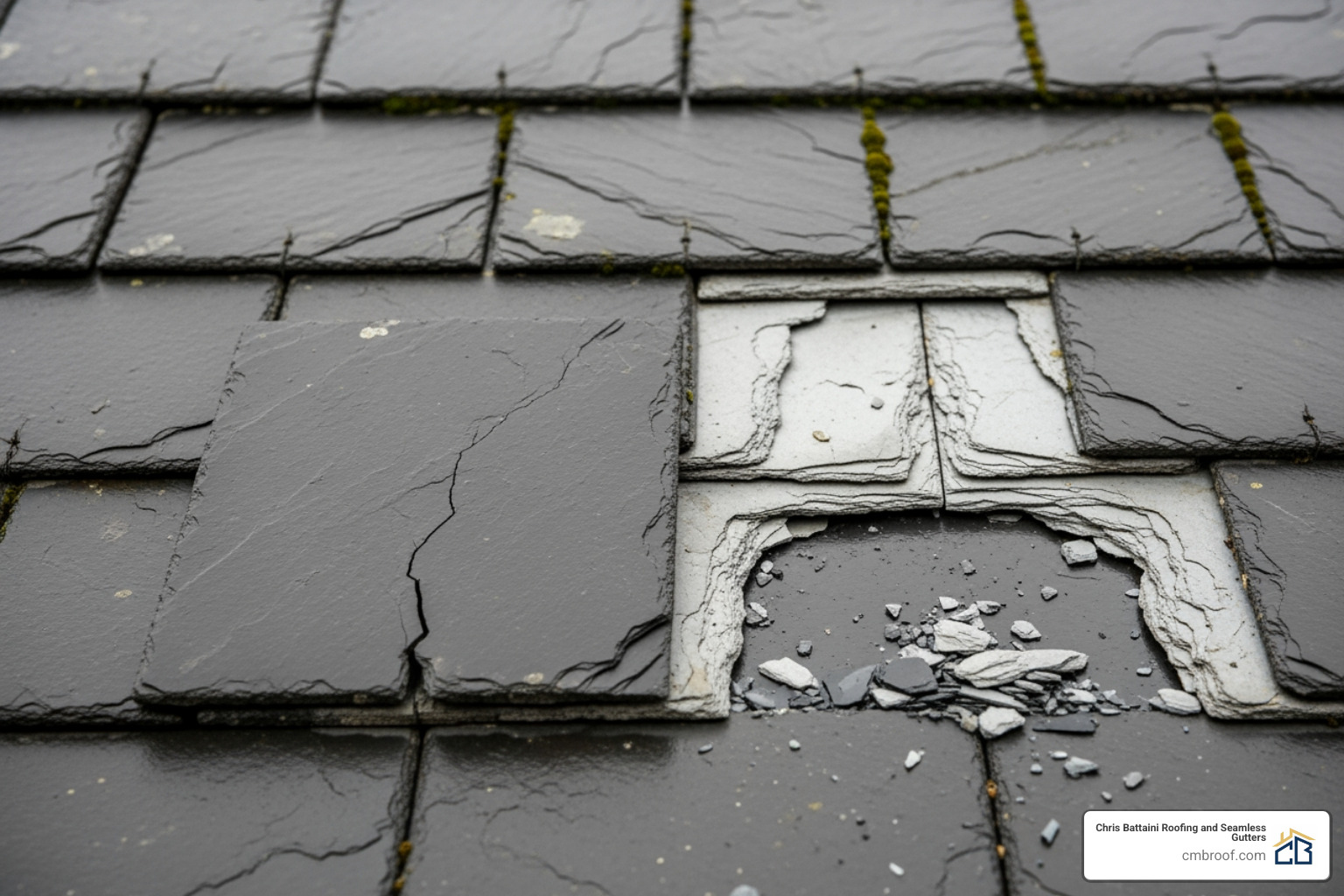
image showing a single cracked slate tile next to a roof section with widespread delaminating slates - Slate Roof Repairs

  • Cracked or Broken Tiles: Individual slates with visible cracks or missing pieces need prompt replacement to prevent water infiltration.
  • Missing Slates: These leave the underlayment exposed and often result from rusted fasteners or impact damage.
  • Sliding Slates: Slates slipping out of alignment usually indicate failed fasteners.
  • Flaking (Delamination): When layers of slate peel apart, it’s a sign the slate itself is deteriorating.
  • Powdering: A chalky or powdery surface indicates the slate is breaking down.
  • Porousness (Dull Thud Test): When tapped, a sound slate makes a crisp ring. A dull thud suggests the slate has become porous and is near the end of its life.
  • Widespread Damage: The “20-30% rule” applies here. If 20% or more of the slates on a roof slope are damaged or deteriorating, it’s generally more cost-effective to replace the entire roof rather than attempt extensive repairs.

Many leaks are caused not by worn-out slates but by corroded flashings or failed fasteners—classic candidates for repair, not replacement. For more on assessing your needs, see our insights on residential roofing.

The Preservation Brief on Slate Roofs emphasizes repairing historic slate roofs whenever possible. This aligns with our philosophy at Chris Battaini Roofing and Seamless Gutters of preserving the longevity and character of slate roofs in Berkshire County, MA.

The Professional Slate Roof Repairs Process

Slate Roof Repairs are a meticulous process requiring specialized tools, knowledge, and a commitment to safety. Due to the material’s fragility, steep pitches, and the need for precision, this is not a DIY project and professional expertise is non-negotiable. Our team at Chris Battaini Roofing and Seamless Gutters approaches every slate repair with the utmost care.

Specialized Tools and Their Use for Slate Roof Repairs

Working with slate effectively and safely demands specific tools rarely found in a general contractor’s kit.
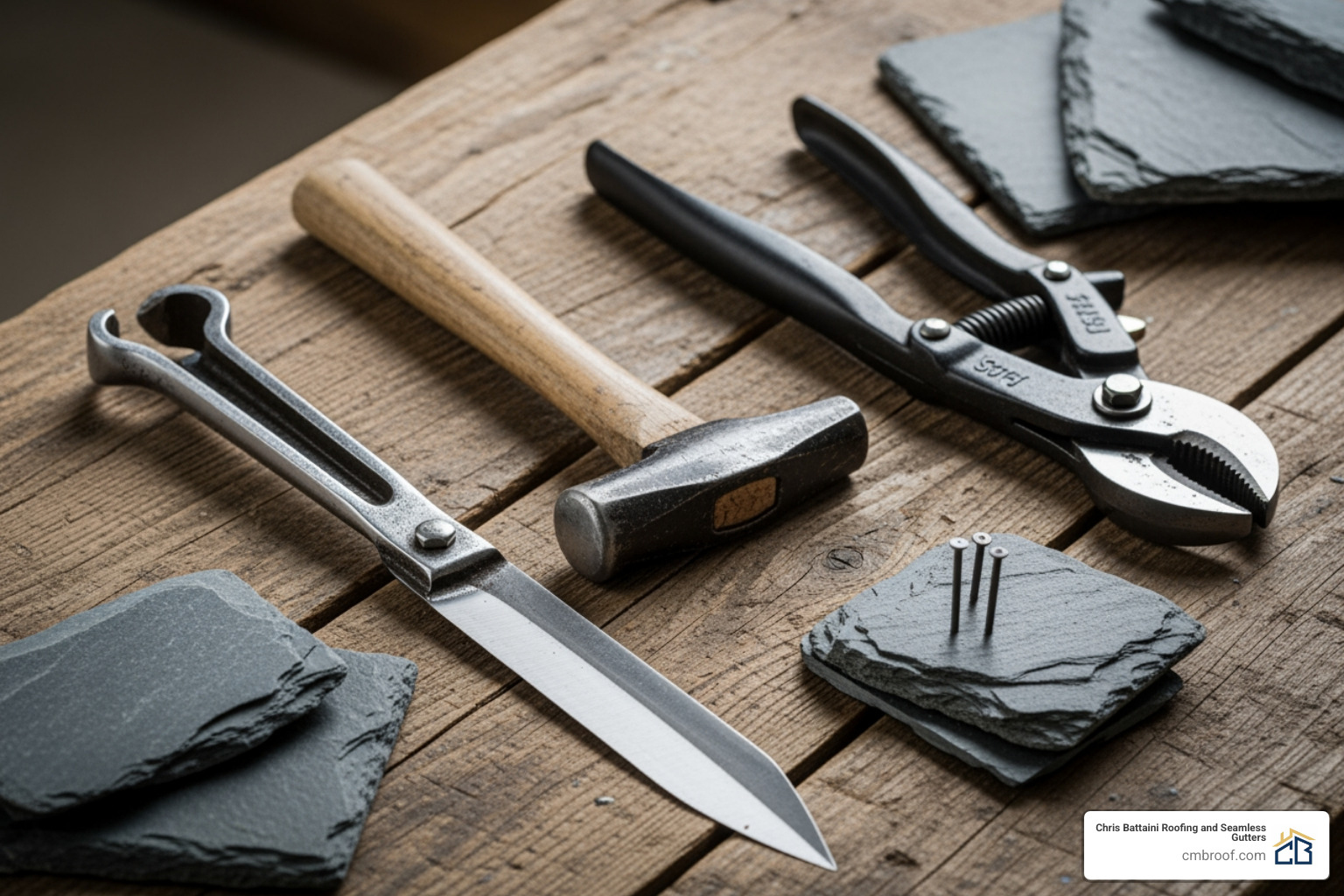
image of specialized slate roofing tools: a slate ripper, slate cutter, and slate hammer - Slate Roof Repairs

  • Slate Ripper: This is the most crucial tool for slate repair. A long, thin steel bar with a hooked end, the slate ripper slides under a slate to hook and cut or pull the nails holding it in place. This allows for the removal of a single damaged slate without disturbing the surrounding roof.
  • Slate Cutter: A slate cutter is indispensable for making clean, accurate cuts on new slates. This ensures the replacement tile matches the exact dimensions needed for a proper fit and uniform appearance.
  • Slate Hammer: This distinctive hammer has a pointed end for punching nail holes in new slates and a sharpened edge for trimming. The punch allows the slate to “hang” correctly, preventing cracks from over-tightened nails.
  • Chicken Ladders (Roof Jacks/Crawling Boards): These temporary platforms hook over the roof’s ridge, providing a stable working surface. They distribute weight to prevent damage and offer secure footing on steep surfaces.
  • Safety Harnesses and Ropes: For any work on a steep roof, fall protection is paramount. We always use OSHA-compliant safety harnesses and ropes to ensure crew safety.

For more detailed information on preventing water damage, visit our page on roof leak repair.

Step-by-Step: Removing and Replacing a Damaged Slate

Individual slate replacement is a delicate process of precision and patience. Here’s a general overview:

  1. Removing the Old Slate: The first step is to carefully remove the broken slate using the slate ripper. We slide the ripper under the damaged slate, locate the nails, and either pull them out or cut their shanks. Once free, the slate can be carefully removed.
  2. Cleaning the Area: After the old slate is removed, we clear any leftover broken pieces or debris from the exposed area. A clean space is essential for a proper, watertight installation.
  3. Installing the New Slate: A carefully matched new slate is slid into the opening and secured using one of two primary methods:
    • Nail and Bib Method: This traditional method involves nailing the new slate and then covering the exposed nail head with a small piece of copper flashing (a “bib”) slid under the course above. This creates a watertight, nearly invisible repair.
    • Slate Hook Method: Alternatively, a pre-fabricated copper slate hook is driven into the sheathing, and the new slate is slid into place, resting on the hook. This method is quicker, though the hook may be slightly visible.
  4. Sealing the Repair: The goal is a watertight repair. This means ensuring proper headlap (overlap) and offset (staggering) are maintained. We use durable materials like copper nails and flashings, which won’t rust and have a service life equal to or greater than the slate itself.

Materials and Matching: The Key to a Lasting Repair

The success of any Slate Roof Repairs hinges on using materials that match the existing roof. A mismatched repair is an eyesore and can compromise your home’s aesthetic, especially on historic properties. More importantly, incompatible or incorrectly sized slates can jeopardize the roof’s watertightness and longevity.

The Importance of Matching Existing Slate

Our goal is to make the new slate blend in seamlessly. This requires careful consideration of several factors:

  • Type and Quarry Origin: Slates from different regions have distinct characteristics. Pennsylvania slates are often grayish-black, while Vermont and New York slates come in greens, reds, purples, and grays. Knowing the original source helps find the closest match.
  • Color and Weathering: Some slates are “unfading,” while “semi-weathering” slates change color over time. We check the underside of an existing slate to determine its original color and match the weathered appearance for a seamless look.
  • Size and Thickness: Replacement slates must match the original length, width, and thickness to maintain proper headlap (overlap) and offset (staggering). An incorrectly sized slate can compromise weathertightness and appearance.
  • Texture: Slate can range from smooth to rough. Matching the texture ensures the new slate doesn’t stand out visually.

Maintaining the historic integrity and aesthetic value of your home through meticulous material matching is a hallmark of our work at Chris Battaini Roofing and Seamless Gutters.

Reclaimed vs. New vs. Synthetic Slate for Repairs

When sourcing replacement slates, we have a few options. We’ll help you find the best solution for your property in Berkshire County, MA.

Material Type Pros Cons Best Use Case
Reclaimed Slate – Excellent color/texture match for older roofs
– Sustainable, eco-friendly
– Often very durable
– Availability can be limited
– Can be more costly due to sourcing and handling
– May have minor imperfections
Ideal for historic homes where a close aesthetic match is paramount
New Natural Slate – Consistent quality and sizing
– Wide range of colors and types available
– Predictable performance
– Can represent a significant investment depending on type and source
– May not perfectly match weathered color of existing roof
Suitable for newer slate roofs or when a large quantity of consistent slate is needed
Synthetic Slate – Lighter weight, easier installation
– Often more affordable than natural slate on average
– Can offer excellent durability and impact resistance
– May not perfectly replicate the natural variation of real slate
– Long-term weathering may differ
– Not suitable for many historic preservation projects
Budget-conscious projects, roofs unable to support weight of natural slate, or when exact match is less critical

For general context only, publicly available internet data often lists installed slate roofing costs starting in the lower range of a few hundred dollars per square and extending to premium products that can exceed three times that amount or more per square. These are broad, third-party averages for slate roofing in general and are not the pricing of Chris Battaini Roofing and Seamless Gutters.

Our team will always discuss available material options with you, considering your budget, the age of your home, and your aesthetic preferences to help you make an informed decision for your Slate Roof Repairs.

Why Professional Expertise is Crucial for Slate Roof Repairs

The complexities of Slate Roof Repairs demand expertise beyond general roofing knowledge. Attempting DIY repairs without proper training, tools, and safety protocols leads to significant immediate and long-term risks. Partnering with experienced professionals like Chris Battaini Roofing and Seamless Gutters is a necessity.

Safety and Techniques for Working on Slate Roofs

Slate roofs present unique safety challenges, especially in Berkshire County’s variable weather:

  • Steep Slope Challenges: Many slate roofs have steep pitches (a minimum of 4-in-12), making access difficult.
  • Slippery Surfaces: Slate becomes incredibly slippery when wet, frosted, or covered in algae, increasing fall risks.
  • Weight Distribution Techniques: Improper foot traffic is a leading cause of broken slates. Professionals use “chicken ladders” or crawling boards to distribute weight and prevent damage.
  • Professional Safety Equipment: We adhere strictly to safety guidelines, utilizing OSHA-compliant safety harnesses, ropes, and anchor points.
  • Ladder and Harness Use: Proper ladder placement and secure harness use are non-negotiable on steep roofs.
  • Protecting Existing Slates: Our experienced roofers know how to steer a slate roof without causing incidental damage, a skill that comes from years of hands-on experience.

The Long-Term Cost of Improper Slate Roof Repairs

Hiring an inexperienced contractor for Slate Roof Repairs may seem cheaper upfront, but the long-term consequences far outweigh any initial savings:

  • Water Damage: Improperly installed slates or flashings invite water penetration, leading to costly interior damage.
  • Structural Degradation: Persistent leaks can rot the underlying wood sheathing and rafters, compromising your home’s structural integrity.
  • Sheathing Rot: Rotted sheathing loses its ability to hold fasteners, causing more slates to become loose or fall off.
  • Devalued Property: A poorly repaired slate roof is an aesthetic detriment that can reduce your property’s curb appeal and market value.
  • Increased Future Repair Costs: An improper repair often fails prematurely, making the next repair more complex and expensive. Using roofing cement, for example, hardens, cracks, and complicates future work.
  • Comparing Repair vs. Replacement Costs: While Slate Roof Repairs are significantly less than a full replacement, if 20% or more of your slates are damaged, replacement may be the more cost-effective option.

Choosing an experienced contractor ensures your Slate Roof Repairs are done correctly the first time, protecting your investment. We are an Owens Corning Platinum Preferred Contractor, a distinction reflecting our commitment to superior workmanship. This expertise is invaluable for the unique challenges of slate roofing in Berkshire County, MA, and our quality is backed by our warranty guarantee.

Conclusion: Preserving the Legacy of Your Slate Roof

A slate roof is a legacy of craftsmanship that can last for centuries. For property owners in Berkshire County, MA, it’s a piece of architectural history that adds significant beauty and value.

This guide covered the causes of damage, repair vs. replacement signs, the specialized process of Slate Roof Repairs, and the importance of matching materials. We also highlighted why improper repairs are a costly mistake.

Proper Slate Roof Repairs are an investment in your home’s longevity and integrity. They extend the roof’s life, preserve its appeal, and protect your property. Repair is almost always the preferred option for damage that isn’t widespread.

At Chris Battaini Roofing and Seamless Gutters, we understand the unique challenges and precise requirements of slate roofing. Our team combines decades of experience with specialized tools and a commitment to meticulous craftsmanship. As an Owens Corning Platinum Preferred Contractor, a distinction earned by only the top tier of roofing professionals in the country, we bring a level of expertise and quality assurance that is best, offering you peace of mind that your slate roof is in capable hands.

Whether you have a few cracked slates, suspect a leak, or need an expert assessment of your roof’s condition, we are here to help. Trust us to preserve the legacy of your slate roof with professional, lasting Slate Roof Repairs.

Chris Battaini Roofing and Seamless Gutters is proud to serve the communities of Berkshire County, Massachusetts.

Contact us for your slate roofing needs.

Follow us on Facebook https://www.facebook.com/chrisbattainiroofing

Get Your Free Estimate Today

Need a reliable roofer? CMB Roofing provides licensed, insured, and professional roofing services for homeowners and businesses.

We stand by a simple promise: Clear estimates. Quality workmanship. Clean job sites.

From roof repairs and full replacements to storm damage restoration, our team delivers dependable results with durable materials, expert installation, and complete site cleanup.


A Practical Guide to Slate Roof Repairs

Why Homeowners Trust Chris Battaini Roofing

  • Owens Corning Platinum Preferred Contractor
  • Licensed & Insured Roofing Company
  • Owner-Supervised Installations
  • Manufacturer-Backed Roofing Warranties
  • Workmanship Installation Guarantee
chris battaini roofing contractor berkshire county logo footer
  • 10 Wendell Ave Extension Pittsfield, MA 01201
  • 210 Columbia St., Lee, MA 01238
MA LIC #101201 / MA HIC #160959
Areas We Service
At Chris Battaini Roofing & Seamless Gutters, we specialize in residential and commercial roofing and gutter installation services across Southern and Northern Berkshire County in Massachusetts.
PPC Right Roof Right Roofer Proud black border Chris Battaini Roofing - BBB Accredited Business logo with A+ Rating displayed.