-
10 Wendell Ave Extension Pittsfield, MA 01201
-
210 Columbia St., Lee, MA 01238

A roof leak or attic condensation can produce the same alarming result: damp insulation, dark roof sheathing, or a ceiling stain. The difference is the moisture path. A roof leak starts outside the building envelope and follows a defect or vulnerable roof detail. Condensation begins when warm, moisture-laden indoor air reaches a cold attic surface. Timing, distribution, and weather history can narrow the inspection, but a single stain does not prove either cause.
Before materials dry or conditions change, record when and where moisture appears. Stay inside or on the ground. Do not climb into an attic if the access is unsafe, insulation hides the framing, electrical components are wet, or the roof structure is icy.
| Pattern you observe | What it may point toward | What to document |
|---|---|---|
| Moisture begins during rain or soon after | An exterior entry path at roofing, flashing, a penetration, or a transition | Rain intensity, wind direction, start time, and the first visible wet area |
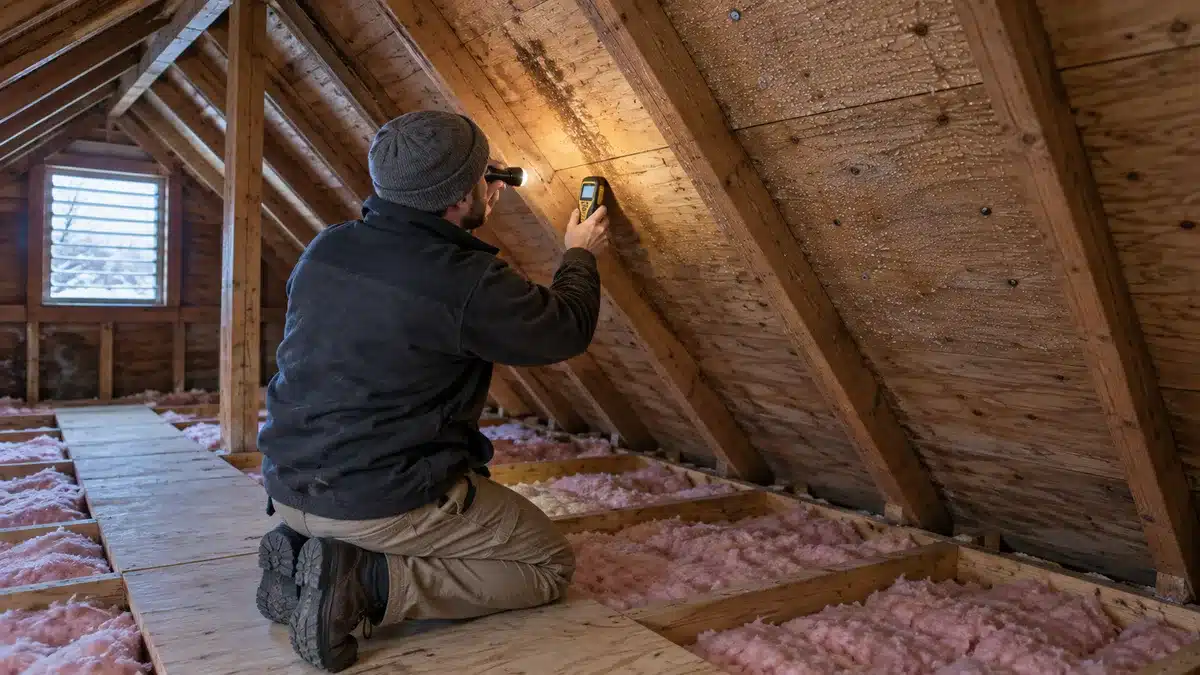
| Frost or droplets appear across a broad cold surface | Indoor moisture reaching cold sheathing or fasteners | Outdoor temperature, indoor humidity if known, and the distribution of dampness |
| Wetness is concentrated near an eave after snowmelt | An ice-dam path or meltwater reaching a vulnerable roof edge | Snow pattern, ice at the eave, stain location, and thaw timing |
| Moisture is near a bath fan duct or attic opening | Air leakage, a duct problem, or a roof penetration that still needs exterior evaluation | Which fixture was used, duct condition visible from a safe walkway, and weather |
| One isolated track follows framing | Water may have traveled from an entry point uphill or sideways from the stain | Photos showing the whole area, not only the final drip point |
These are inspection clues, not a remote diagnosis. More than one moisture source can exist at the same time, and water often moves along decking, rafters, nails, insulation, or ceiling materials before it becomes visible.
In a Berkshire County winter, the roof deck can be much colder than the occupied rooms below. Warm indoor air carries moisture. If that air leaks through ceiling gaps, attic hatches, wiring penetrations, recessed fixtures, or exhaust connections, water vapor can condense or freeze when it reaches cold sheathing and metal fasteners.
Mass Save weatherization guidance explains that uncontrolled air movement can contribute to moisture buildup and condensation. It also identifies insulated bath exhaust connections as one part of controlling moisture. That does not mean every damp attic needs more ventilation or insulation. Air sealing, insulation, exhaust routing, and ventilation work as a system, and changing one component without understanding the assembly can move the problem instead of solving it.
Condensation is more plausible when dampness or frost is spread across many cold points, appears during a cold spell without a matching precipitation event, or becomes noticeable when stored frost melts during a warm-up. The location of air leaks and mechanical exhaust matters. So do indoor humidity, outdoor temperature, and the way the attic is designed.
An exterior leak is more likely to repeat with a particular weather trigger. Rain, wind-driven rain, snowmelt, or an ice dam can expose an opening at shingles, flashing, valleys, sidewalls, roof penetrations, or the eave. The visible interior mark may be lower than the entry point because water follows the underside of the deck or nearby framing.
A useful roof inspection connects three views: the interior stain or damp material, accessible attic evidence, and exterior roof details. Treating only the spot directly above a ceiling stain can miss the actual path.
Exterior-leak clues include a sharp wet track that reappears during similar storms, localized deterioration near a penetration or transition, or dampness that begins soon after precipitation reaches one roof plane. A prior patch does not settle the question. If the same stain returns, the earlier repair may not have addressed the complete path.
The most useful homeowner record tracks both weather and building activity. For each occurrence, note:
This record is more useful than guessing from stain color. Old discoloration can remain after materials have dried, while a small new wet area may be difficult to see without a comparison photo.
If the pattern follows precipitation, the roof evaluation should examine the covering, flashing sequence, penetrations, transitions, edges, and concealed travel path. If the pattern follows cold weather and indoor moisture, the investigation should also examine ceiling-plane air leakage, exhaust routing, insulation continuity, and the attic’s intended ventilation path.
The U.S. Department of Energy guide to durable attics treats roof or flashing leaks, indoor water vapor, ventilation conditions, and ice dams as separate moisture sources that can leave overlapping evidence. The practical lesson is to define the source before selecting the repair.
A roofer may need to coordinate with an insulation, weatherization, HVAC, plumbing, or restoration professional when evidence points beyond the roof covering. That is not a failure of diagnosis. It is how the repair scope stays tied to the verified source.
Move belongings away from an active drip and keep people clear of sagging ceiling material. Do not touch a wet light fixture, fan, outlet, or wiring. If water is near electrical components, use an appropriate emergency professional. Do not cut open a bulging ceiling unless a qualified person has evaluated the hazard.
Even when the source is condensation, repeated wetting can damage insulation, finishes, and wood components. Drying the affected area and correcting the moisture path both matter.
Chris Battaini Roofing provides roof leak repair in Lee and throughout Berkshire County. Bring the timing record, photos, known repairs, and weather pattern to the evaluation. The goal is to distinguish exterior entry from indoor moisture, trace the path, and recommend the smallest scope that addresses the verified cause.
Need a reliable roofer? CMB Roofing provides licensed, insured, and professional roofing services for homeowners and businesses.
We stand by a simple promise: Clear estimates. Quality workmanship. Clean job sites.
From roof repairs and full replacements to storm damage restoration, our team delivers dependable results with durable materials, expert installation, and complete site cleanup.