-
10 Wendell Ave Extension Pittsfield, MA 01201
-
210 Columbia St., Lee, MA 01238

Roll-on roofing tar is a bitumen or asphalt-based waterproofing product applied with a roller, brush, or squeegee to flat and low-slope roofs. It creates a seamless, moisture-resistant layer — and it’s a popular choice for garages, sheds, carports, and low-slope residential roofs across Berkshire County.
Here’s a quick summary of what you need to know:
It looks straightforward. But applying it wrong — over a damp deck, in the wrong temperature, or without proper lap seams — leads to leaks, bubbles, and premature failure. That’s exactly what this guide is here to prevent.
I’m Christopher Battaini, owner of Chris Battaini Roofing and Seamless Gutters, and over more than two decades serving homeowners in Pittsfield, Lenox, Dalton, and surrounding Berkshire County communities, I’ve seen plenty of roll-on roofing tar jobs done right — and plenty done wrong. In this guide, I’ll walk you through everything a property owner or DIYer should understand before touching a bucket of roll-on roofing tar.
Roll on roofing tar word roundup:
To get the best results, we first need to look at what is actually inside that bucket. Liquid-applied roof glues and coatings are not all created equal. Depending on your building’s structure and local weather conditions in places like Williamstown MA, you will need to choose the right formulation.
Traditional cold-process asphalt adhesives are formulated to bond organic or fiberglass-reinforced roll roofing sheets. They are highly viscous, liquid-applied, and do not require heating or open flames. These adhesives act as both a bonding agent and an additional waterproofing barrier.
SBS (Styrene-Butadiene-Styrene) modified adhesives contain synthetic rubber polymers. This modification gives the cured tar superior elasticity, allowing it to expand and contract during the freezing winters and warm summers we experience in Berkshire County. If you want a longer-lasting bond that resists cracking, SBS-modified formulations are highly recommended.
While coal tar was once the industry standard for flat commercial roofs due to its excellent water-resistance, it is rarely used in modern residential applications. Coal tar has a distinct, extremely pungent odor, contains high levels of volatile organic compounds (VOCs), and requires strict safety protocols. Modern asphalt-based formulas are much safer, easier to handle, and environmentally compliant.
Fibrated adhesives, such as Gardner® Roll Roofing Adhesive, contain interlocking structural fibers (typically fiberglass or cellulose). These fibers add tensile strength, allow for a heavier brush application, and help bridge minor gaps or cracks in the substrate. Non-fibrated options are thinner and are generally reserved as primer coats or very light sealants.
Low-slope roofs present unique engineering challenges. Unlike steep-slope roofs that shed water rapidly using gravity, low-slope roofs (defined as having a pitch of less than 2:12) retain water much longer.
Because water moves slowly across these surfaces, traditional asphalt shingles are not an option. Water can easily capsize shingles by blowing upward under the laps, leading to catastrophic leaks. Instead, low-slope roofs require continuous, sealed membranes.
The table below outlines how roll roofing systems compare to other common options. For a deeper look at your choices, read our guide on Flat Roofing Materials.
| Roofing System | Pitch Limits | Average Lifespan | Key Benefits | Primary Drawbacks |
|---|---|---|---|---|
| Roll Roofing (with Tar) | < 2:12 (Down to 1:12 double coverage) | 5–10 Years | Extremely low material cost, simple cold application | Shorter lifespan, high maintenance, sensitive to UV |
| Asphalt Shingles | $ge$ 2:12 | 20–30 Years | Highly aesthetic, durable, widely available | Cannot be used on low-slope or flat surfaces |
| Single-Ply (EPDM / TPO) | Flat (0:12) to Low-Slope | 20–30+ Years | Exceptional durability, excellent ponding water resistance | Higher upfront material and professional installation costs |
While single-ply membranes offer superior longevity, there are specific scenarios where using roll-on roofing tar with mineral-surfaced roll roofing is the most practical choice:
To learn more about how flat roof designs differ, you can explore the various Types of Flat Roofs used throughout Massachusetts.
The golden rule of any low-slope roofing project is that your finished roof is only as good as the surface beneath it. If you apply adhesive over a dirty, wet, or rotting deck, the system will fail within months.
Before opening a single can of roll-on roofing tar, we perform the following preparation steps:
For residential low-slope applications, we highly recommend reviewing the manufacturer standards, such as those found in Mineral Surfaced Roll Roofing for Residential Applications, to ensure your substrate meets warranty requirements.
Applying roll-on roofing tar requires the right tools to achieve a uniform, continuous film. Depending on the size of the project, professional crews utilize different application methods:
One of the most common installation mistakes is applying too much or too little adhesive.
According to the RUST-OLEUM Technical Data, a typical cold-process adhesive has a practical coverage rate of 50 square feet per gallon to achieve a recommended wet film thickness of 32 mils. Always consult your product’s specific data sheet before beginning.
While it is possible for a dedicated property owner to tackle a small shed, we strongly advise hiring a licensed professional for residential additions or commercial buildings in North Adams MA. The physical demands and margin for error are high.
Here is the high-level process we follow to ensure a leak-free installation:
To understand the complete mechanics of laying down these rolls, refer to our detailed resource on Roll With It: Your Ultimate Guide to Asphalt Roll Roofing Installation.
Working with roofing adhesives demands strict adherence to safety protocols. Solvent-based asphalt adhesives release strong fumes that can cause dizziness or respiratory irritation.
When evaluating low-slope roofing systems, it is helpful to look at general market pricing. According to online data and general industry averages, the cost to install a professional low-slope roll roofing system typically ranges from $3,200 to $11,500 depending on the roof size, deck condition, and accessibility.
Please note: These are average costs sourced from publicly available internet data and do not reflect the actual rates of Chris Battaini Roofing. Every roof is unique, and we provide custom, detailed estimates on-site.
At standard conditions (77°F and 50% relative humidity), cold-process roll roofing adhesives dry to the touch in 24 hours. However, achieving a full chemical cure takes approximately 7 days. During colder weather or high-humidity days in Pittsfield MA, this curing window can extend significantly. We recommend waiting at least 28 days before applying any reflective aluminum roof coatings over a newly installed system.
For those looking to avoid the fumes, mess, and liquid application of traditional tar, self-adhered systems are an excellent alternative. Products like the Self-Adhered SBS Cap Sheet Roofing System | Tarco utilize a peel-and-stick backing. These systems install up to 30% to 40% faster than cold-applied systems and provide an instant, watertight seal without chemical odors.
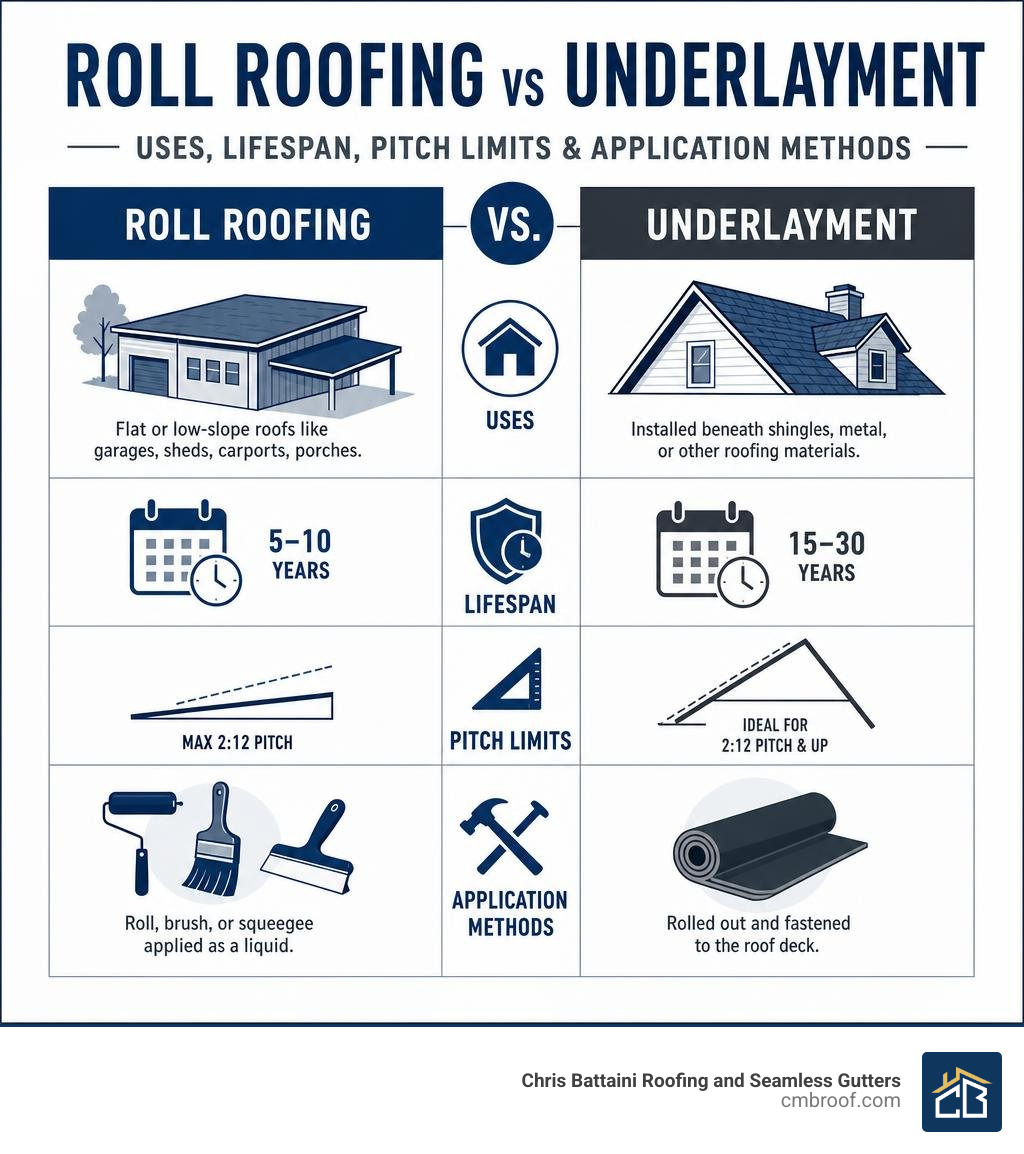
No. Roll roofing and underlayment are entirely different materials designed for different purposes. Underlayments (such as organic saturated felt or synthetic polymer sheets) are thin water-resistant barriers meant to sit beneath shingles or metal panels. Roll roofing is a heavy, granule-surfaced outer wear layer. Using roll roofing as an underlayment will create a lumpy, uneven surface and trap destructive moisture within your roof deck.
Applying roll-on roofing tar is a cost-effective way to protect low-slope structures, but it requires meticulous surface preparation, precise adhesive application, and favorable weather conditions to succeed. A single missed seam or trapped pocket of moisture can lead to rot, mold, and expensive interior damage.
At Chris Battaini Roofing and Seamless Gutters, we take the stress out of low-slope and flat roofing. Serving homeowners and commercial property owners throughout Berkshire County — including Pittsfield MA, Dalton MA, Lenox MA, and beyond — we provide owner-led, on-site supervision and exceptional workmanship warranties.
Why risk the mess and hassle of handling hot or sticky adhesives yourself? Let our professional team install a beautiful, durable, and fully warranted roof that will stand up to the toughest Massachusetts winters.
Ready for a reliable, leak-free roof? Contact us today at +413-441-4840 or fill out our online form to request your professional consultation: Contact Chris Battaini Roofing. You can also learn more about our specialized solutions by visiting our Flat Roofing Services page.
Need a reliable roofer? CMB Roofing provides licensed, insured, and professional roofing services for homeowners and businesses.
We stand by a simple promise: Clear estimates. Quality workmanship. Clean job sites.
From roof repairs and full replacements to storm damage restoration, our team delivers dependable results with durable materials, expert installation, and complete site cleanup.