-
10 Wendell Ave Extension Pittsfield, MA 01201
-
210 Columbia St., Lee, MA 01238

Commercial roof inspection services are professional evaluations that assess your roof’s condition, identify problems early, and help you avoid expensive emergency repairs. Here’s what you need to know:
What Commercial Roof Inspection Services Include:
When You Need an Inspection:
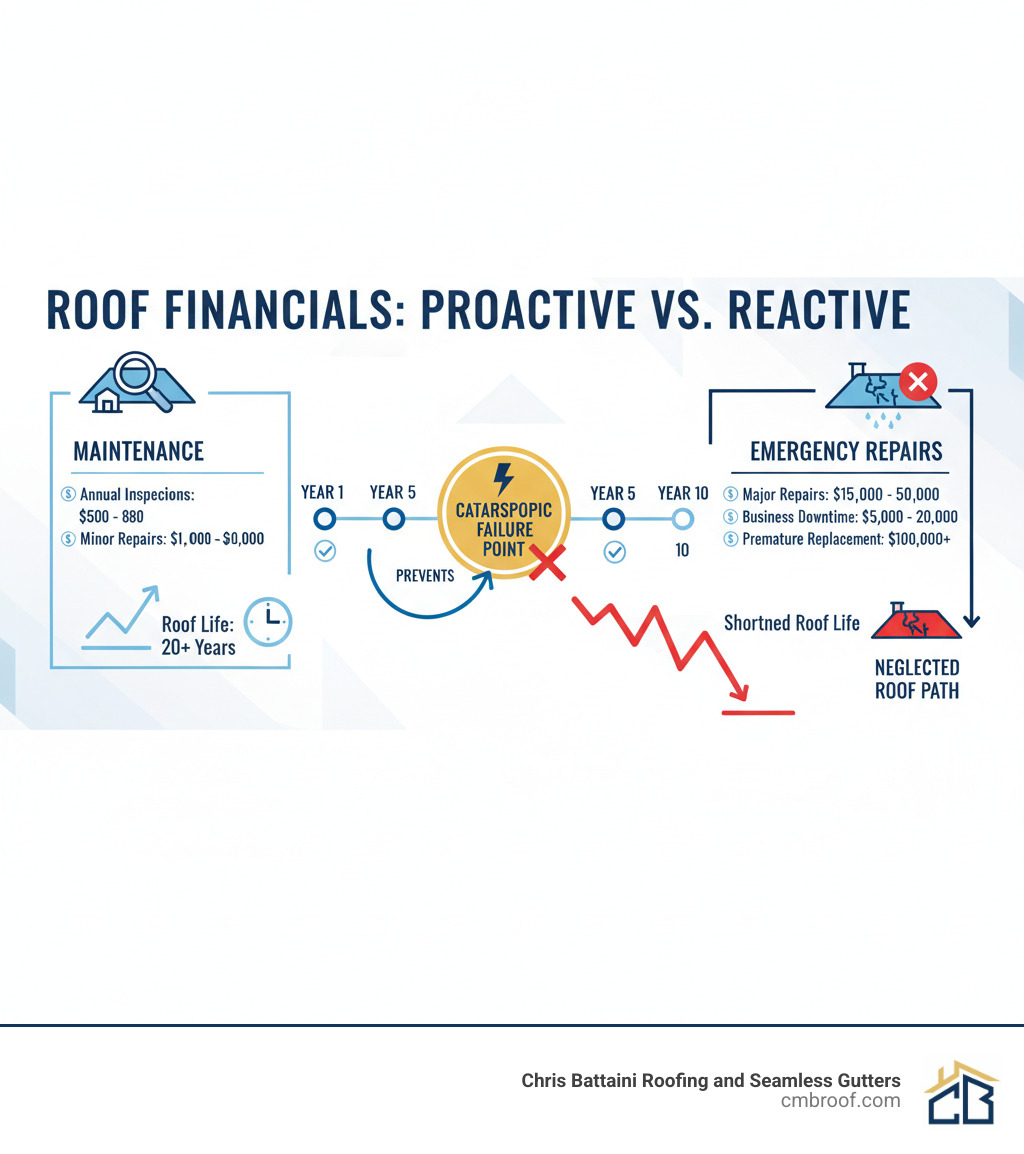
Your commercial roof protects everything beneath it—your inventory, equipment, employees, and daily operations. Without regular inspections, minor issues like small membrane cracks or clogged drains can escalate into catastrophic failures costing tens of thousands in repairs, plus business downtime and damaged inventory.
The research is clear: property owners who invest in regular inspections spend far less than those facing emergency repairs. A sudden roof failure doesn’t just mean repair costs—it means business interruption, lost records, damaged facilities, and potentially lengthy downtime while scrambling for rushed repairs.
This guide breaks down the 10 most important aspects of commercial roof inspection services. You’ll learn what to look for in an inspection company, how technology like thermal imaging detects problems invisible to the naked eye, and why independent certified inspectors provide more reliable assessments than contractors who also sell repairs.
Quick look at commercial roof inspection services:
Your commercial roof does something remarkable every single day: it protects everything that makes your business run. From the inventory on your shelves to the equipment that powers your operations, from your employees to your critical business records—your roof shields it all. That’s why commercial roof inspection services aren’t just another line item on your maintenance budget. They’re a strategic investment that pays dividends in longevity, security, and peace of mind.
Think about it this way: your roof is constantly under assault. Sun, wind, rain, snow, ice—the elements never take a day off. Over time, even the most well-built commercial roof develops wear and tear. Small problems start to emerge. A tiny crack here. A loose flashing there. A drain that doesn’t quite clear as quickly as it used to. None of these issues announce themselves with fanfare, but each one has the potential to grow into something far more serious.
That’s where regular inspections become your first line of defense. When you catch a small membrane crack early, you’re looking at a minor repair that might cost a few hundred dollars. Miss that same crack, and water starts seeping in. First it saturates the insulation. Then it reaches the roof deck. Before you know it, you’re facing structural damage, mold remediation, and a repair bill that’s jumped from hundreds to tens of thousands of dollars. We’ve seen it happen more times than we’d like to count.
The numbers tell a compelling story. Research shows that proper maintenance and periodic inspections can extend your roof’s service life by up to 50%. A commercial roof that might have lasted 15 years without attention can reach 20 to 25 years—or even longer—with a well-defined maintenance program. Most property owners spend far less on regular commercial roof inspection services than they ever would on emergency repairs and premature replacement.
But the financial benefits go beyond just repair costs. Consider what happens when a roof fails unexpectedly. Your business operations grind to a halt. Inventory gets damaged. Records are destroyed. Employees can’t work in affected areas. You’re scrambling to find emergency contractors who can respond immediately—and paying premium prices for that urgency. The cascade of costs from business interruption alone can dwarf the actual repair expenses.
The structural implications can’t be ignored either. Even a small, seemingly insignificant roof issue can compromise your building’s overall integrity if left unaddressed. Water damage doesn’t stop at the roof deck—it travels down walls, weakens structural supports, and creates conditions for mold growth that can affect indoor air quality and employee health. What started as a minor maintenance issue becomes a major liability.
There’s another crucial benefit that’s easy to overlook: insurance and code compliance. Regular inspections create a documented history of your roof’s condition and your commitment to proper maintenance. This documentation becomes invaluable when you need to file an insurance claim after a storm or other covered event. Insurance companies look favorably on property owners who can demonstrate proactive care, and that documented history helps keep claims straightforward and disputes minimal.
Local building codes also require that commercial roofs remain safe and structurally sound. Regular inspections ensure you’re meeting these standards, protecting you from potential code violations and the fines that come with them. Your inspection reports serve as proof of compliance, giving you confidence that your property meets all regulatory requirements.
For more information on comprehensive protection for your commercial property, explore our Commercial Roofing Services.
The bottom line? Neglecting your commercial roof is a gamble you can’t afford to take. The roof overhead isn’t just another building component—it’s the protective barrier that keeps your entire business operation running smoothly. Investing in regular inspections means you’re taking control of your building’s future, catching problems when they’re manageable, and avoiding the kind of catastrophic failures that can put your business at serious risk.
Your commercial roof has a way of communicating with you—sometimes quietly, sometimes urgently. Learning to recognize these signals can save you from expensive repairs and business disruptions down the road.
Let’s start inside your building, where problems often announce themselves first. Water stains on ceilings or walls are the classic red flag—your roof’s way of waving for help. You might also notice musty or mildew odors, especially after a good rain. These aren’t just unpleasant; they’re evidence that water has found its way inside and is causing damage you can’t see yet.
Here’s a less obvious clue: unexplained spikes in your energy bills. When moisture compromises your roof’s insulation, your heating and cooling systems work overtime to maintain comfortable temperatures. That inefficiency shows up in your monthly costs. Professional commercial roof inspection services are specifically designed to catch these early warning signs—leaks, heat loss, and storm damage—before they snowball into major interior repairs.
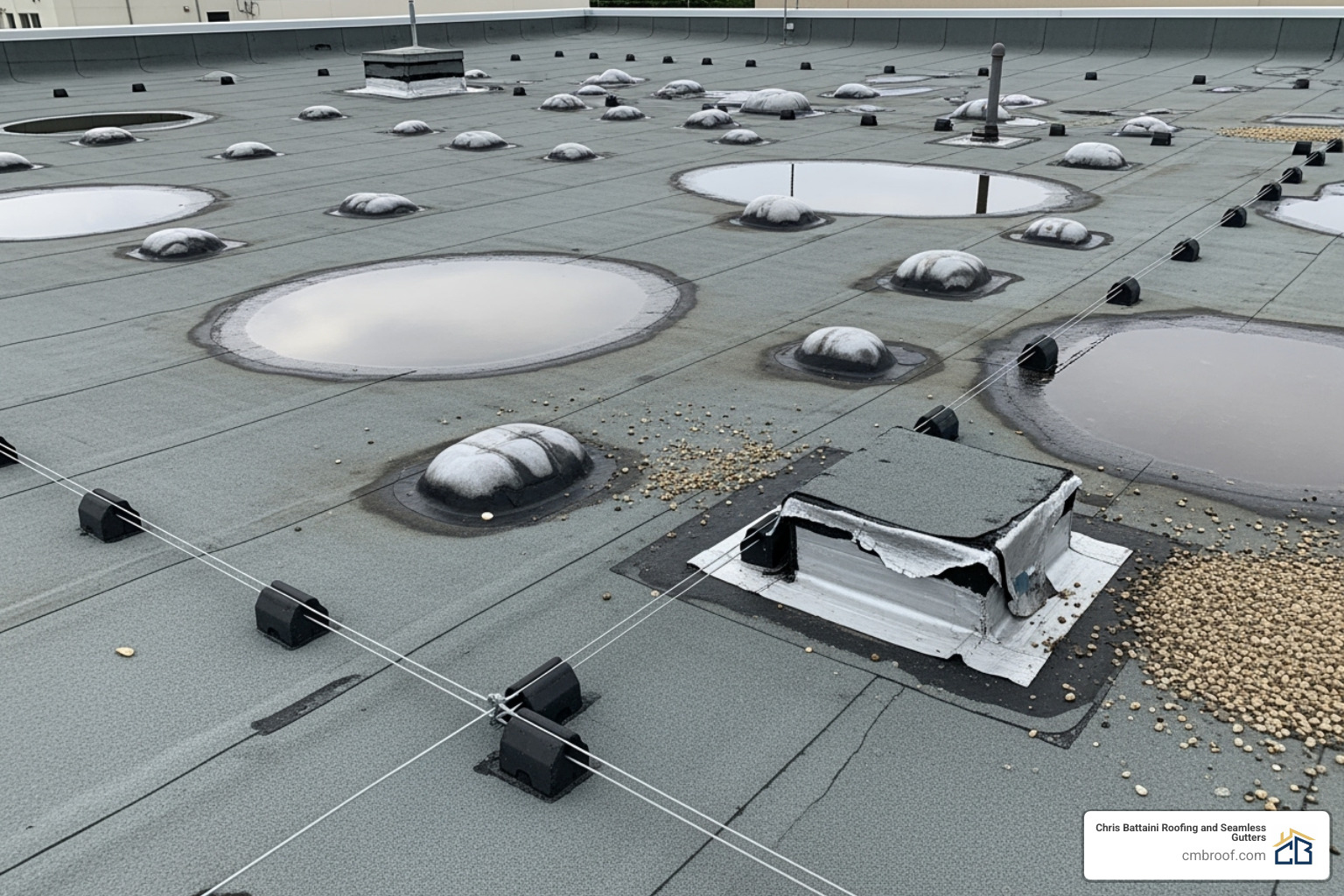
Step outside, and your roof often tells an even clearer story. Ponding water that lingers 48 hours or more after rainfall signals poor drainage and sets the stage for accelerated membrane deterioration. Look for membrane cracks, blisters, or open seams in your roofing material—these are essentially invitations for water to enter your building.
Don’t overlook the basics, either. Clogged drains or gutters filled with debris are notorious troublemakers for commercial properties, preventing proper water runoff and creating pressure points where leaks develop. Pay special attention to deteriorated flashing around penetrations like vents, pipes, HVAC units, and skylights. When flashing cracks, loosens, or goes missing entirely, your roof’s most vulnerable spots are left exposed to the elements.
If you’re seeing signs of a leak, time is of the essence. Visit our Roof Leak Repair page for immediate help.
The calendar matters, too. If your roof is approaching the end of its warranty period or hasn’t had a thorough inspection in several years, schedule one soon. We typically recommend inspections every two or three years for newer roofs, and at least annually as they age.
Finally, severe weather events should trigger an automatic inspection. Even if everything looks fine from ground level, heavy snow loads, high winds, or hail storms can cause hidden damage that only trained eyes and professional equipment can detect. A roof might appear intact while harboring problems that will reveal themselves weeks or months later—by which time the damage has spread considerably.
Regular inspections after weather events give you peace of mind and protect your investment. They’re not just about finding problems; they’re about catching them early when repairs are straightforward and affordable.
When we conduct commercial roof inspection services, we’re not just taking a quick peek from the ground and calling it a day. We’re performing a thorough, methodical examination that covers every inch of your roofing system—from the spaces inside your building to the very top of your roof and everything in between.
Think of it as a full-body checkup for your roof. We start our process with an interior examination, heading up into your attic or ceiling spaces to look for telltale signs of trouble. Water stains, mold growth, and structural issues often show themselves here first. We also check your insulation carefully—if it’s damp or damaged, you’re losing energy (and money) every single day.
Next comes the exterior examination, where we actually get up on your roof and walk every section. This hands-on approach lets us spot issues that simply aren’t visible from ground level. We’re looking at the roof surface itself, checking all the flashing and penetrations, and evaluating how well your drainage system is working.
Finally, we perform a subsurface examination using advanced technology like infrared cameras and moisture meters. This step is crucial because moisture can hide beneath your roof membrane for months, quietly causing damage that won’t become visible until it’s already cost you thousands in repairs.
During our inspection, we examine every critical component of your roofing system with careful attention to detail.
The roof membrane or surface is your first line of defense against the elements, so we scrutinize it closely. We’re looking for cracks, tears, punctures, blisters, and open seams—any weakness that could let water through. Each roofing material has its own vulnerabilities. With TPO roofs, we focus on seam integrity and any signs of punctures or weathering. For EPDM systems, we check for tears and problems with adhesive bonds. PVC roofs get examined for weld strength and chemical degradation. Modified Bitumen roofs are inspected for cracks, splits, and granule loss, while metal roofs are checked for corrosion, loose panels, and fastener damage. For more details on these materials, see our Commercial Flat Roofing guide.
Flashing and penetrations are where most roof failures actually happen. Anywhere your roof membrane meets another surface—around vents, pipes, HVAC units, skylights, or along parapet walls—is a potential weak point. We carefully inspect every seal and piece of flashing for cracks, deterioration, or displacement. These areas need special attention because even a small gap can channel water right into your building.
Your drainage system might not seem glamorous, but it’s absolutely critical. We inspect your gutters and scuppers for blockages and proper pitch, check that downspouts are clear and directing water away from your foundation, and verify that internal drains are functioning properly and securely connected. When drainage fails, water ponds on your roof, and that standing water accelerates wear and tear dramatically.
We also assess the structural components that support your entire roofing system. This includes examining your roof deck for deflection, rot, or water damage, checking that wall attachments are secure, and inspecting parapet walls for cracks or structural distress. A roof membrane is only as good as the structure beneath it.
Our comprehensive point-by-point approach ensures we catch both obvious problems and subtle signs of potential issues. This thoroughness is what separates professional commercial roof inspection services from a simple visual check—and it’s what saves you from costly surprises down the road.
A skilled inspector’s trained eye is irreplaceable, but we’d be selling you short if we relied on vision alone. Modern commercial roof inspection services now employ sophisticated technology that reveals problems invisible to the naked eye—and keeps our team safer in the process.
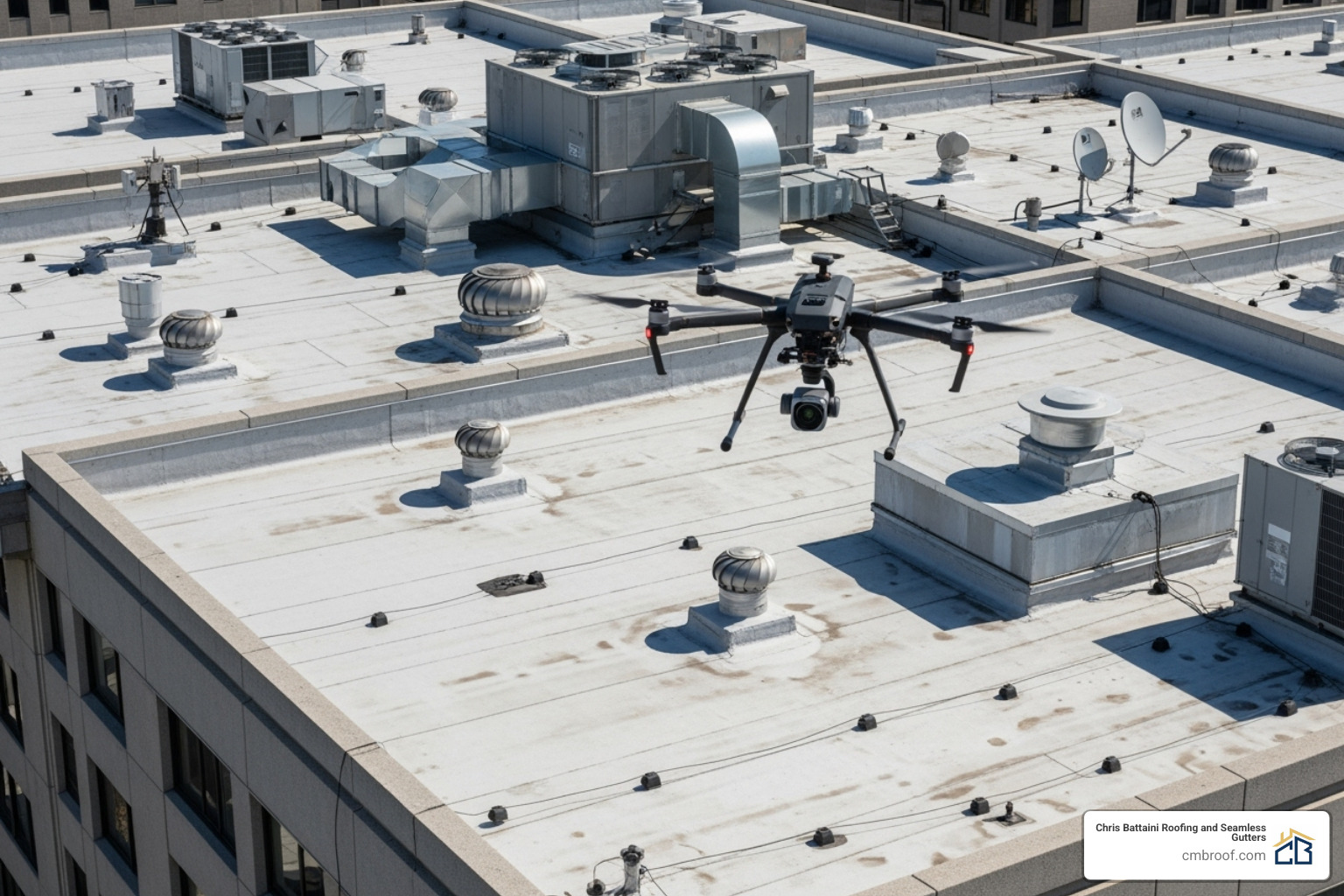
Think about inspecting a 50,000 square foot industrial roof. Walking every inch would take hours and put our team at risk navigating around HVAC units, skylights, and potentially weak areas. That’s where drones become game-changers.
Drones dramatically improve safety by eliminating the need for inspectors to access dangerous or hard-to-reach areas. Steep pitches, fragile sections, and areas around roof edges no longer pose a risk to our team. For property managers, this also means reduced liability concerns during the inspection process.
The efficiency gains are remarkable, especially for large or complex roofs. What might take a crew half a day to walk and document, a drone can survey in under an hour. Less time on your roof means less disruption to your daily operations—and you still get a more thorough inspection.
But here’s what really matters: the high-resolution imagery these drones capture is extraordinary. We’re talking about cameras that can zoom in on a small crack or blister from 60 feet in the air and capture it in crystal-clear detail. This imagery allows us to spot subtle patterns of wear, identify drainage issues from a bird’s-eye view, and create a comprehensive visual record of your roof’s condition. These detailed photos and videos become part of your inspection report, giving you a clear picture of exactly what we found and where.
This technology is nothing short of remarkable. Infrared cameras detect temperature differences across your roof surface—and those temperature variations tell a story about what’s happening beneath the membrane.
Here’s how it works: wet insulation holds heat differently than dry insulation. When we conduct thermal imaging in the early morning or evening (when temperature contrasts are most pronounced), areas with trapped moisture show up as distinct thermal signatures. It’s like having X-ray vision for your roof.
The beauty of infrared technology is that it’s completely non-destructive. We don’t need to cut into your roof to find moisture problems. Instead, we can pinpoint exactly where water has infiltrated, creating a precise map of problem areas. When your roofing contractor knows exactly where the moisture is, they can target repairs surgically rather than replacing large sections unnecessarily—saving you significant money.
Beyond leak detection, thermal imaging also reveals energy loss. Areas where your building is losing heat in winter (or gaining it in summer) show up clearly in thermal scans. These aren’t always related to leaks—sometimes they indicate compressed or damaged insulation, gaps in the building envelope, or air leaks that are quietly driving up your utility bills month after month.
After thermal imaging identifies suspicious areas, we confirm our findings with moisture meters that provide precise, quantitative data. These handheld devices measure the actual moisture content in roofing materials, giving us hard numbers rather than just visual indicators.
This verification step is crucial for your inspection report. It transforms a thermal “cold spot” into documented evidence: “This section has 28% moisture content, well above the acceptable threshold.” That kind of specific data is invaluable when planning repairs, filing insurance claims, or making the case for necessary maintenance to building owners or boards.
By combining the comprehensive coverage of drones with the subsurface insights of infrared imaging and the precision confirmation of moisture meters, our commercial roof inspection services deliver an unprecedented level of accuracy and detail. No hidden problem goes undetected, and you get a complete picture of your roof’s true condition—not just what’s visible on the surface.
Not every roof inspection is the same, and understanding which type you need can save you time, money, and headaches. Think of it like going to the doctor: sometimes you need a routine check-up, other times you need a specialist for a specific concern. The same principle applies to commercial roof inspection services.
Routine or preventative maintenance inspections are your roof’s regular wellness visits. We typically recommend these at least twice a year—ideally in spring and fall—to catch small problems before they become expensive emergencies. During these inspections, we conduct a thorough visual and technological assessment of your entire roof system, examining the membrane, flashing, drainage, and basic structural components. The goal is simple: identify minor issues like small cracks, blocked drains, or deteriorating flashing while they’re still easy and affordable to fix. You’ll receive a detailed report outlining current conditions, any minor repair recommendations, and either peace of mind or a proactive maintenance plan.
When you’re considering purchasing or leasing a commercial property, a pre-purchase inspection becomes absolutely essential due diligence. This isn’t the time to cut corners. We provide a highly detailed assessment that often includes subsurface moisture surveys using thermal imaging, structural evaluations, and a review of any available past maintenance records. Our inspectors work to detect any defects that are likely to cause problems or need repair in the future. The comprehensive report we provide outlines the roof’s condition, identifies existing defects, estimates repair or replacement costs, and assesses whether the roof is suitable for your intended use. This information becomes invaluable for negotiation and long-term budgeting.
After severe weather strikes—whether it’s a hailstorm, high winds, or heavy snow—an insurance claim inspection documents the damage accurately and thoroughly. This focused inspection identifies and documents damage directly attributable to the specific weather event, carefully distinguishing it from pre-existing wear and tear. We provide photographic evidence and detailed measurements that support your claim submission to your insurance company. Having regular inspections on record beforehand makes these claims much more straightforward and helps ensure you receive fair compensation.
Finally, warranty inspections verify that your roof has been installed and maintained according to the manufacturer’s specifications and warranty requirements. This is critical for ensuring that any future defects remain covered under warranty. We review installation specifications, assess material condition, and look for evidence of proper maintenance. The outcome is either confirmation that your warranty remains valid or identification of specific areas needing attention to maintain that coverage.
Here’s how these inspection types compare:
| Inspection Type | Primary Purpose | Typical Scope | Outcome |
|---|---|---|---|
| Routine/Preventative | Catch issues early through proactive maintenance | Complete visual and tech assessment of entire roof system | Report with current conditions, minor repairs, and maintenance plan |
| Pre-Purchase | Due diligence before buying or leasing property | Highly detailed with moisture surveys, structural evaluation, records review | Comprehensive condition report with repair costs and remaining service life |
| Insurance Claim | Document storm or peril damage for claims | Focused on damage from specific insured event with photos and measurements | Detailed damage report to support insurance claim submission |
Each type of inspection serves a distinct purpose, and choosing the right one for your situation ensures you get the information you need to make smart decisions about your commercial roof.
Think about what’s sitting on top of your business right now. That commercial roof overhead isn’t just shingles and membrane—it’s the shield protecting your entire investment. Everything you’ve worked to build sits beneath it: your inventory, your equipment, your employees, and the daily operations that keep your business running.
Commercial roof inspection services are professional evaluations where trained experts assess your roof’s condition from top to bottom. They identify small problems before they become big ones, and honestly, they’re one of the smartest investments you can make for your property.
Here’s what a thorough inspection includes: a visual assessment of your membrane, flashing, drainage system, and structural components. Modern inspections also use technology-based diagnostics—think drones and infrared cameras that can spot moisture hiding beneath the surface where your eyes can’t see it. You’ll receive detailed photo-documented reports showing exactly what’s going on up there, complete with repair priorities and cost estimates. The inspector will verify compliance with building codes and insurance requirements, and help you develop a preventative maintenance plan that can extend your roof’s lifespan by up to 50%.
When should you schedule an inspection? At least twice per year—ideally in spring and fall when you can catch seasonal damage early. Always get one after severe weather events like heavy snow, hail, or high winds. If you notice interior water stains or your energy bills suddenly spike for no clear reason, that’s your roof asking for attention. Definitely schedule an inspection before purchasing or selling commercial property—it’s essential due diligence. And if you’re filing an insurance claim, a professional inspection provides the documentation you need.
Let’s be real about what happens when you skip regular inspections. That small crack in the membrane? It lets water seep in. The water damages insulation. The damaged insulation can’t do its job, so your heating and cooling costs climb. Meanwhile, moisture spreads to the roof deck. Before you know it, you’re looking at structural damage, ruined inventory, mold remediation, and a repair bill that makes your stomach drop.
The research is clear: property owners who invest in regular commercial roof inspection services spend far less over time than those who wait for emergency repairs. A sudden roof failure isn’t just about fixing the roof—it’s business interruption, lost records, damaged facilities, and potentially weeks of downtime while you scramble to find a contractor who can fit you in on short notice. For more comprehensive protection, explore our Commercial Roofing Services.
This guide walks you through the 10 most important aspects of commercial roof inspection services. You’ll learn what separates a quality inspection company from the rest, how technology like thermal imaging can spot problems invisible to the naked eye, and why independent certified inspectors often provide more reliable assessments than contractors who also sell repairs. We’ll also cover specific challenges for roofs in our New England climate—because a roof in Berkshire County faces very different stresses than one in, say, Arizona.
By the end, you’ll know exactly what to look for, what questions to ask, and how to turn inspection findings into a smart action plan that protects your investment for years to come. If you need immediate help with a leak, visit our Roof Leak Repair page, or check out our solutions for commercial roof repair, Commercial Roof Replacement, and commercial roof storm damage.
Think of your commercial roof as the unsung hero of your business. Day after day, it stands guard over everything that matters—your inventory, your equipment, your employees, and your daily operations. That’s why commercial roof inspection services aren’t just another line item on your maintenance budget. They’re a strategic investment in protecting what you’ve built.
Your roof shields your entire operation from the elements, but like any hardworking asset, it takes a beating over time. Weather, temperature swings, UV exposure, and simple aging all take their toll. Without regular check-ups, small issues that could be fixed quickly and affordably turn into expensive nightmares. We’ve seen it happen too many times—a tiny crack in the membrane becomes a major leak, water seeps into the insulation, and before you know it, you’re looking at replacing an entire roof section instead of patching a small problem.
The numbers tell a compelling story. Proper repairs and periodic maintenance can extend your roof’s service life by up to 50%. That means a roof designed to last 20 years might give you 30 years of reliable service—simply because you caught problems early. Most property owners spend far less on regular inspections than they ever would on emergency repairs. It’s the classic “ounce of prevention” wisdom, and it absolutely holds true for commercial roofing.
Here’s what happens when inspections fall by the wayside: A sudden roof failure doesn’t just mean calling a contractor. It means business interruption, damaged inventory, lost records, water-stained equipment, and potential mold remediation. Your staff might need to relocate while repairs happen. Customers might not be able to access your facility. The cascade of consequences extends far beyond the roof itself, affecting your bottom line in ways you might not anticipate until you’re in the middle of it.
Beyond protecting your wallet, regular commercial roof inspection services keep you on the right side of building codes and insurance requirements. Inspections document your roof’s condition over time, which makes filing claims straightforward if disaster does strike. They also verify that your roof meets local building standards—something that matters both for regulatory compliance and for keeping your insurance policy valid. The last thing you need during an emergency is to find that neglected maintenance has voided your coverage.
The core purpose of these inspections is simple: catch small problems before they become big ones. A professional inspector spots the warning signs that most property managers would never notice—subtle membrane deterioration, early flashing failures, or drainage issues that haven’t caused obvious problems yet. These early interventions are what separate roofs that reach their full lifespan from those that fail prematurely, leaving owners scrambling for emergency solutions at the worst possible time.
For more information on how we can help protect your business, explore our Commercial Roofing Services.
Your commercial roof has a way of communicating with you—sometimes it’s a gentle tap on the shoulder, other times it’s more like an urgent shout. Learning to recognize these signals can save you from expensive surprises and business disruptions down the road.
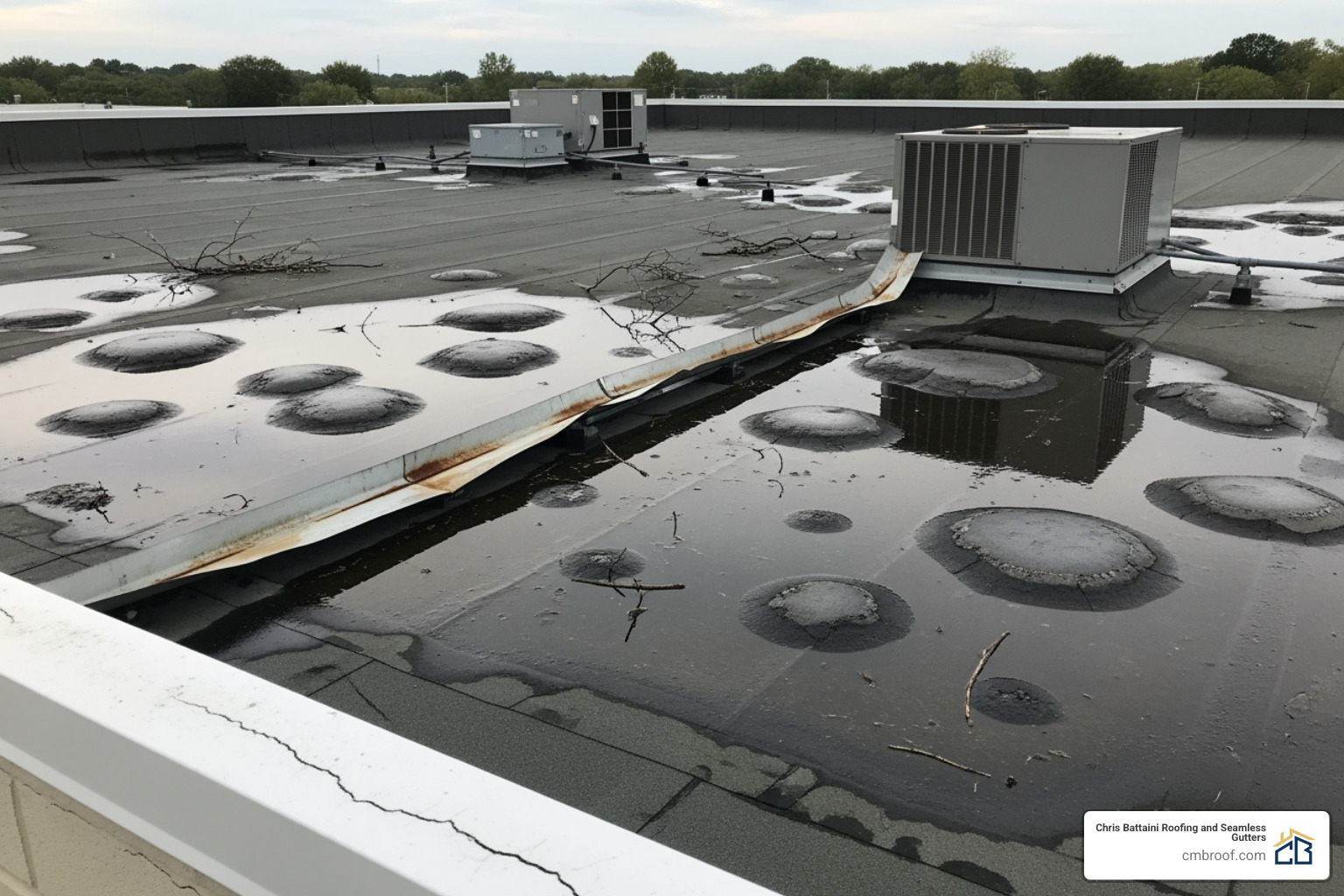
Start by listening to what your building’s interior is telling you. Water stains creeping across ceilings or walls are obvious red flags, but don’t ignore the subtler hints. That persistent musty smell after a rainstorm? It’s not just unpleasant—it’s your building warning you about moisture infiltration and potential mold growth. And if your energy bills have suddenly jumped without explanation, your roof might be the culprit. Compromised insulation from water damage lets heat escape in winter and flood in during summer, forcing your HVAC system to work overtime.
We’ve seen property managers overlook these early warning signs, only to face costly interior repairs later. Discoloration around skylights is particularly telling—it’s rarely “just cosmetic” and usually signals active leaks that need immediate attention. Professional commercial roof inspection services are trained to spot these issues before they cascade into major problems.
The view from outside often tells an even clearer story. Take a walk around your building after the next rainfall. If you notice ponding water still sitting on your roof 48 hours later, that’s trouble. Your drainage system isn’t doing its job, and standing water accelerates membrane deterioration like nothing else. It’s one of the fastest ways to shorten your roof’s lifespan.
Look closely at your roof membrane for cracks, blisters, or open seams—these are literal doorways for water to enter your building. Clogged drains and gutters might seem like minor nuisances, but they’re disaster triggers for commercial properties. When water can’t drain properly, it finds other ways down—usually through your roof and into your building. Check the flashing around vents, pipes, HVAC units, and parapet walls too. If it’s cracked, loose, or missing entirely, your roof’s most vulnerable points are completely exposed to the elements.
If you spot any of these warning signs, don’t wait for them to worsen. Visit our Roof Leak Repair page for immediate assistance, or learn more about our comprehensive Roof Maintenance Franklin County services.
Your roof’s age matters more than you might think. Even if everything looks fine, a roof approaching the end of its warranty period deserves a thorough professional inspection. We generally recommend scheduling inspections every two to three years after a new roof installation, then ramping up to at least once a year as your roof ages. Think of it like taking your car in for regular maintenance—catching small issues early prevents big breakdowns later.
Severe weather events should always trigger an inspection call, even when everything appears normal from ground level. Heavy snow loads stress your roof’s structure and drainage system in ways that aren’t always immediately visible. High winds can lift membrane edges and damage flashing, while hail creates punctures that might not leak right away but will eventually. The damage from these events often hides beneath the surface, silently compromising your roof’s integrity until a professional inspection brings it to light.
In our New England climate, with its freeze-thaw cycles and harsh winters, these inspections aren’t optional luxuries—they’re essential protection for your investment. Follow us on Facebook to stay updated on seasonal maintenance tips and weather alerts that might affect your commercial roof.
When we conduct commercial roof inspection services, we don’t just glance at your roof from the ground and call it a day. Our process is a comprehensive, multi-faceted examination designed to uncover every potential issue—both the ones staring you in the face and the sneaky problems hiding beneath the surface. Think of it as a full physical for your roof, where we perform a point-by-point check of every critical component of your roofing system.
Our inspection process typically begins with an interior examination. That’s right—we start inside your building, looking for telltale signs of water intrusion like stains on ceilings, mold growth, or structural issues in the attic space. We also assess your insulation for moisture damage, which can lead to significant energy loss and those unexpectedly high utility bills you might have been scratching your head over.
Next comes the exterior examination, where the real detective work happens. We physically access the roof (when safe and feasible) to get up close and personal with every square foot. This isn’t a quick walk-around; it’s a thorough inspection of the roof surface, flashing, penetrations, and drainage system. We’re looking at the big picture and the tiny details—because sometimes it’s that small crack or barely noticeable blister that signals a bigger problem brewing.
The third phase is the subsurface examination, and this is where modern technology becomes our best friend. Using advanced tools like infrared cameras and moisture meters, we can detect moisture trapped beneath the roof membrane—problems that are completely invisible to the naked eye. It’s like having X-ray vision for your roof.
Now, let’s talk about what we’re actually scrutinizing during these inspections. We leave no stone unturned, or rather, no membrane unexamined.
Your roof membrane or surface is the primary shield protecting everything beneath it. We carefully inspect its integrity, looking for cracks, tears, punctures, blisters, and open seams. Different commercial roofing materials have different vulnerabilities. For TPO (Thermoplastic Polyolefin) roofs, we’re checking seam integrity, punctures, and weathering. With EPDM (Ethylene Propylene Diene Monomer), we look for tears, punctures, and issues with adhesive bonds or seam laps. PVC (Polyvinyl Chloride) roofs get scrutinized for weld strength and any signs of chemical degradation. Modified Bitumen systems are inspected for cracks, splits, bubbling, and granule loss. And for metal roofs, we check for corrosion, loose panels, damaged fasteners, and seam integrity. Each material tells its own story of wear and weathering. For more details on these materials and how they protect your building, see our Commercial Flat Roofing guide.
Flashing and penetrations are where most roof leaks actually start. These are the areas where your roof membrane meets another surface—and they’re the most common points of failure. We inspect the seals and flashing around all vents, pipes, and HVAC units for cracks, deterioration, or dislodgement. Skylights get special attention; we examine their flashing, seals, and frames for any signs of leaks or damage. We also assess the coping and flashing along parapet walls at the edges of your roof. Think of these areas as the vulnerable joints in your roof’s armor—they need to be in perfect condition to keep water out.
Your drainage system might not seem glamorous, but it’s absolutely paramount for preventing ponding water and the accelerated deterioration that comes with it. We inspect gutters and scuppers for blockages, damage, or improper pitch that could prevent water from flowing where it should. We check downspouts to ensure they’re clear and directing water away from your building’s foundation. And we examine internal drains for debris, proper function, and secure connections. A clogged drain today can mean a flooded roof tomorrow.
Finally, we assess the structural components to ensure your roof’s foundation is solid. We look at your roof deck condition, searching for signs of deflection, rot, or damage from water intrusion. We verify that wall attachments are secure, ensuring the roof system is properly fastened to your building’s structure. And we check parapet walls for cracks, spalling, or other signs of structural distress that could compromise your roof’s integrity.
Our comprehensive approach ensures that we identify not just the obvious issues, but also the subtle signs of weakness or potential problems that could lead to costly repairs down the line. We’re not just inspecting your roof—we’re protecting your investment and giving you peace of mind.
While a keen eye and extensive experience are invaluable, modern commercial roof inspection services leverage cutting-edge technology to improve accuracy, efficiency, and safety. These tools allow us to see what the human eye cannot, ensuring a truly comprehensive assessment.
Drones have revolutionized how we inspect large and complex commercial roofs. Their benefits are manifold:
Infrared cameras are perhaps the most powerful tool for detecting hidden problems. These cameras measure surface temperature variations, which often indicate moisture trapped beneath the roof membrane:
When infrared images are provided, your roofing contractor gains a precise map of problem areas, enabling them to target repairs more effectively and avoid unnecessary tear-offs.
To confirm and quantify the findings from thermal imaging, we use moisture meters. These handheld devices provide precise readings of moisture content within the roofing system or underlying components. They:
By combining the bird’s-eye view of drones with the subsurface insights of infrared cameras and the precision of moisture meters, our commercial roof inspection services provide an unparalleled level of detail and accuracy, ensuring no hidden problem goes unnoticed.
Just as you wouldn’t visit your doctor for the same type of appointment every time—sometimes it’s a routine check-up, other times you need specialized testing—commercial roof inspection services come in different varieties to meet your specific needs.
Think of this as your roof’s wellness visit. We typically recommend scheduling these inspections at least twice a year, ideally in spring and fall when seasonal changes put the most stress on your roofing system.
The goal here is simple: catch the small stuff before it becomes big stuff. During a routine inspection, we’re looking for minor issues like hairline cracks in the membrane, leaves clogging your drains, or flashing that’s starting to pull away from penetrations. These are the kinds of problems that cost a few hundred dollars to fix now, but could cost tens of thousands if left unchecked.
Our inspectors conduct a thorough visual assessment of your entire roof system—the membrane, flashing, drainage components, and basic structural elements. We often use thermal imaging and moisture detection technology to spot problems you can’t see with the naked eye. You’ll receive a detailed report outlining current conditions, any minor repairs we recommend, and either peace of mind that everything looks good or a clear maintenance plan to keep small issues from growing.
If you’re considering buying or leasing a commercial property, skipping a roof inspection is like buying a used car without looking under the hood. It’s a risk you simply shouldn’t take.
A pre-purchase inspection goes much deeper than a routine check-up. We’re not just looking at what’s visible—we’re conducting subsurface moisture surveys with infrared technology, evaluating structural components, and reviewing any available maintenance records. The purpose is to give you a complete picture of the roof’s current condition, how much life it has left, and what repairs or replacements you’ll need to budget for in the coming years.
This information becomes invaluable during negotiations. If we find the roof needs $30,000 in repairs within the next two years, that’s leverage at the bargaining table. Or it might be the information that helps you walk away from a bad deal. Either way, you’re making an informed decision rather than gambling with one of your property’s most expensive components.
When a storm rolls through with damaging winds or hail, you need documentation that stands up to insurance company scrutiny. That’s where an insurance claim inspection comes in.
These inspections are laser-focused on identifying and documenting damage caused by the specific weather event or peril covered by your policy. We distinguish between storm damage and pre-existing wear and tear—a crucial distinction that insurance adjusters care deeply about. Our inspectors photograph every area of concern, take detailed measurements, and create a comprehensive report that quantifies the damage.
Here’s where having a history of regular inspections really pays off. If you’ve been documenting your roof’s condition all along, there’s no question about what damage is new versus what was already there. It makes the claims process much smoother and helps ensure you receive fair compensation.
Your roof’s warranty is only valuable if you maintain it according to the manufacturer’s requirements. A warranty inspection verifies that your roof was installed correctly and has been properly maintained, ensuring that if problems do arise, you’re covered.
We review installation specifications, assess material condition, and look for evidence of proper ongoing maintenance. If we find any issues that could void your warranty—like improper repairs or neglected maintenance—we’ll alert you so you can address them before it becomes a problem. The outcome is either confirmation that your warranty is in good standing, or a clear list of what needs attention to maintain that coverage.
Here’s a quick comparison to help you understand which inspection you might need:
| Inspection Type | Primary Purpose | Key Outcome |
|---|---|---|
| Routine/Preventative | Catch minor issues before they become expensive problems | Maintenance plan or clean bill of health |
| Pre-Purchase | Understand roof condition and costs before buying/leasing | Detailed condition report with cost projections for negotiations |
| Insurance Claim | Document storm or peril damage for insurance purposes | Evidence-based report supporting your claim |
| Warranty | Verify compliance with manufacturer requirements | Confirmation of coverage or action items to maintain warranty |
Understanding these different types of commercial roof inspection services helps you schedule the right inspection at the right time, protecting both your investment and your peace of mind.
Need a reliable roofer? CMB Roofing provides licensed, insured, and professional roofing services for homeowners and businesses.
We stand by a simple promise: Clear estimates. Quality workmanship. Clean job sites.
From roof repairs and full replacements to storm damage restoration, our team delivers dependable results with durable materials, expert installation, and complete site cleanup.