-
10 Wendell Ave Extension Pittsfield, MA 01201
-
210 Columbia St., Lee, MA 01238

Commercial roof storm damage can threaten the integrity of your building and disrupt business operations if not identified and addressed promptly.
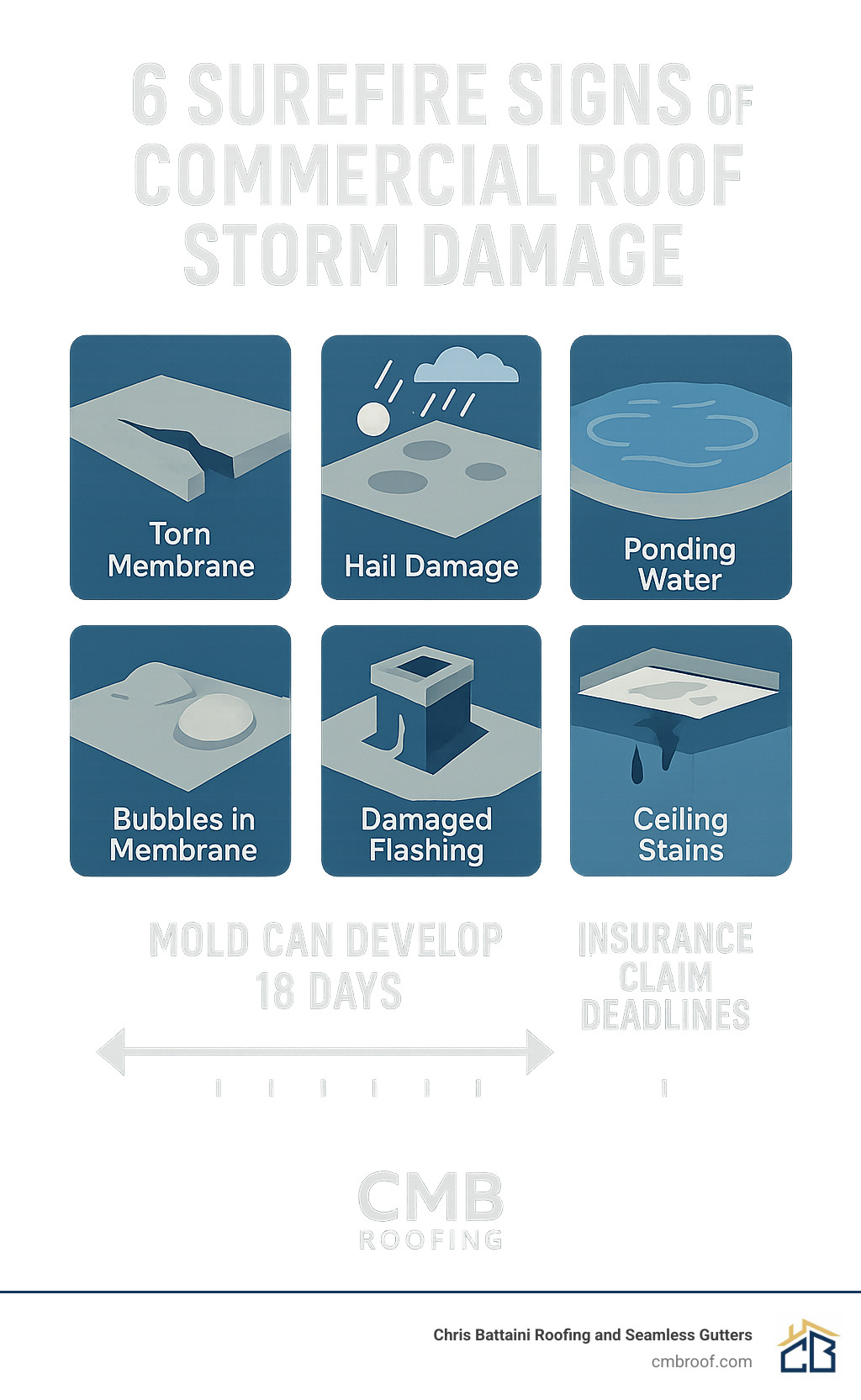
Here are the 6 key signs of commercial roof storm damage to look for:
Commercial roofs face unique challenges during severe weather events. Even moderate winds of 50-75 mph can damage low-slope commercial roofing systems, despite being well below hurricane force. Most manufacturers’ warranties don’t cover winds exceeding 54 mph, leaving building owners vulnerable if they don’t take quick action.
What makes commercial roof storm damage particularly concerning is how easily it can go undetected. A small puncture from hail or debris might not cause an immediate leak, but it can compromise your roof’s integrity and lead to more serious problems down the road.
“It only takes one instance with the right conditions for winds to wreak havoc on commercial low-sloped roofs,” notes one industry expert. Unlike residential pitched roofs where damage is often visible from the ground, commercial flat roofs require careful inspection to spot problems before they escalate.
Ponding water—defined as standing water that remains on your roof for more than 48 hours after precipitation—is another major concern. Each storm makes the problem worse as water weight compresses insulation and expands the affected area.
Remember: most insurance companies limit the time to file a claim for storm damage, making immediate inspection and documentation essential for protecting your investment.
Commercial roof storm damage terms explained:
– commercial roof installation
– commercial roof repair solutions

Spotting commercial roof storm damage isn’t always as straightforward as you might think. There’s a critical difference between visible damage you can spot from the ground and hidden problems that lurk beneath the surface. This distinction matters because it’s often those concealed issues that lead to the most expensive repairs when left unchecked.
Unlike residential roofs, commercial roofing systems rarely “blow off” dramatically during storms. Instead, they typically fail gradually when exposed to winds that exceed their design specifications. Damage usually begins at the vulnerable edges and methodically works its way inward, creating a domino effect that can eventually compromise your entire roofing system.
Let’s walk through the six most reliable warning signs that your commercial roof has taken a beating from Mother Nature:
| Visible Damage Signs | Hidden Damage Indicators |
|---|---|
| Torn membrane edges | Moisture under membrane |
| Obvious punctures | Compressed insulation |
| Standing water | Weakened adhesion |
| Dislodged equipment | Microfractures in membrane |
| Granules in gutters | Mold beginning to form |
| Water stains on ceiling | Slight sagging of deck |
The perimeter of your commercial roof is its first line of defense – and often the first place to show signs of commercial roof storm damage after high winds. The physics here are fascinating: during windstorms, negative pressure develops around the roof edges, creating a powerful lifting effect that can compromise your entire roofing system.
Here’s something many building owners don’t realize: that FM I-90 rating manufacturers love to tout? It’s measuring uplift pressure (90 pounds), not wind speed. This common misunderstanding often leads to false confidence about how much wind your roof can actually withstand.
“When we say a roof has ‘blown off,’ that’s not technically what happens in most cases,” our technicians often explain. “What actually occurs is that the membrane begins to fail at the edges where that negative pressure hits hardest.”
Watch for peeled-back membrane sections, loose or missing edge metal, visible gaps in perimeter flashing, wrinkles near roof edges, or displaced ballast on ballasted systems. In our experience, proper edge installation is one of the most effective ways to minimize wind damage. When we inspect commercial roofs after storms, we frequently find that damage could have been prevented with better edge fastening and adhesive placement.
Hail damage shows up differently depending on your roofing material. On metal roofs, you’ll see obvious denting, while single-ply membranes like TPO or EPDM might display subtle circular scuff marks rather than dramatic punctures.
For roofs with granulated surfaces like modified bitumen or built-up roofing systems, hail often knocks off the protective granules that shield your roof from harsh UV rays. After a hailstorm, take a peek at your roof drains and gutters – finding piles of granules there is a dead giveaway of hail damage, even when the roof surface looks fine from a distance.
“A roof can look perfectly intact while hiding significant hail damage that will shorten its lifespan by years,” we often tell our clients.
What makes hail particularly sneaky is that it can bounce off rooftop equipment and hit your roof surface multiple times. Even small hail (under 1 inch) can cause significant long-term damage through cumulative impact. For the latest scientific research on severe thunderstorms and their impact, the National Severe Storms Laboratory offers valuable insights.
When water remains on your commercial roof for more than 48 hours after rainfall, that’s ponding – and it’s a serious red flag for commercial roof storm damage. This standing water adds substantial weight to your roof structure and accelerates membrane deterioration.
“Each storm makes ponding worse,” we explain to our clients. “The water weight compresses the insulation below, creating a deeper depression that collects even more water in the next storm. It’s a vicious cycle.”
Look for water that sticks around long after rain stops, concentric “bathtub rings” showing water level changes, algae growth, sagging of the roof deck, or deteriorated membrane in ponding areas. In extreme cases, you might even spot small plants or grass beginning to grow in persistently wet areas – a situation that further clogs drainage paths and speeds up deterioration.
After storms, we always make a point to check for new or expanded ponding areas, as they can indicate structural issues that need immediate attention.
Those raised bubbles or blisters in your roofing membrane occur when moisture or air becomes trapped between layers of your roofing system. While these can develop gradually due to installation issues, they often appear suddenly or worsen after storms due to water infiltration or pressure changes.
“What makes these tricky,” our technicians often point out, “is that moisture can travel many feet from its entry point before creating visible bubbles. The leak might be happening in one spot, but showing up somewhere completely different.”
Be on the lookout for raised areas in the membrane that feel soft underfoot, bubbles that shift slightly when pressed, spongy sections of insulation beneath the membrane, membrane separation at seams, or areas where the membrane appears stretched.
Today’s advanced inspection techniques, including infrared moisture surveys, can detect these hidden moisture pockets before they cause visible damage. These non-invasive technologies allow us to identify and address problems before they escalate into major leaks.
The most vulnerable points on any commercial roof are the transitions and penetrations. Flashings around HVAC units, skylights, vents, and roof edges take the brunt of storm impact and are particularly susceptible to damage.
During high winds, rooftop equipment can shift ever so slightly, breaking weather seals and creating entry points for water. Even small movements – sometimes just millimeters – can compromise the integrity of flashing and allow moisture to penetrate your building envelope.
“Those loose fasteners on rooftop equipment might seem minor,” we often tell building managers, “but they actually indicate significant wind forces were at work during the storm.”
Watch for loose or missing coping metal, gaps in flashing around penetrations, displaced HVAC curbs, bent exhaust fans, loose fasteners, or damaged skylight seals. Wind-driven debris can also impact these components, creating punctures or dents that might not be visible from ground level.
Perhaps the most obvious sign of commercial roof storm damage is water finding its way inside your building. However, by the time water stains appear on interior ceilings or walls, significant damage may have already occurred to your roofing system and building structure.
According to industry research, mold can begin growing on a roof approximately 18 days after initial water intrusion. This relatively short timeline makes prompt inspection and repair critical to preventing health hazards and additional damage.
Watch for water stains on ceiling tiles or walls, dripping during or after rainfall, musty odors in upper floors, increased humidity levels, visible mold growth, or unexplained spikes in energy costs (often due to wet insulation losing its effectiveness).
What complicates matters is that water entering through storm damage doesn’t always create a visible leak directly below the entry point. It can travel along structural elements before appearing, making the actual damage location difficult to pinpoint without professional inspection.
Chris Battaini Roofing and Seamless Gutters—serving Berkshire, Hampden, Hampshire & Franklin Counties in Massachusetts—can inspect, document, and address these issues before minor damage becomes a major problem.
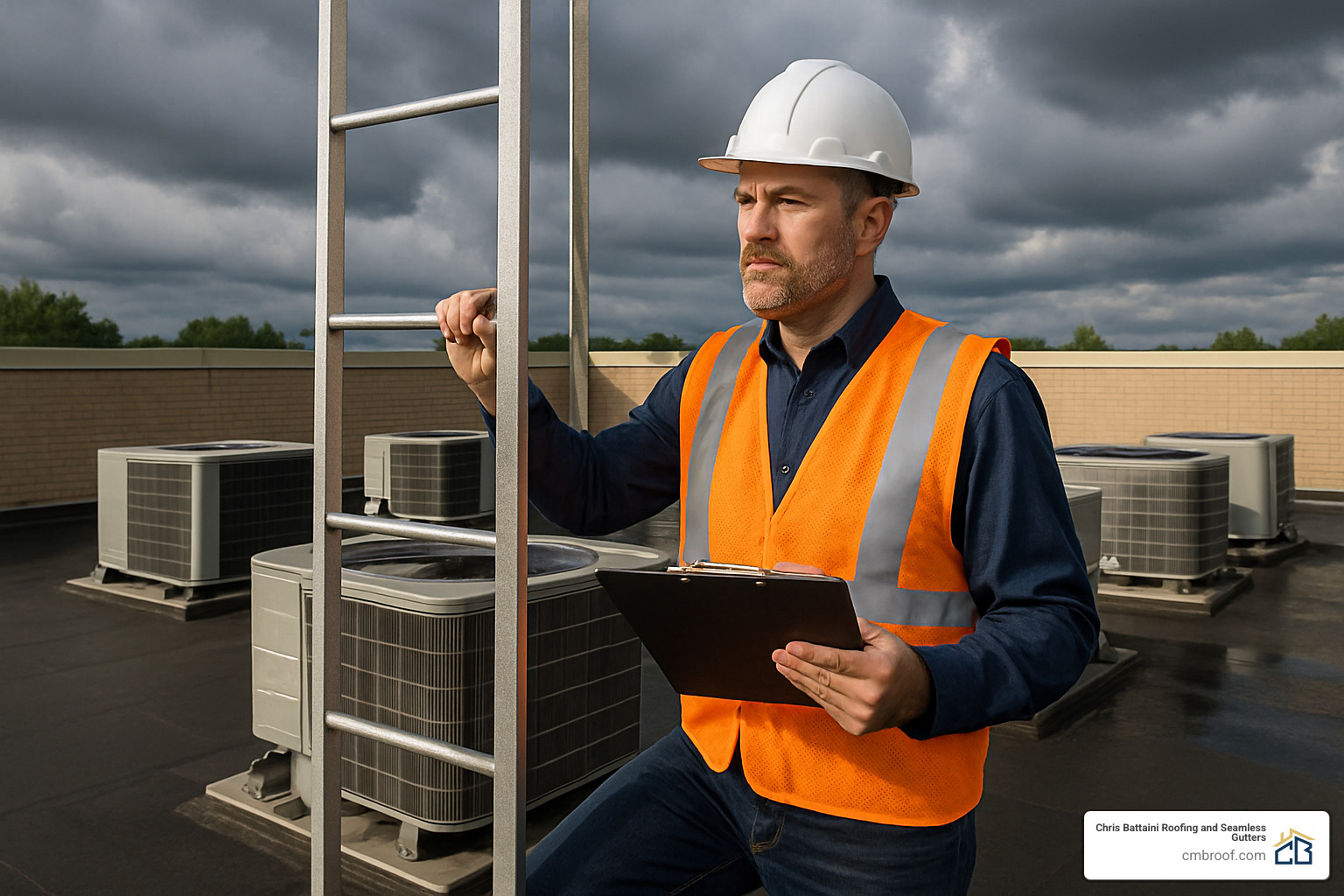
When Mother Nature releasees her fury on your commercial property, the clock starts ticking. Those first few hours after a storm can make or break your insurance claim process and determine how quickly your business gets back on track.
Before anything else, safety isn’t just a priority—it’s the only priority. The sobering reality is that in 2019 alone, 880 people lost their lives after falling from roofs. That’s not a statistic we share to frighten you, but to emphasize that no roof inspection is worth risking anyone’s wellbeing.
“We’ve seen too many property managers try to handle post-storm inspections themselves,” says Chris Battaini. “The damage you can’t see from the ground is often the most dangerous to investigate without proper equipment.”
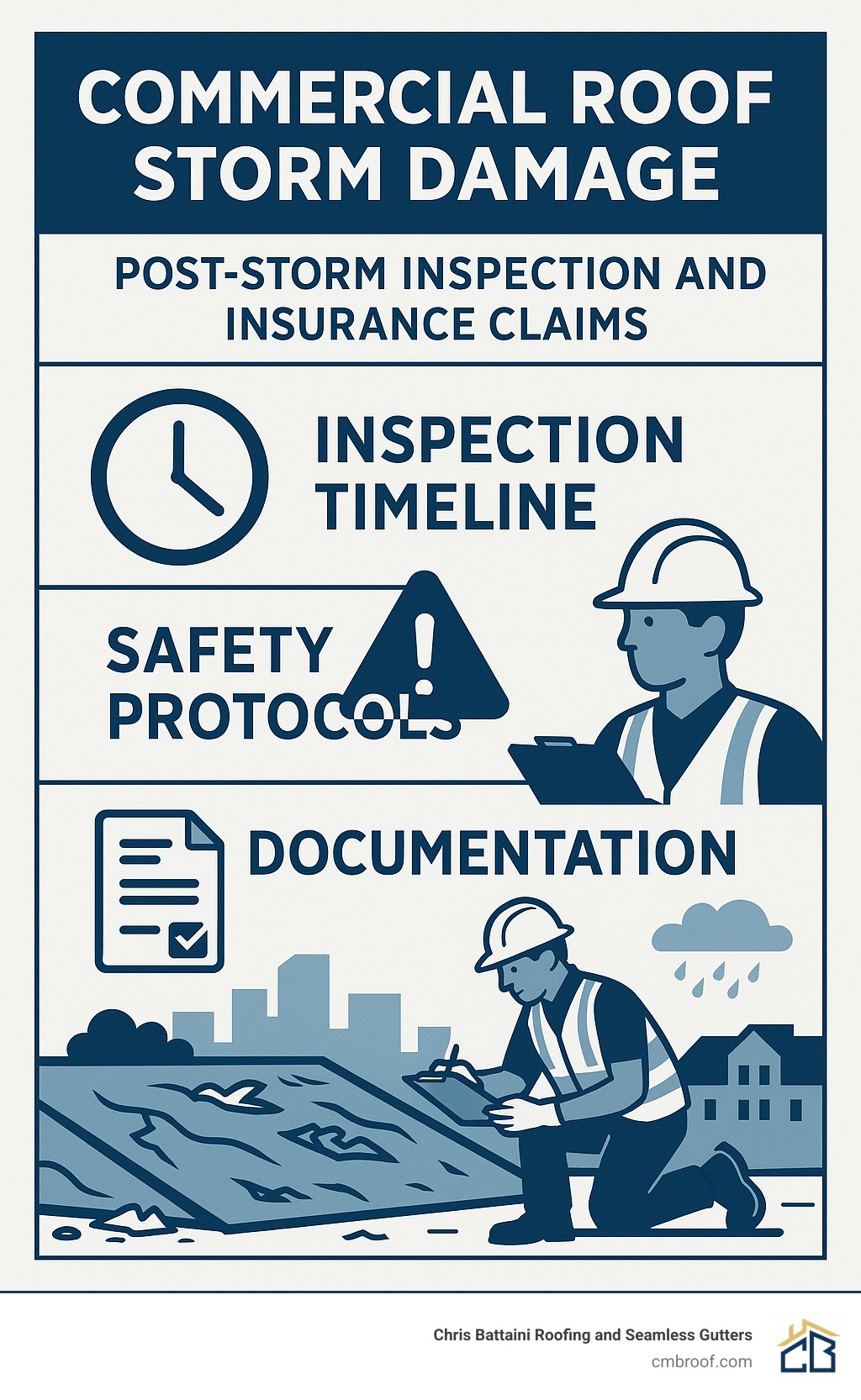
The moment after a storm passes is not the time to rush to the roof. Take a breath and follow a methodical approach to safety first.
Begin by establishing a clear safety perimeter around your building, especially if there’s visible debris or damage. Those chunks of insulation or pieces of flashing scattered around your property aren’t just unsightly—they’re warning signs of what might have happened up top.
Check for electrical hazards before anyone approaches the building. Downed power lines or exposed wiring create life-threatening situations that require professional intervention. When in doubt, call your utility company.
Structural integrity isn’t something you can eyeball from a distance. Water-damaged ceilings may have compromised load-bearing capacity, and what looks like minor sagging could indicate major structural issues. If you spot any concerning signs, evacuate the area immediately and bring in structural engineers.
OSHA regulations aren’t suggestions—they’re requirements designed to keep everyone safe. Proper fall protection, including guardrails or personal fall arrest systems, is non-negotiable for anyone accessing the roof.
Your insurance company will want evidence—lots of it. Today’s technology offers safer, more thorough documentation options than ever before.
Start with ground-level photography to capture obvious damage without putting anyone at risk. Use your smartphone’s timestamp feature to establish when each photo was taken, creating a clear timeline for your insurance claim.
Video walkthroughs with verbal descriptions provide context that still photos sometimes miss. As you record, narrate what you’re seeing: “This is the northeast corner where we’re finding the most debris” or “Notice the water staining on this interior ceiling directly below the HVAC unit.”
Drone technology has revolutionized commercial roof storm damage assessment. These eye-in-the-sky tools capture comprehensive aerial views without requiring anyone to climb a ladder. Many professional roofing companies now offer drone inspections as part of their storm damage assessment services.
“The beauty of drone photography is that it gives us a complete picture without putting anyone at risk,” explains Chris Battaini. “We can see patterns of damage that might not be obvious from ground level or even from walking the roof.”
Don’t forget to capture both wide-angle shots showing the overall condition and close-ups of specific damage points. And always, always back up your documentation to cloud storage. The last thing you need is to lose crucial evidence because of a damaged device.
While your initial documentation is valuable, it’s no substitute for a thorough professional inspection. Commercial roofing systems have multiple components and layers, and damage isn’t always visible to untrained eyes.
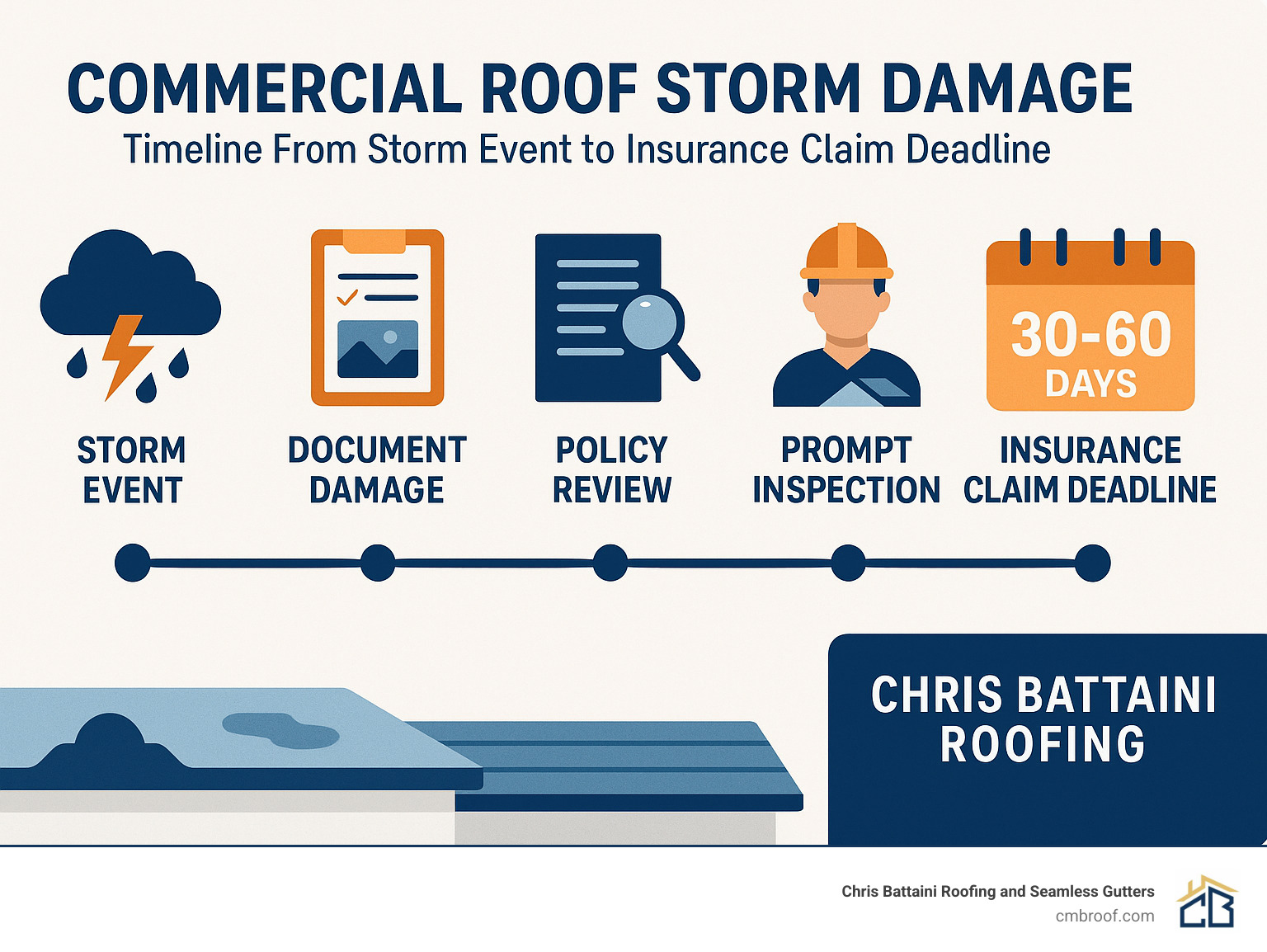
Most insurance policies have strict timelines for reporting damage—some as short as 30 days. By scheduling a professional inspection within 24-72 hours, you’re not only protecting your claim rights but also preventing secondary damage that could occur from water infiltration.
Professional inspectors bring specialized equipment like infrared scanners that can detect moisture trapped beneath the surface where it’s invisible to the naked eye. They know exactly what to look for and how to document it in ways that satisfy insurance requirements.
Many roofing warranties also require prompt reporting of storm damage to maintain coverage. Waiting too long could void your warranty protection, leaving you fully responsible for repairs that might otherwise have been covered.
If emergency repairs are needed to prevent further damage, professional roofers can install temporary patches or tarps to keep your building dry until permanent repairs can be made. This proactive approach often saves thousands in additional damage.
For a thorough post-storm inspection that meets insurance and warranty requirements, our roof inspection services provide the documentation and expertise you need to protect your investment.
Chris Battaini Roofing and Seamless Gutters—serving Berkshire, Hampden, Hampshire & Franklin Counties in Massachusetts—can inspect, document, and restore your roof before minor issues become costly failures.
When it comes to insurance claims for commercial roof storm damage, the details matter—a lot. Most commercial property policies have tight deadlines that catch building owners by surprise. You typically have between 30 to 60 days to file a claim, though some policies give you as little as two weeks after the storm hits.
Think of your documentation as telling the complete story of what happened to your roof. Your insurance company wasn’t there during the storm, so your evidence needs to paint the picture for them.
“The difference between an approved claim and a denied one often comes down to how well you document everything,” says a veteran insurance adjuster. “Most building owners simply don’t realize how detailed their documentation needs to be.”
Your storm damage documentation package should include weather records from local sources confirming the storm’s severity, a thorough inventory of all visible damage, and measurements of affected areas. If you’re fortunate enough to have pre-storm photographs, these provide invaluable “before” evidence for comparison.
Professional assessment reports from qualified roofing contractors carry significant weight with insurance companies. These reports translate damage into industry-standard language that adjusters understand and respect.
Don’t forget to keep detailed records of every conversation with your insurance company—names, dates, and what was discussed. This paper trail can prove invaluable if there are disputes about what was reported and when.
The photos and videos you take after a storm aren’t just records—they’re powerful evidence that can make or break your claim. Here’s how to make them count:
Always include reference objects for scale in your photographs. A tape measure, coin, or even a standard business card helps adjusters understand the true size of damage that might otherwise be difficult to gauge from photos alone.
Make sure some of your photos capture identifying features of your building to establish location. This creates a complete picture that connects the damage to your specific property.
Lighting matters tremendously in roof documentation. Try to photograph during overcast days when possible—direct sunlight creates harsh shadows that can hide damage, while overcast conditions provide even lighting that reveals more detail.
Walk your roof systematically when taking photos, moving in a consistent pattern so no areas are missed. This methodical approach shows insurance companies you’ve been thorough and aren’t cherry-picking only the worst damage.
Drone photography has been a game-changer for roof documentation. These aerial perspectives reveal patterns of damage that might not be apparent from ground level or even when standing on the roof. Professional drone operators can capture high-resolution images that document the entire roof surface safely and comprehensively.
If available, infrared or thermal images can be incredibly persuasive evidence. These specialized photos reveal moisture trapped beneath the surface—damage that’s invisible to the naked eye but will cause serious problems if left unaddressed.
Your insurance adjuster is likely juggling dozens of claims simultaneously. Making their job easier with organized, thorough documentation significantly increases your chances of a favorable outcome.
Prepare before they arrive. Have a detailed damage report ready before the adjuster visits your property. This preparation shows you’re serious and helps guide their inspection to ensure nothing is overlooked.
Whenever possible, have a roofing professional present during the insurance inspection. Their expertise can help identify storm-related damage that might otherwise be dismissed as wear-and-tear or pre-existing conditions.
Be specific about storm damage. Insurance companies are looking for clear connections between the weather event and the damage you’re claiming. Pointing out hail impact marks, wind-lifted membranes, or water intrusion paths directly related to the storm strengthens your case considerably.
Take time to understand your policy coverage, including exclusions and limitations. This knowledge helps you speak the same language as your adjuster and focus your claim on covered damages.
If any part of your claim is denied, always request written explanations. These documents can be valuable if you need to appeal the decision or provide additional evidence to support your claim.
Follow up consistently on your claim status. Polite persistence shows you’re serious about your claim and helps prevent it from being delayed or forgotten in the shuffle of paperwork.
Commercial roof repair solutions begin with proper documentation. The more thoroughly you document your commercial roof storm damage, the more likely you are to receive fair compensation to restore your building to pre-storm condition.
Chris Battaini Roofing and Seamless Gutters—serving Berkshire, Hampden, Hampshire & Franklin Counties in Massachusetts—can help you steer the documentation process with professional expertise that insurance companies respect.
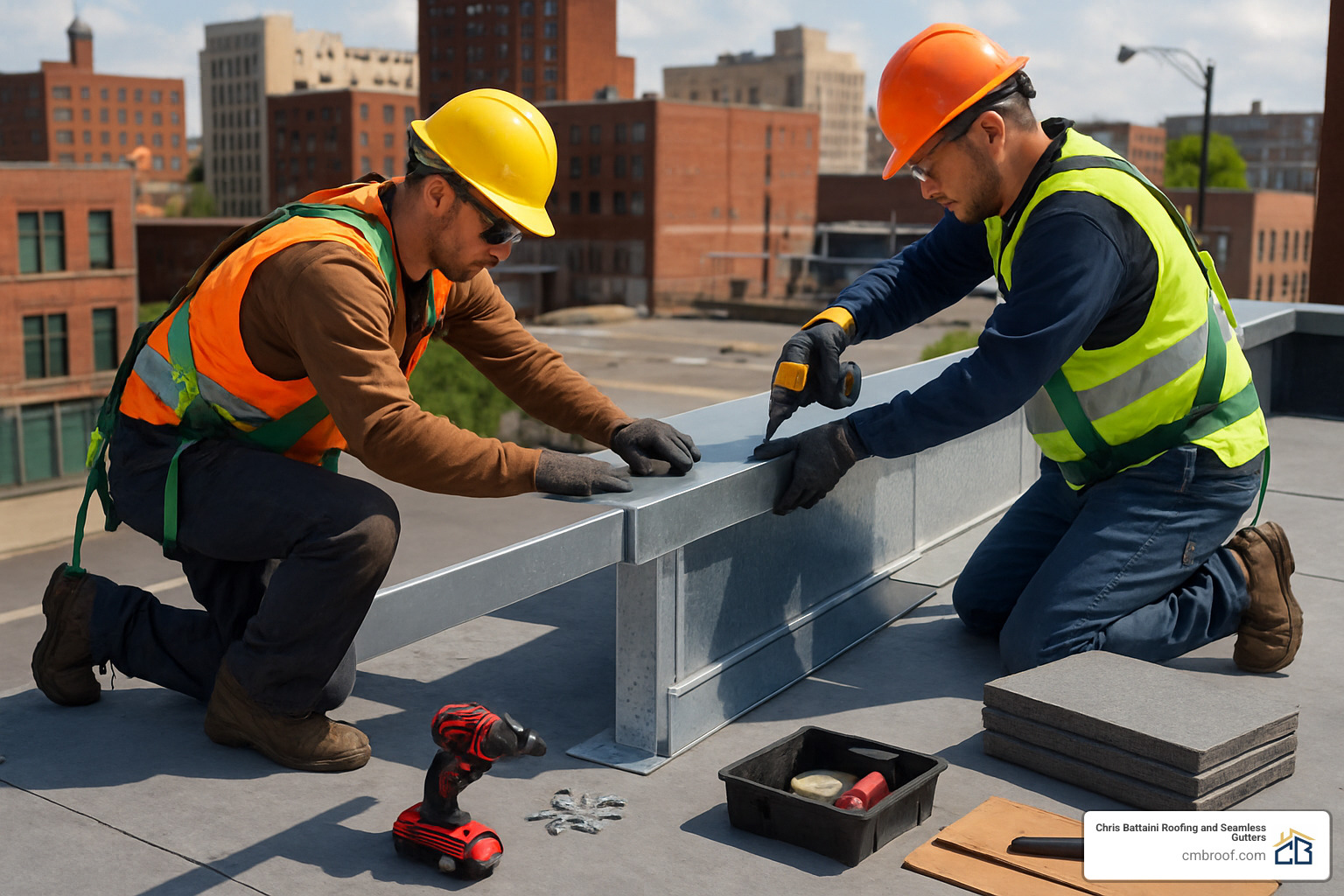
The best defense against commercial roof storm damage happens long before dark clouds appear on the horizon. Smart building owners know that proactive care and thoughtful design improvements dramatically reduce a roof’s vulnerability when severe weather strikes.
“An ounce of prevention is worth a pound of cure” has never been truer than with commercial roofing. Regular inspections are your first line of defense against storm damage.
We recommend scheduling professional roof inspections twice yearly—typically in spring after winter’s harsh conditions and in fall before winter arrives. These check-ups catch small issues before they become major problems during a storm event.
After any significant weather event, a quick post-storm assessment can identify subtle damage that might otherwise go unnoticed. Those tiny punctures or slightly lifted edges might seem minor today, but they become your building’s greatest vulnerability during the next storm.
The financial case for preventive maintenance is compelling. For every dollar invested in regular maintenance, building owners typically save $4-$10 in emergency repairs and business disruption costs. That’s an impressive return on investment by any standard.
A well-documented maintenance history also strengthens your position with both warranty providers and insurance companies. When storm damage does occur, having records of proper care can make the difference between a covered claim and a denied one.
When it’s time for roof replacement or major repairs, smart material choices can dramatically improve your roof’s storm resilience.
Higher-grade membranes with superior puncture and tear resistance might cost slightly more initially but provide significant protection during extreme weather. The difference between standard TPO and premium PVC, for instance, can be dramatic when hail strikes your building.
Edge details deserve special attention, as most wind damage begins at the roof perimeter. Increasing edge fastener spacing from 12″ to 6″ on center might seem like a small change, but it can dramatically improve wind uplift resistance. Adding peel-stop bars at perimeters and penetrations provides additional security during high winds.
Impact-resistant coverboards installed beneath the membrane create a shock-absorbing layer that protects against hail damage. When combined with stronger adhesives and modern seam technologies, these improvements create a significantly more resilient roofing system.
The cost difference between standard and improved systems is often minimal compared to the improved protection they provide. As one client told us after their upgraded roof survived a severe storm while neighboring buildings suffered extensive damage: “That extra 5% we spent on better materials saved us 100% of replacement costs.”
Water is both friend and foe to commercial roofs. Proper drainage design ensures it doesn’t become your enemy during heavy storms.
Tapered insulation systems eliminate ponding water by creating positive drainage toward outlets. This seemingly simple improvement prevents the vicious cycle where standing water compresses insulation, creating deeper depressions that collect even more water with each rainfall.
Regular clearing of drains, scuppers, and gutters is essential maintenance that prevents backup during heavy rains. Clogged drainage is one of the most common yet preventable causes of roof leaks and structural damage during storms.
Overflow drainage provisions act as your insurance policy during extreme rainfall events. When primary drains can’t keep up, these secondary systems prevent catastrophic ponding and potential collapse.
Don’t overlook the importance of debris removal and vegetation control around your building. Tree limbs that scrape against roofing membranes create weak points, while fallen branches become dangerous projectiles during high winds.
For roofs with regular foot traffic, walkway pads protect the membrane from damage that could compromise its weather resistance. These simple additions create designated pathways that prevent random traffic patterns and the membrane punctures that often result.
“Proper edge fastening and adhesive placement are critical in preventing wind damage,” our installation teams emphasize. These seemingly minor details, often overlooked during installation or repair, can determine whether your roof remains intact during the next major storm.
By implementing these strategies, you’re not just protecting your building—you’re making a smart investment in business continuity and peace of mind. When storm clouds gather, you’ll rest easier knowing your roof is prepared to weather whatever comes your way.
Chris Battaini Roofing and Seamless Gutters—serving Berkshire, Hampden, Hampshire & Franklin Counties in Massachusetts—can help you implement these proactive strategies before the next storm arrives.
You might be surprised to learn that winds don’t need to reach hurricane levels to damage your commercial roof. Commercial roof storm damage can occur at wind speeds as low as 50 to 75 miles per hour—speeds that are common in many ordinary thunderstorms.
Here’s something many building owners don’t realize: most commercial roof warranties won’t cover wind damage when speeds exceed 54 mph. That’s not very high when you think about it!
Commercial roofs rarely “blow off” dramatically in one piece like you might see in movies. Instead, they tend to fail gradually as wind creates negative pressure at the edges and perimeter. This lifting effect can break adhesion and compromise your roofing system even during what seems like a moderate storm.
There’s also a common misunderstanding about those FM I-90 ratings you might see mentioned for commercial roofs. This doesn’t mean the roof can withstand 90 mph winds—it actually means the system can resist 90 pounds of uplift pressure. Big difference! This misinterpretation often leads building owners to believe their roofs are more wind-resistant than they actually are.
When it comes to commercial roof storm damage, time is definitely not on your side. You should file your insurance claim as quickly as possible after the storm event.
Most commercial property insurance policies include strict notification deadlines—typically between 30 and 60 days after the damage occurs. Some policies have deadlines as short as 14 days! Miss this window, and you might be paying for all those repairs yourself.
The smart approach is to start your claims process by:
Insurance companies can—and often do—deny claims filed after their specified deadlines, no matter how severe your damage might be. Don’t risk it!
The answer is usually yes, but with some important conditions. Hidden commercial roof storm damage is typically covered if it resulted directly from a covered event (like a storm) and you find and report it within your policy’s timeframe.
The tricky part? Proving that hidden damage was actually caused by the storm rather than normal wear and tear or pre-existing conditions. This is where having a relationship with a professional roofing contractor becomes invaluable.
Modern inspection techniques make a huge difference here. We use tools like infrared moisture scanning to detect hidden water intrusion that isn’t visible during standard visual inspections. These detailed findings significantly strengthen your insurance claim when properly documented.
It’s worth noting that insurance policies can vary tremendously in their coverage terms, exclusions, and requirements. We always recommend carefully reviewing your specific policy and having a conversation with your insurance provider about coverage for hidden storm damage before you need to file a claim.
Chris Battaini Roofing and Seamless Gutters—serving Berkshire, Hampden, Hampshire & Franklin Counties in Massachusetts—can help you steer the complex world of storm damage assessment and insurance documentation.
When storm clouds roll away, the clock starts ticking on protecting your commercial property investment. Commercial roof storm damage isn’t something that can wait for “someday” attention—it demands immediate, expert response to prevent today’s minor issues from becoming tomorrow’s costly disasters.
Throughout this guide, we’ve explored the six critical warning signs that should trigger immediate action: torn membranes that leave your building vulnerable, hail damage that compromises your roof’s protective layer, dangerous ponding water that adds weight and accelerates deterioration, suspicious blisters and bubbles hiding moisture intrusion, compromised flashings that create entry points for water, and those telltale interior leaks that signal trouble has already moved inside.
Your commercial roof tells its story of storm damage in both obvious and subtle ways. While some damage announces itself with dramatic leaks, the most expensive problems often begin as almost invisible compromises to your roofing system that worsen with each passing day.
This is precisely why professional inspection within that critical 24-72 hour window after a storm isn’t just recommended—it’s essential. These prompt inspections serve multiple crucial purposes: identifying hidden damage that untrained eyes would miss, preserving your valuable warranty coverage, meeting those strict insurance claim deadlines, and preventing the cascade of secondary damage that follows water infiltration.
Looking beyond immediate repairs, we’ve seen how thoughtful, proactive approaches pay significant dividends in roof resilience. Regular maintenance inspections, strategic material upgrades, improved edge details, and proper drainage systems collectively create a roofing system that stands strong when storms strike. These investments typically return $4-$10 for every dollar spent by preventing emergency repairs and business disruptions.
At Chris Battaini Roofing and Seamless Gutters, we bring a personal touch to commercial roofing that larger companies simply can’t match. Our owner-led, on-site approach ensures that every inspection, repair, and installation reflects our commitment to excellence and our deep understanding of New England’s unique weather challenges.
Don’t let storm damage silently undermine your building’s integrity. Contact us today for a thorough roof assessment that gives you clear answers and practical solutions. Our experienced team will help you steer everything from emergency repairs to insurance documentation with the kind of straightforward guidance that’s increasingly rare in today’s world.
Chris Battaini Roofing and Seamless Gutters proudly serves Berkshire, Hampden, Hampshire, and Franklin Counties in Massachusetts, delivering peace of mind to commercial property owners through exceptional workmanship and genuine care for your building’s long-term health.
Need a reliable roofer? CMB Roofing provides licensed, insured, and professional roofing services for homeowners and businesses.
We stand by a simple promise: Clear estimates. Quality workmanship. Clean job sites.
From roof repairs and full replacements to storm damage restoration, our team delivers dependable results with durable materials, expert installation, and complete site cleanup.