-
10 Wendell Ave Extension Pittsfield, MA 01201
-
210 Columbia St., Lee, MA 01238

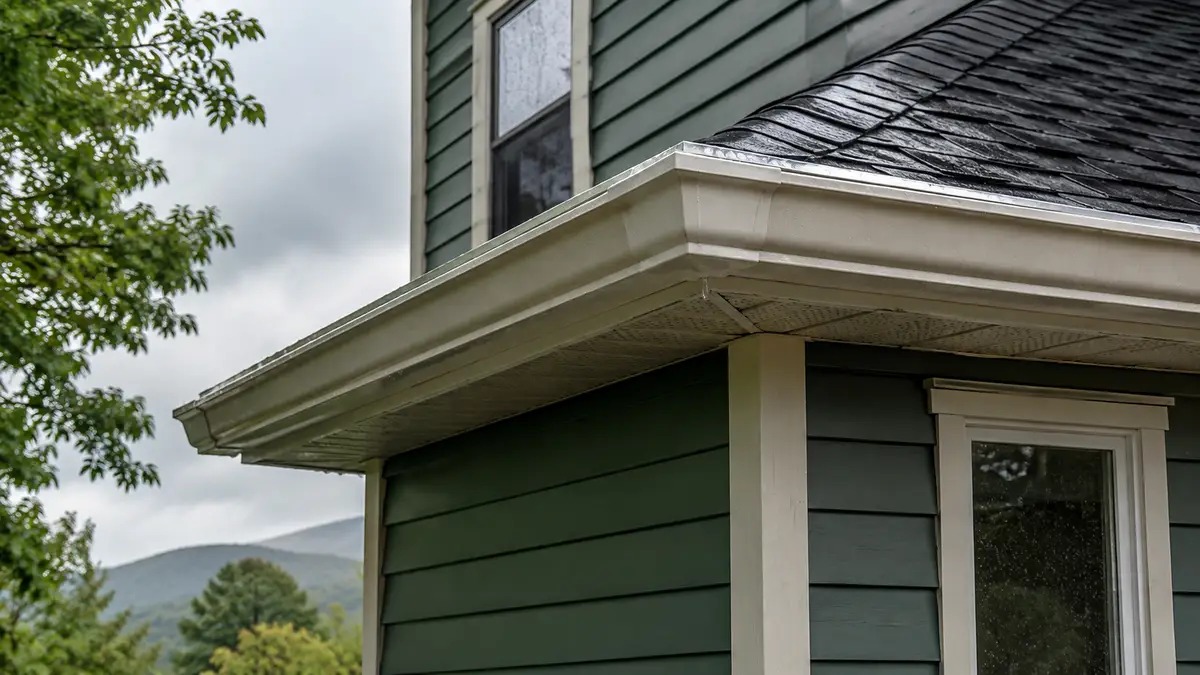
A seamless gutter corner leak usually begins at the miter—the fabricated joint where two continuous gutter runs change direction. “Seamless” means there are no routine seams along each straight run; corners, end caps, and outlets still require connections. Resealing can solve a sound, stable joint, but a corner that is out of alignment, holding water, or moving with loose supports needs the underlying condition corrected first.
An inside or outside corner is made from compatible miter components, overlapping gutter material, or a combination chosen for the gutter profile. The joint is fastened and sealed so water can pass through the change in direction. In its job-site guidance, Spectra Gutter Systems notes that every change in gutter direction requires a miter and that pitch, fascia condition, and downspout placement are part of the site assessment.
The corner is therefore a designed connection, not proof that the straight gutter runs were pieced together. Diagnosis should determine whether the connection itself failed or whether movement and drainage conditions are repeatedly stressing it.
Observe from the ground during or immediately after rain. Do not climb a ladder, lean from a window, or handle the gutter while surfaces are wet.
| What you see | What it may indicate | Professional check |
|---|---|---|
| A small drip directly under the miter | A local sealant gap, fastener path, or small opening in the joint | Cleanliness, adhesion, overlap, fasteners, and joint condition |
| Water sits in the corner after rain | Reverse pitch, a low point, or an outlet that is not drawing the run down | Run elevation, hanger positions, outlet, and downspout flow |
| The corner separates or changes shape | Support movement, fascia deterioration, impact, or an unstable miter assembly | Fascia, hangers, fastening, alignment, and metal condition |
| Water spills over the corner’s outer edge | Concentrated roof runoff or inadequate drainage near the direction change | Roof geometry, gutter position, capacity, outlet layout, and downspout route |
| Water runs behind the gutter | The source may be the roof edge, apron, drip edge, or gutter position rather than the miter | Eave detail, back of gutter, fascia, and roof-edge drainage path |
| Dark staining continues below a dry joint | Old staining, condensation, or water traveling from another location | Controlled observation and moisture-source confirmation |
A close phone video can show whether water emerges through the joint, crosses over the top, or arrives from behind. Those paths call for different repairs.
Resealing is most likely to hold when both gutter runs are properly pitched, the corner remains rigid and aligned, the metal is not split or badly deformed, and water does not remain trapped at the joint. The repair process depends on the existing system, but it normally requires a dry, clean surface and compatible gutter sealant applied to the correct side of the joint.
Smearing new material over dirt, oxidation, wet sealant, or a moving gap can hide the opening without creating a durable bond. The old joint may need to be opened, cleaned, refastened, and resealed. Product compatibility matters; an installer should confirm the gutter material and existing sealant rather than assume any exterior caulk is suitable.
A corner connects two runs, so it can be pulled in different directions when hangers loosen, fascia softens, or a run develops a low point. If the metal moves whenever the gutter fills, a new bead of sealant becomes the flexible patch for a structural alignment problem.
The inspection should follow both runs from the miter to their outlets. Useful checks include:
If alignment is the cause, the repair may involve resetting hangers, correcting pitch, repairing the support surface, or rebuilding the miter before it is sealed.
A watertight corner can still spill if more water arrives than the nearby outlet and downspout can carry. Roof valleys, steep planes, and additions can concentrate runoff near a direction change. A blocked outlet, weak downspout discharge, or long run with too few discharge points can keep the corner full.
That condition is different from a joint leak. The recent guide to gutters that overflow in heavy rain even when clear explains how spill location, downspout discharge, pitch, and roof geometry can separate cleaning, repair, and layout correction. A corner repair should not be approved until that wider flow path is understood.
The smallest durable scope is the one that removes the verified cause, not necessarily the one that uses the least material on the day of service.
Chris Battaini Roofing installs seamless gutters for Berkshire County homes and businesses. A corner evaluation should identify whether the durable fix is a clean reseal, a rebuilt miter, corrected alignment and support, or a change to how the run drains.
Need a reliable roofer? CMB Roofing provides licensed, insured, and professional roofing services for homeowners and businesses.
We stand by a simple promise: Clear estimates. Quality workmanship. Clean job sites.
From roof repairs and full replacements to storm damage restoration, our team delivers dependable results with durable materials, expert installation, and complete site cleanup.