-
10 Wendell Ave Extension Pittsfield, MA 01201
-
210 Columbia St., Lee, MA 01238

Hall hook slate repair is one of the most effective methods for replacing a broken or missing slate — permanently, invisibly, and without disturbing the surrounding roof.
Here’s the quick answer if that’s all you need:
No lead straps. No silicone. No trimming the slate head. Just a clean, permanent fix.
Slate roofs are built to last over a century — but even the best ones eventually lose a slate or two. When that happens, the repair method matters just as much as the replacement slate itself. Traditional fixes like lead straps or silicone blobs are often unsightly, short-lived, or unprofessional. They can also fail building standards if not done correctly.
The Hall Hook was designed specifically to solve these problems. Developed over 20 years by an experienced slating contractor with 45 years in the trade, it gives roofers a way to replace broken slates without any visible hardware, without losing head lap, and without compromising the roof’s long-term integrity.
I’m Christopher Battaini, owner of Chris Battaini Roofing and Seamless Gutters, and with over two decades of roofing experience serving homeowners across the North Shore and Greater Boston area, I’ve seen how the right tools — like those used in hall hook slate repair — make all the difference between a patch job and a proper repair. In the sections below, I’ll walk you through exactly how it works and why it’s worth doing right.
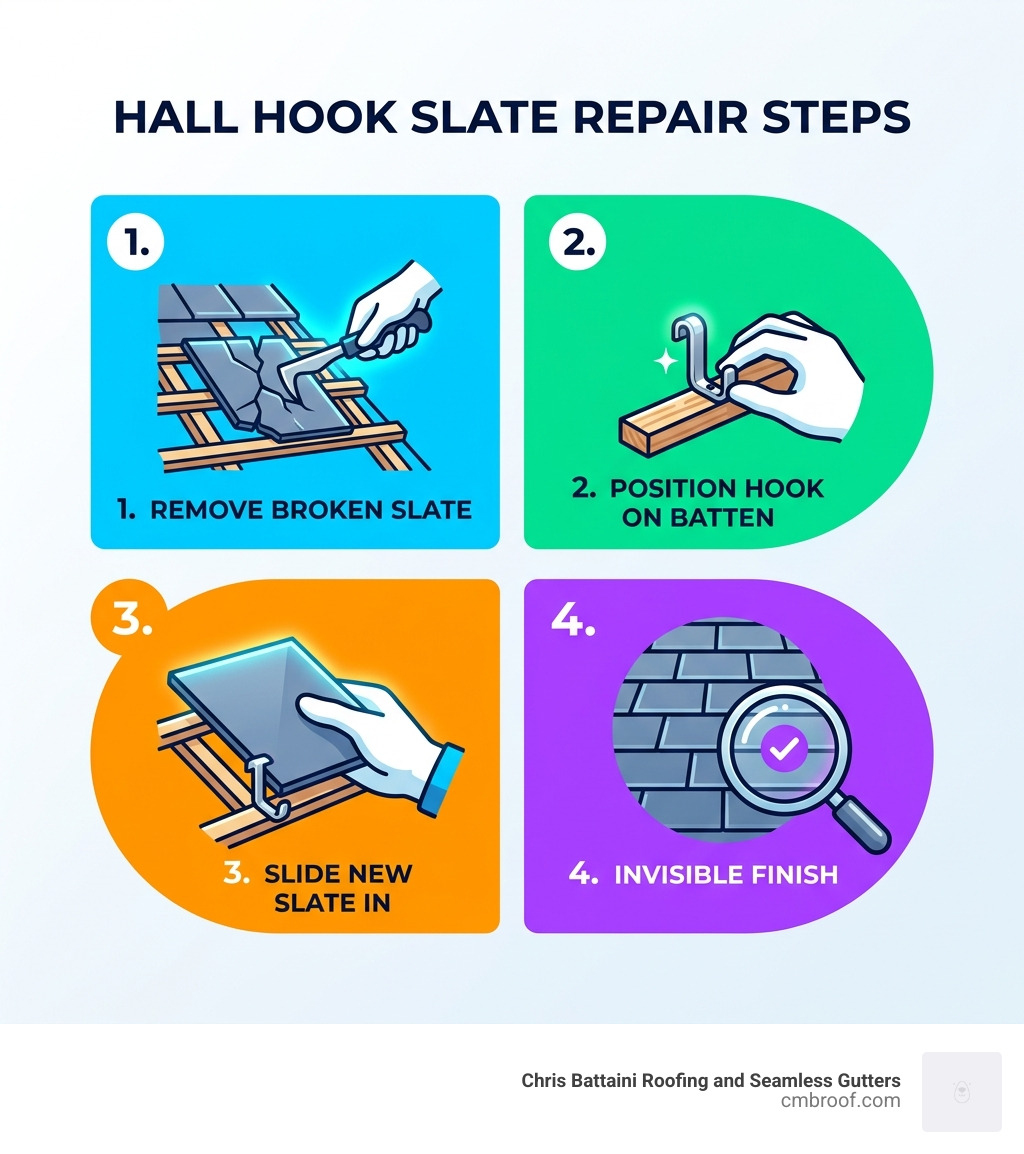
Basic hall hook slate repair terms:
The technology behind hall hook slate repair was born out of professional frustration. Jimmy Hall, a veteran slater and tiler with 45 years of hands-on experience, spent over 20 years refining this device. He wanted to move away from “tingles” (visible metal straps) and messy adhesives that often fail after just a few seasons of Berkshire County weather.
Unlike traditional slate hooks that are visible at the tail of the slate, the Hall Hook is a permanent, secret fixing. It is designed to be a fail-safe device that maintains the original aesthetic of a historic roof. By using a specialized hook that grips the batten and the slate internally, we can perform a Slate Roofing Repair that is virtually undetectable from the ground. This is a significant leap forward for homeowners who value the architectural beauty of their natural slate.
The Hall Hook is a compact but incredibly strong piece of engineering. Measuring approximately 110mm by 65mm, it is sized perfectly to fit within the standard laps of most residential slate roofs. Its primary features include:
When we perform a hall hook slate repair in Berkshire County, we have to account for intense snow loads and freeze-thaw cycles. The Hall Hook is manufactured from A2-304 Austenitic Stainless Steel. This material carries a high corrosion rating, making it suitable even for aggressive environments.
In terms of building standards, these hooks are designed to align with guidelines like BS 5534. The standards suggest that hook fixings should not exceed 2.7mm in thickness and should generally be thinner than the slate itself to prevent “kicking” or lifting the surrounding tiles. By adhering to these technical specifications, we ensure that every slate roof repair we perform meets the highest industry benchmarks for safety and longevity.
Repairing a slate roof requires a blend of finesse and the right equipment. You can’t just hammer a nail into a slate and expect it to hold without cracking. We use a specific set of tools to ensure the integrity of the roof remains intact during the How To Repair A Broken Roof Slate process.
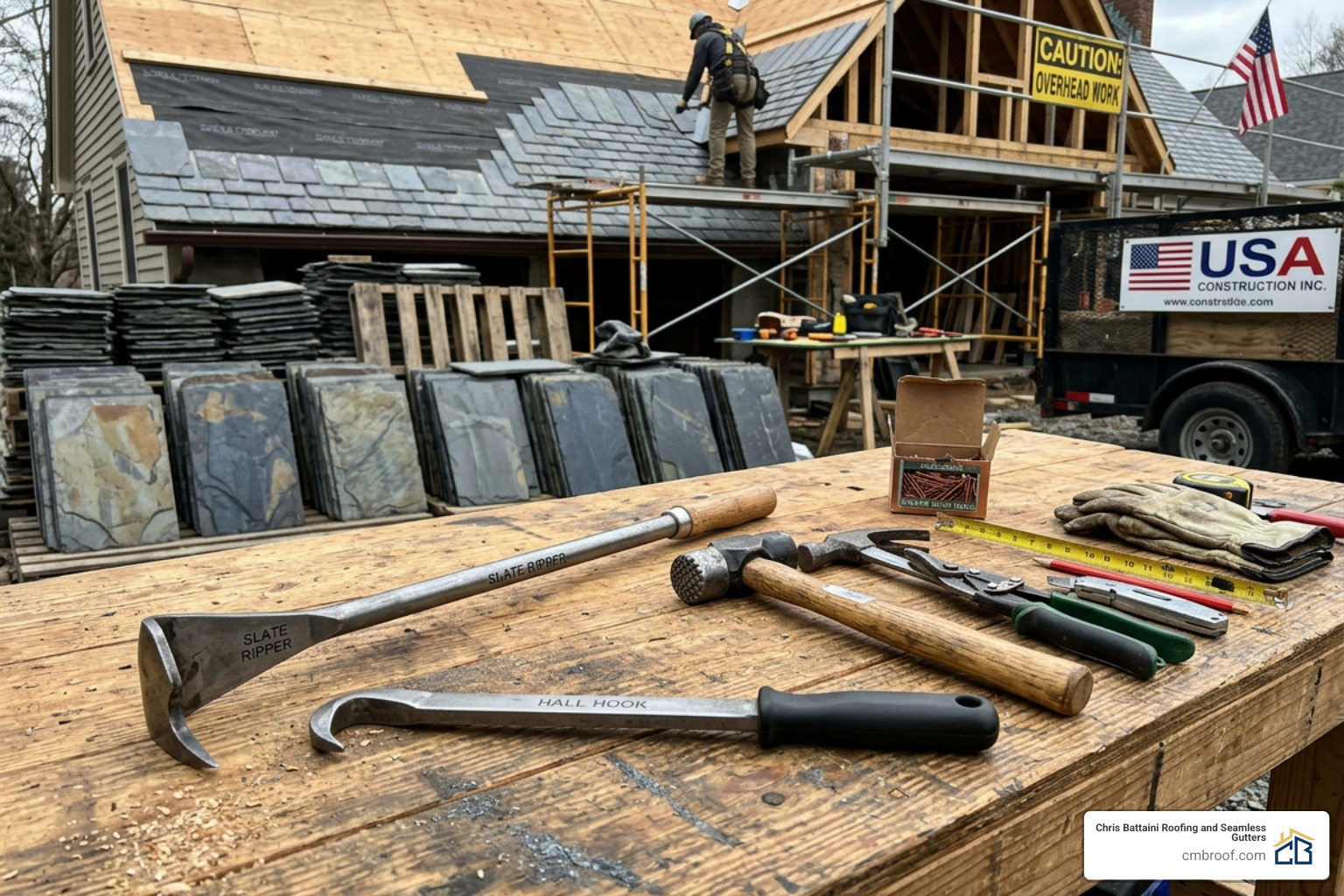
The most critical tool in our kit is the slate ripper. This long, flat metal tool allows us to slide up under the slates and hook onto the existing nails. With a sharp tug, we can cut or pull the nails without breaking the slates above. For the Hall Hook specifically, we also use a “HookPull” tool, which is often included in professional packs. This tool is essential for correctly positioning and “setting” the hook once the new slate is in place.
Before we even touch a hook, we perform a thorough inspection. Often, what looks like one missing slate from the ground is actually a sign of “nail fatigue” across a larger area. Nail fatigue occurs when the original copper or galvanized nails corrode, causing slates to slip.
During a Slipped Slate Repair, we are extremely careful to protect the wooden battens (or laths) underneath. Old battens in historic homes can become dry and brittle. If a roofer pulls a nail too aggressively, they risk snapping the batten, which turns a simple repair into a major structural headache. We use a technique of turning the slate ripper slightly to the side to pull nails along the length of the wood rather than against the grain.
Once the area is clear, we prepare the replacement slate. It’s vital to match the thickness and type of the existing slate, whether it’s a standard natural slate or a specialized variety found in areas like Great Barrington, MA.
The installation follows these steps:
This process ensures a permanent security that can withstand the high winds we often see in the Berkshire hills.
For decades, the “go-to” repair for a slipped slate was a “tingle” — a strip of lead or copper nailed to the batten and bent over the bottom of the slate. While functional, they are unsightly. Over time, these metal straps can also soften or “unroll” under the weight of sliding snow, leading to repeat failures.
| Feature | Hall Hook | Lead/Copper Straps | Silicone/Adhesive |
|---|---|---|---|
| Visibility | Invisible/Secret | Highly Visible | Visible Blobs |
| Longevity | Permanent (Stainless) | Weakens over time | Short-term (weeks/months) |
| Building Code | Standards Compliant | Often frowned upon | Not compliant |
| Head Lap | Preserved | Often lost | N/A |
When performing a hall hook slate repair in Lenox, MA, we prioritize the “head lap.” This is the distance the slate overlaps the course two rows below it. Traditional repairs often involve trimming the top of the slate to make it fit, which reduces this overlap and creates a path for water to blow up under the roof. The Hall Hook allows us to keep the slate at its full length.
The most obvious advantage is aesthetic. On a beautiful historic home in Stockbridge, MA, the last thing a homeowner wants to see is a row of shiny metal “band-aids” on their roof. Because the Hall Hook is a secret fixing, the repair is invisible.
Structurally, it follows NFRC (National Federation of Roofing Contractors) guidelines. By using stainless steel rather than plastic or temporary fixings, we provide a repair that matches the 100-year lifespan of the slate itself. It doesn’t degrade in UV light, and it won’t crack when the temperature drops to sub-zero in January.
While highly versatile, there are specific situations where we have to evaluate the use of hooks. According to technical bulletins, certain types of hooks (specifically crimped versions) are not recommended for roof pitches below 25 degrees. For very low-pitched roofs, a combination of fixings may be required to ensure water-tightness.
Additionally, if you have exceptionally thick “vernacular” slates — those over 5mm or 1/4 inch thick — we may need to adjust our technique. In places like Lee, MA, where you might find older, heavier stone slates, the standard Hall Hook is usually sufficient, but the “set” of the hook must be checked carefully to ensure it has cleared the thickness of the stone.
When homeowners in Dalton, MA, ask about the cost of slate repair, it’s important to understand that slate work is a specialized trade. The materials for a hall hook slate repair are relatively inexpensive — often sold in packs of 10 for a modest price — but the value lies in the expertise required to navigate a slate roof without causing more damage.
Based on publicly available internet data, professional slate repairs using specialized hooks typically range from $200 to $850 per incident. These are not the client’s actual pricing. The final cost depends on the height of the roof, the pitch, the number of slates being replaced, and the ease of access. A simple repair on a porch roof will naturally cost less than a repair on a three-story Victorian gable.
We always recommend annual inspections for our neighbors in Pittsfield, MA. Berkshire weather is tough on roofs. Between the heavy ice dams in winter and the high winds of spring, slates can shift.
During an inspection, we look for:
Catching a slipped slate early and fixing it with a hall hook slate repair can prevent thousands of dollars in interior water damage later on.
Yes, they are compatible with natural slate, fiber cement slates, and even some types of asbestos tiles (though asbestos requires specialized handling). They work best on standard-thickness slates but can be adapted for thicker varieties.
No. This is the primary “selling point” of the Hall Hook. Unlike a copper tingle or a standard slate hook that wraps around the bottom of the slate, the Hall Hook stays hidden in the shadow line and the vertical joint.
Because they are made from high-grade A2-304 stainless steel, the hooks are designed to last as long as the roof itself. They are corrosion-resistant and mechanically fastened, meaning they won’t “unbend” or rot away.
A slate roof is an investment in your home’s history and its future. When a slate breaks, don’t settle for a temporary patch that ruins the look of your home. Choosing a Professional Slate Roof Repair using the Hall Hook system ensures your roof stays beautiful and watertight for decades to come.
Whether you are in North Berkshire County or down in the South County towns like Sheffield or Great Barrington, we are here to help you maintain your roof with the best tools and techniques available.
Chris Battaini Roofing and Seamless Gutters is an Owens Corning Platinum Preferred Contractor. This earned, elite designation is limited to the top tier of roofing professionals nationwide.
The company services Berkshire County, Massachusetts.
Follow us on Facebook — https://www.facebook.com/chrisbattainiroofing
Need a reliable roofer? CMB Roofing provides licensed, insured, and professional roofing services for homeowners and businesses.
We stand by a simple promise: Clear estimates. Quality workmanship. Clean job sites.
From roof repairs and full replacements to storm damage restoration, our team delivers dependable results with durable materials, expert installation, and complete site cleanup.