
Understanding the Real Cost of Cedar Shake Roof Replacement
Looking for the cost of a cedar shake roof replacement cost? Here’s your quick answer:
| Average Cost Factor | Typical Range (2025) |
|---|---|
| Total Project Cost | $15,800 – $45,000 |
| Cost Per Square Foot | $8 – $15 |
| Materials | $3.50 – $8.50 per sq ft |
| Labor | $2 – $5 per sq ft (50-60% of total) |
| Tear-Off & Disposal | $1 – $5 per sq ft |
| Permits | $100 – $500 |
Note: These are average costs based on internet data, not actual costs from Chris Battaini Roofing and Seamless Gutters.
When homeowners think about cedar shake roof replacement, the first thought is often about its stunning natural beauty—followed quickly by concern about the price tag. Cedar shake roofs are undeniably among the most visually appealing roofing options available, creating that perfect rustic charm or neat natural finish that can dramatically improve your home’s curb appeal.
But that beauty comes at a cost.
The truth is, cedar shake roof replacement represents a significant investment for any homeowner. Unlike standard asphalt shingles, cedar requires specialized installation techniques, premium materials, and specific maintenance to perform at its best. All these factors contribute to a higher upfront cost.
What many homeowners don’t realize is that while the initial investment is higher, cedar shake roofs can last 30-50 years when properly maintained—significantly longer than many alternatives. This durability, combined with excellent insulation properties and natural resistance to insects, means your investment often pays dividends over time.
As one homeowner put it: “I balked at the initial estimate for my cedar shake roof, but fifteen years later, while my neighbors have already replaced their asphalt roofs, mine still looks fantastic and has needed minimal maintenance.”
Whether you’re replacing an existing cedar shake roof or considering an upgrade from another material, understanding the true costs involved will help you make an informed decision without the sticker shock.
Cedar Shake Roof Replacement Cost in 2025
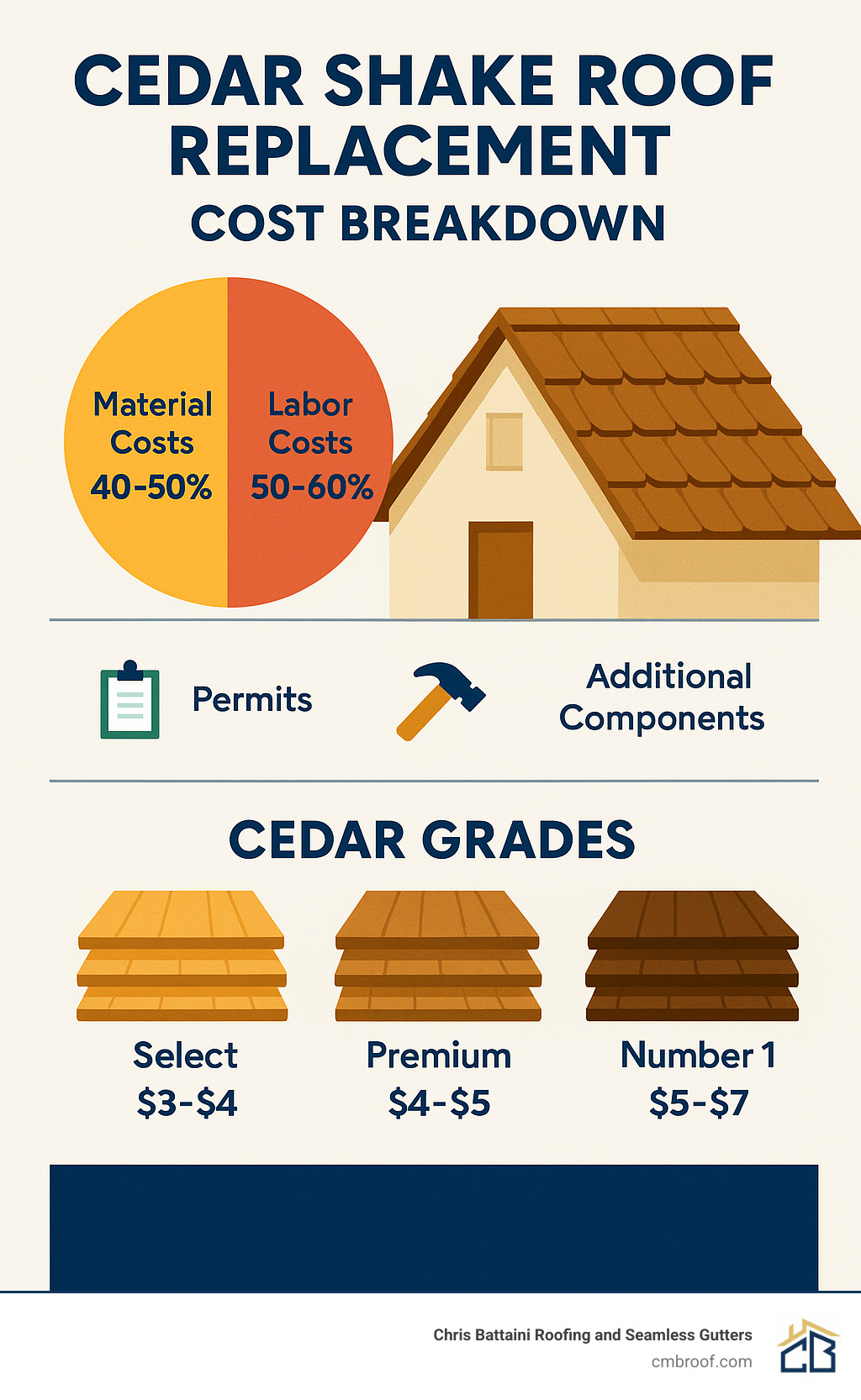
The national average for cedar shake roof replacement cost in 2025 ranges from $15,800 to $45,000, with most homeowners paying between $18,000 and $25,000 for a standard 1,500-2,000 square foot roof. This wide range isn’t arbitrary—it reflects the many variables that affect your bottom line, including your roof’s size and complexity, the grade of cedar you select, and where your home is located.
Breaking it down to square footage makes these numbers more digestible. You can expect to pay between $8 and $15 per square foot for a fully installed cedar shake roof. Roofers typically measure in “squares” (100 square feet each), so that translates to $800 to $1,500 per roofing square.
Why the premium price compared to asphalt shingles? It’s a combination of materials and craftsmanship. Cedar is a naturally beautiful, premium material, and installing shakes requires specialized knowledge and techniques that not every roofer possesses. Labor typically accounts for 50-60% of your total cedar shake roof replacement cost—a significant but necessary investment in quality installation.
| Cedar Shake Grade | Material Cost (per sq ft) | Installed Cost (per sq ft) | Lifespan |
|---|---|---|---|
| Common Grade | $3.50-$5.50 | $8.00-$10.50 | 20-30 years |
| Select Grade (80% straight grain) | $5.50-$7.00 | $10.50-$12.50 | 25-40 years |
| Premium (100% straight grain) | $7.00-$8.50 | $12.50-$15.00 | 30-50 years |
Note: These are average costs based on internet data, not actual costs from Chris Battaini Roofing and Seamless Gutters.
Typical cedar shake roof replacement cost per square foot
The materials themselves will set you back $3.50 to $8.50 per square foot, depending on the grade you choose. Think of cedar grades like cuts of meat—premium grades with straighter grain patterns and fewer defects cost more but deliver better performance and longer life.
Labor adds another $2 to $5 per square foot to your bill. Got a steep roof? Prepare for that price to climb too. Anything over a 6/12 pitch (meaning the roof rises 6 inches for every 12 inches of horizontal run) can increase labor costs by 20-50%. This isn’t your contractor being greedy—steep roofs require additional safety equipment and slow down the installation process considerably.
To get a ballpark figure for your own roof, try this simple math:
1. Figure out your roof’s square footage
2. Apply a pitch multiplier (1.05 for relatively flat roofs, 1.12 for medium pitch, 1.25 for steep roofs)
3. Multiply by the cost per square foot for your chosen cedar grade
Average cedar shake roof replacement cost by roof size
Let’s look at how these costs play out for common home sizes:
For a 1,500 sq ft roof, expect to pay around $12,000 for common grade cedar on a simple roof, $16,500 for select grade on an average complexity roof, or up to $22,500 for premium grade on a complex roof with multiple angles and features.
A 2,500 sq ft roof jumps to approximately $20,000 for basic common grade installation, $27,500 for mid-range select grade, and $37,500 for premium grade on a complex roof structure.
For larger homes with a 3,500 sq ft roof, budget around $28,000 for the most basic option, $38,500 for select grade with average complexity, or as much as $52,500 for premium cedar on a complex roof design.
Note: These are average costs based on internet data, not actual costs from Chris Battaini Roofing and Seamless Gutters.
Breaking down labor, tear-off and disposal costs
Before your beautiful new cedar shakes can go up, the old roofing has to come down. Tear-off and disposal typically runs between $1 and $5 per square foot. Several factors influence where you’ll fall in that range:
The number of existing layers needing removal can drastically affect costs—two or three layers take significantly more time and effort than one. As one Great Barrington homeowner told us: “The tear-off was more expensive than I expected because we had two layers of old roofing materials. Make sure you know exactly what’s up there before getting quotes.”
Roof accessibility plays a major role too. Is your home on a steep hill? Surrounded by landscaping that makes dumpster placement difficult? These logistics can increase costs.
Local dump fees vary widely by region, with some areas charging hefty premiums for construction waste disposal. And labor rates in your area matter—according to Bureau of Labor Statistics data, roofers earn up to $35 per hour nationally, with specialized cedar installers sometimes commanding $60+ hourly. Here in Berkshire County and Southern Vermont, we typically see rates near the national average, though prices can spike during the busy summer season.
Hidden line items you shouldn’t miss
When budgeting for your cedar shake roof, don’t forget these essential components that can add $3,000-$5,000 to your project:
Underlayment is your roof’s critical second line of defense, costing $0.20-$2.00 per square foot (about $3,300 for an average home). Quality underlayment is non-negotiable with cedar shakes.
Flashing around chimneys, vents, and valleys prevents leaks at these vulnerable points, adding $200-$600 to your project.
Drip edge protects your fascia and directs water into gutters, costing $100-$500 depending on your home’s perimeter.
Treatments matter too. Fire retardant treatments ($200-$1,000) might be required by code in some areas, while algaecide/fungicide treatments ($200-$1,000) can significantly extend your roof’s life, especially in damp climates. Copper strips installed near the ridge ($2-$4 per linear foot) provide ongoing protection against moss and algae growth.
These aren’t fancy add-ons—they’re essential components of a properly installed cedar shake roof system. Skipping these elements to save money upfront is like buying a car without windshield wipers. Your roof might look fine initially, but its performance and lifespan will suffer dramatically.
Cedar Shakes 101: Shakes vs Shingles, Grades & Styles

Before we dive deeper into the dollars and cents, let’s make sure you understand exactly what you’re investing in. After all, when you’re spending thousands on a roof, you should know the difference between a shake and a shingle (and no, they’re not just fancy roofing terms designed to confuse homeowners).
How cedar shakes differ from cedar shingles
When you see a charming cottage with a rustic, textured wooden roof that looks like it belongs in a fairy tale, you’re likely admiring cedar shakes. On the other hand, that neat, uniform wooden roof with clean lines is probably made of cedar shingles.
The differences go beyond appearances though. Cedar shakes are hand-split, giving them that distinctive rustic character with natural variations in thickness and texture. They’re significantly thicker (typically ½-¾ inch) than their more refined cousins. Cedar shingles, meanwhile, are machine-sawn on both sides, resulting in a smoother, more uniform appearance at a thinner profile (usually ⅜-½ inch).
This distinction isn’t just aesthetic—it affects your wallet too. Cedar shakes typically cost 20-30% more than cedar shingles due to their thicker profile, more labor-intensive manufacturing process, and more complex installation requirements.
As one of our recent customers in Lenox put it: “I loved the character of the shakes—every piece tells a story with its unique grain and texture. Worth every penny for that authentic New England look.”
Material grades and why they matter
Not all cedar shakes are created equal. The grade you choose dramatically impacts both your initial cedar shake roof replacement cost and how long that investment will last.
Common Grade shakes are the budget-friendly option, containing a mix of heartwood and sapwood with some knots and natural imperfections. They still look beautiful, but their irregular grain patterns might mean they won’t stand up to harsh Berkshire winters quite as long as higher grades.
Select Grade strikes a balance between cost and longevity, containing approximately 80% straight-grain cedar with fewer defects. For many homeowners, this mid-range option provides the best value proposition.
Premium/Straight-Grain shakes represent the gold standard. Made from 100% straight-grain heartwood cedar, these top-tier shakes lay flatter, have minimal defects, and can last up to 50 years with proper maintenance. They’re the most expensive upfront but often the most economical in the long run.
Many of our savvier clients in Berkshire County opt for what we call the “hybrid approach”—using premium grade shakes on the most visible roof sections and select grade on less prominent areas. This strategy maintains curb appeal while keeping costs manageable.
Wood species and treatments
While Western Red Cedar dominates the market (and for good reason—its natural oils resist decay and insects beautifully), you do have other options:
Western Red Cedar remains the gold standard for cedar roofing, offering that rich, warm color that weathers to a distinguished silver-gray over time. It’s naturally resistant to rot and insects thanks to its high oil content.
White Cedar (also called Eastern White Cedar) offers a lighter initial color and comes with a slightly lower price tag, though it generally doesn’t last quite as long as its western cousin.
Treated Cedar undergoes additional processing to improve specific properties. Fire-retardant treatments are particularly important in wildfire-prone areas and often required by local building codes. Preservative treatments can extend your roof’s lifespan by enhancing resistance to moisture, fungi, and insects.
Beyond species and treatments, cedar offers impressive insulating properties, with an R-value approximately twice that of asphalt shingles. This natural insulation can contribute to energy efficiency year-round, keeping your home cooler in summer and warmer in winter.
When properly specified and installed, your cedar shake roof doesn’t just protect your home—it becomes a defining architectural feature that improves with age, developing a distinguished patina that can’t be replicated by synthetic alternatives.
Note: These are average costs based on internet data, not actual costs from Chris Battaini Roofing and Seamless Gutters.
What Drives Your Cedar Shake Roof Replacement Cost?
Ever wonder why your neighbor’s cedar roof quote was so different from yours? The truth is, many factors influence the final price tag of your cedar shake roof replacement cost – and understanding them can help you make smarter decisions about your investment.
Roof complexity & pitch premiums
Your roof’s design is one of the biggest cost drivers. Those charming architectural details that give your home character? They also add to your bottom line.
Steep roofs (anything over a 6/12 pitch) typically add 20-50% to labor costs. Why? The steeper the roof, the slower the work and the more safety equipment required. Your roofer isn’t just charging more for fun – they’re accounting for the extra time and safety precautions needed.
Those beautiful dormers and valleys that add character to your home also add complexity. Each one requires careful cutting, fitting, and flashing. As one Stockbridge homeowner finded: “Our cottage has four dormers and multiple roof planes. We paid about 30% more than our neighbor with a simple gable roof – but the finished look was worth every penny.”
Don’t forget about penetrations like chimneys, skylights, and vents. Each one is essentially a mini-project within your roof replacement, requiring special flashing and meticulous waterproofing.
Material grade & finish upgrades
As we covered earlier, cedar grade significantly impacts your bottom line. But there are other material considerations that affect your cedar shake roof replacement cost:
Class A fire-rated treatments add roughly $1-$3 per square foot but provide peace of mind and may even reduce your insurance premiums. For homes in wooded areas of the Berkshires, this upgrade is often worth considering.
Copper strips installed every 10 courses help prevent algae growth, adding $2-$4 per linear foot. In our humid New England climate, this modest investment can significantly improve your roof’s appearance over time.
Decorative cuts like rounded, diamond, or fish-scale patterns create stunning visual interest but require more material and specialized labor. These artistic touches can transform your home’s appearance but expect to pay a premium.
Regional price swings & code requirements
Your location plays a surprisingly large role in determining costs. Here in Berkshire County, our labor rates tend to align with national averages, but our building codes account for our significant snow loads.
Local building requirements may dictate specific underlayment types, ice and water shield coverage, and ventilation standards. According to EPA research on moisture control, proper ventilation isn’t just code compliance – it’s essential for preventing moisture damage that can dramatically shorten roof lifespan.
Permit costs typically range from $100-$500 depending on your municipality. While it might be tempting to skip this step, proper permitting protects you and ensures your installation meets all local requirements.
Material availability also affects pricing. Since most cedar comes from the Pacific Northwest, we typically see slightly higher material costs here on the East Coast due to shipping distances.
Maintenance, lifespan & total cost of ownership
The smartest way to evaluate your cedar shake roof replacement cost is to consider the big picture – not just the upfront price.
Regular professional inspections ($200-$500) every 2-3 years help catch small issues before they become big problems. Professional cleaning ($300-$600) every 3-5 years removes debris and prevents moss growth. Retreatment with preservatives ($200-$1,000) every 1-3 years extends your roof’s life considerably.
When you do the math, a premium cedar shake roof costing $30,000 with a 40-year lifespan comes to $750 per year – comparable to the annual cost of less expensive roofing materials that need replacement more frequently. Factor in cedar’s superior insulation properties (nearly twice the R-value of asphalt), and you may even recoup some costs through energy savings.
As one Great Barrington client told us: “I was shocked by the initial estimate, but when my contractor broke down the cost per year and factored in the energy savings, cedar actually made financial sense for our forever home.”
Note: These are average costs based on internet data, not actual costs from Chris Battaini Roofing and Seamless Gutters.
Cedar Shake vs Synthetic & Other Roofing Options
When you’re weighing your roofing options, it’s natural to wonder if cedar shakes are really worth the investment. Let’s compare them to other popular materials to help you make the most informed decision for your home.
Cost-per-year-of-use comparison
Looking beyond just the initial price tag gives you a much clearer picture of value. When we divide the upfront cost by expected lifespan, the numbers tell an interesting story:
| Roofing Material | Average Installed Cost (per sq ft) | Typical Lifespan | Cost Per Year (per sq ft) |
|---|---|---|---|
| Asphalt Shingles | $4.25-$8.25 | 15-30 years | $0.28-$0.55 |
| Cedar Shakes | $8.00-$15.00 | 30-50 years | $0.27-$0.50 |
| Synthetic Cedar | $9.00-$13.50 | 30-50 years | $0.30-$0.45 |
| Metal Roofing | $8.00-$14.00 | 40-70 years | $0.20-$0.35 |
| Slate | $15.00-$30.00 | 75-100+ years | $0.20-$0.40 |
Note: These are average costs based on internet data, not actual costs from Chris Battaini Roofing and Seamless Gutters.
Isn’t that eye-opening? While the initial cedar shake roof replacement cost might make you wince, the annual cost often works out similar to – or even better than – some “budget” options. It’s like choosing between a quality pair of boots that last years versus cheap ones you’ll replace next season.
Aesthetics, performance & eco impact
There’s more to consider than just dollars and cents when choosing your roof:
Curb appeal that can’t be matched: Real cedar has a warmth and character that’s impossible to fully replicate. As one Lenox homeowner told us, “Our cedar shake roof completely transformed our home’s appearance – it’s the first thing visitors comment on.” The natural weathering process creates a beautiful silvery patina over time that many homeowners treasure.
Superior insulation: Cedar’s natural insulating properties give it an R-value approximately twice that of asphalt shingles. This translates to real energy savings throughout the seasons – cooler summers and warmer winters. Many of our Berkshire County customers notice the difference in their utility bills after upgrading to cedar.
Weather warrior: Cedar stands up remarkably well to our New England conditions. With wind resistance up to 245 mph (compared to just 130 mph for typical asphalt), cedar shakes can handle those fierce Berkshire winter storms. Plus, their natural flexibility makes them less prone to cracking in freeze-thaw cycles.
Earth-friendly choice: For environmentally conscious homeowners, cedar offers significant advantages. As a renewable resource, cedar requires substantially less energy to produce than synthetic alternatives. According to research from the Canadian Wood Council, wood roofing generates 12-20% less energy use and 15-29% fewer greenhouse gas emissions than steel or concrete options. At the end of their long life, cedar shakes are biodegradable rather than ending up in landfills.
Synthetic alternatives worth considering: If you love the cedar look but have concerns about maintenance or fire resistance, synthetic cedar options have come a long way. These products typically cost between $9 and $13.50 per square foot installed and might be right for you if:
- Your local building codes require Class A fire ratings
- You want the look of cedar with less maintenance
- You prefer a manufacturer’s warranty that can extend 50+ years
- You live in an area with particularly harsh weather conditions
According to research from the Cedar Bureau, properly installed and maintained cedar shake roofs in similar climates to ours can last 40+ years – a testament to both the material’s durability and the importance of expert installation.
When considering the total package – appearance, performance, longevity, and environmental impact – cedar shakes offer a compelling value proposition that many of our customers find well worth the initial investment.
Budgeting, Hiring Pros & Saving Money
Successfully managing your cedar shake roof replacement cost requires careful planning, hiring the right professionals, and identifying potential savings without compromising quality.
DIY vs Professional Installation
While DIY installation might seem like a way to save on labor costs, cedar shake installation is complex and unforgiving of mistakes. Consider:
- Safety risks: Roof work is inherently dangerous, especially on steep pitches.
- Specialized tools: Proper installation requires specific tools and equipment.
- Expertise: Incorrect installation can lead to leaks, premature failure, and voided warranties.
- Warranties: Professional installation often comes with workmanship warranties (typically 10+ years).
As one roofing contractor explained: “I’ve seen too many DIY cedar shake roofs fail prematurely. The money saved on installation is quickly lost when the roof needs early replacement or repairs.”
For most homeowners, professional installation by experienced cedar shake installers is the wisest choice. At Chris Battaini Roofing and Seamless Gutters, we bring decades of experience with cedar shake installation throughout Berkshire County and Southern Vermont.
Smart ways to trim your cedar shake roof replacement cost
If you’re looking to manage costs without sacrificing quality, consider these strategies:
- Accent roofing: Install cedar shakes only on visible portions of your roof, using less expensive materials on less visible areas.
- Strategic grade mixing: Use premium grades on weather-facing slopes and select grades on less exposed areas.
- Off-season installation: Schedule your replacement during slower seasons (typically late fall or winter) when contractors may offer better rates.
- Phased replacement: If budget is tight, consider replacing your roof in phases, prioritizing the most damaged sections first.
- Maintenance plan: Some contractors offer discounted maintenance plans when bundled with installation, potentially saving money over time.
- Permit assistance: Work with contractors who handle permitting to avoid costly mistakes or delays.
One Williamstown homeowner shared: “We saved about 20% by scheduling our cedar shake replacement in November instead of waiting until spring when everyone wants their roof done.”
Cutting corners on materials or installation quality will likely cost more in the long run through reduced lifespan and increased maintenance needs.
Frequently Asked Questions about Cedar Shake Roof Replacement Cost
How long will a cedar shake roof last in New England?
The rugged New England climate presents unique challenges for cedar shake roofing. In Berkshire County and Southern Vermont, where winter freeze-thaw cycles and summer humidity create a demanding environment, you can typically expect a cedar shake roof to last between 25-40 years.
Your roof’s longevity depends significantly on the grade you choose. Premium grade cedar shakes with 100% straight grain naturally resist warping and splitting better than common or select grades, potentially adding 5-10 years to your roof’s lifespan.
“The secret to cedar longevity in our region isn’t just the material quality—it’s all about what happens underneath,” explains a veteran roofer with over 30 years of experience in the Berkshires. “Proper ventilation prevents moisture from getting trapped beneath the shakes, which is absolutely critical in our climate.”
Regular maintenance makes an enormous difference too. Simple tasks like keeping your roof clear of debris, preventing moss growth, and scheduling periodic treatments can add decades to your roof’s life. Many homeowners find that investing in annual or bi-annual professional inspections pays for itself by identifying small issues before they become major problems.
Are cedar shake roofs a fire hazard?
It’s true that untreated cedar shakes are naturally combustible, which has led some communities to restrict their use, particularly in fire-prone regions. However, this doesn’t mean you can’t have both beauty and safety.
Today’s fire-resistant cedar shake options provide excellent protection when properly installed. These pressure-treated shakes can achieve various fire ratings:
- Class A rating: The highest fire resistance (can withstand severe fire exposure)
- Class B rating: Moderate fire resistance
- Class C rating: Light fire resistance
Achieving these ratings typically requires a complete system approach, including fire-retardant-treated cedar shakes, specific underlayment materials, and proper installation techniques. While this fire protection does add approximately $1-$3 per square foot to your cedar shake roof replacement cost, it offers significant peace of mind and may even reduce your insurance premiums.
In Berkshire County and Southern Vermont, requirements vary by municipality. Some areas mandate specific fire ratings for all new roofing installations, while others have more flexible guidelines. Always check with your local building department before finalizing your roofing plans.
Can I overlay a metal roof on top of old cedar shakes?
Yes, installing metal roofing over existing cedar shakes is sometimes possible and could save you $1-$5 per square foot in tear-off and disposal costs. However, this approach isn’t right for every home, and several crucial factors need consideration.
First and foremost, your home’s structure must be able to support the additional weight. Cedar shakes are already relatively heavy, and adding metal roofing creates a cumulative load that some older homes weren’t designed to handle.
The condition of your existing cedar shakes matters tremendously. As one local contractor puts it: “If your current cedar roof has significant rot, warping, or water damage, installing new roofing over the top is like putting a fresh coat of paint on a crumbling foundation. You’re just hiding problems that will eventually catch up with you.”
Local building codes also come into play. Some municipalities limit the number of roofing layers allowed or prohibit installing new roofing over existing materials entirely. These regulations exist for good reason—they ensure structural safety and proper installation.
“While it’s tempting to save on tear-off costs, I generally recommend removal to ensure we can address any hidden deck damage,” says a roofing specialist with decades of experience in the Berkshires. “Starting with a clean slate allows us to guarantee the integrity of your entire roofing system, not just the visible surface.”
If you’re considering this approach, a professional inspection is absolutely essential to determine if your roof is a suitable candidate.
Note: These are average costs based on internet data, not actual costs from Chris Battaini Roofing and Seamless Gutters.
Conclusion

A cedar shake roof isn’t just a home improvement project—it’s an investment in your home’s character, protection, and value. Yes, the cedar shake roof replacement cost runs higher than many alternatives (typically $15,800 to $45,000), but there’s a reason cedar has adorned prestigious homes for centuries. The natural beauty, exceptional durability, and remarkable performance make it worth every penny for many homeowners.
Think of cedar as the difference between a mass-produced suit and one that’s custom specifically for you. The initial price might make you pause, but the way it fits your home and stands up to time makes the investment worthwhile.
As one of our customers in Stockbridge put it: “Every time I pull into my driveway, I fall in love with my cedar roof all over again. Even after seven years, it looks more beautiful than the day it was installed—and my neighbors’ asphalt roofs are already showing their age.”
At Chris Battaini Roofing and Seamless Gutters, we believe in doing things right. When we install a cedar shake roof, we’re not just nailing wood to your home—we’re crafting a roofing system designed to protect and improve your property for decades. Our owner-led approach means Chris himself oversees your project, ensuring the attention to detail that mass-market roofing companies simply can’t match.
We understand that a roof replacement represents a significant expense for most families. That’s why we offer transparent pricing, honest assessments, and flexible options to help you make the most of your investment. Whether you’re replacing an existing cedar roof or upgrading from another material, we’ll guide you through every step of the process.
Ready to explore what a cedar shake roof could do for your home? We’d love to help. Our team proudly serves homeowners throughout Berkshire, Hampden, Hampshire, and Franklin Counties in Massachusetts, as well as Southern Vermont. We’ll provide a detailed, no-pressure consultation and estimate custom to your home’s specific needs.
For more information about cedar shake roofing options, materials, and installation techniques, visit our Cedar Shake Roofing page or contact us today to schedule your consultation.
Chris Battaini Roofing and Seamless Gutters proudly serves Berkshire, Hampden, Hampshire, and Franklin Counties in Massachusetts, as well as Southern Vermont.