
Understanding Asphalt Shingles Cost per Square: The Complete Guide
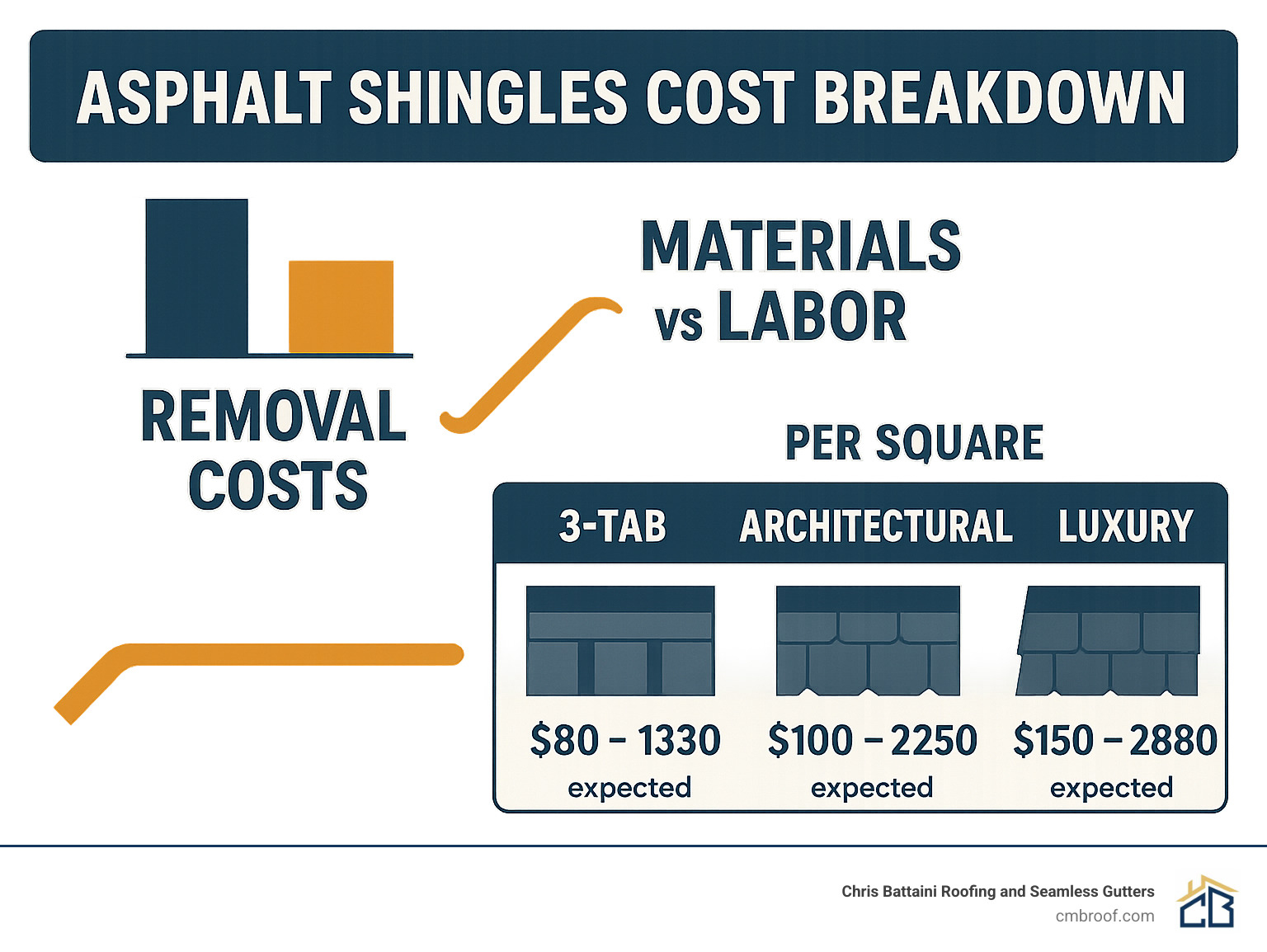
Asphalt shingles cost per square ranges from $80 to $280 for materials only, or $200 to $700 per square installed, depending on the type of shingle you choose:
| Shingle Type | Materials Only (per square) | Installed (per square) |
|---|---|---|
| 3-Tab | $80-$130 | $200-$500 |
| Architectural | $100-$250 | $400-$600 |
| Luxury/Premium | $150-$280 | $500-$700 |
When planning your roofing budget, understanding what a “square” means is essential. In roofing terms, a square equals 100 square feet of roof coverage. This industry-standard measurement helps contractors calculate materials and labor costs accurately.
For homeowners in Berkshire County and beyond, knowing the cost per square helps you budget your roofing project without surprises. Most residential roofs range from 15 to 30 squares (1,500 to 3,000 square feet), depending on your home’s size and roof complexity.
It’s worth noting that while a bundle of asphalt shingles costs between $27 and $45, you’ll need three bundles to cover one square since each bundle typically covers about 33 square feet. This translates to roughly $81 to $135 in material costs alone per square.
These figures represent average costs based on internet data, not actual pricing from Chris Battaini Roofing and Seamless Gutters. Local factors, roof complexity, and current material costs will influence your specific project quote.
Chris Battaini Roofing and Seamless Gutters services Berkshire, Hampden, Hampshire, and Franklin Counties in Massachusetts.
Must-know asphalt shingles cost per square terms:
– asphalt roof replacement
– asphalt shingle roof leak repair
– asphalt shingle roof repair
How Much Do Asphalt Shingles Cost per Square in 2025?

Looking at the roofing landscape in 2025, homeowners across Berkshire County and beyond are seeing quite a range when it comes to asphalt shingles cost per square. The national average currently sits between $80 and $280 for materials alone, while complete installation pushes that range to $200-$700 per square.
Why such a wide spread? It’s all about choices. Just like cars come in everything from basic models to luxury editions, asphalt shingles offer different tiers of quality, durability, and curb appeal. Your budget might lead you one way, while your home’s architecture or neighborhood might suggest another.
Let’s break down what you’re looking at for each type of shingle:
| Shingle Type | Materials Only (per square) | Installed (per square) | Typical Lifespan | Wind Rating |
|---|---|---|---|---|
| 3-Tab | $80-$130 | $200-$500 | 15-20 years | Up to 60 mph |
| Architectural | $100-$250 | $400-$600 | 20-30 years | Up to 130 mph |
| Luxury/Premium | $150-$280 | $500-$700 | 25-40 years | 110-130 mph |
These figures represent average costs based on internet data, not actual pricing from Chris Battaini Roofing and Seamless Gutters. Your specific project may cost more or less depending on your unique roof characteristics and current market conditions.
Average Material Prices per Square – Asphalt Shingles Cost per Square
When you’re budgeting for a new roof, understanding the bare materials cost helps set your baseline expectations. The asphalt shingles cost per square starts with the shingles themselves, which come packaged in bundles.
3-tab shingles are your budget-friendly option at $80-$130 per square. They’re lighter (about 2 pounds per square foot) and have a flat, uniform appearance. You’ll typically need 3 bundles to cover a square, with each bundle covering roughly 33 square feet.
Moving up a tier, architectural or dimensional shingles run $100-$250 per square. These mid-range options offer more texture, better shadow lines, and improved durability. They’re heavier at about 3 pounds per square foot and also typically require 3 bundles per square.
For those seeking premium curb appeal, luxury shingles cost $150-$280 per square. These top-tier options often mimic slate or wood shake appearances and can weigh up to 4 pounds per square foot. Some premium products might require 4 bundles per square since each bundle might only cover 25 square feet.
That asphalt is a petroleum product, so when oil prices climb, shingle costs often follow – sometimes by 5-10%. It’s worth asking about current material trends when you get your estimate.
Total Installed Asphalt Shingles Cost per Square
The true asphalt shingles cost per square goes beyond just the shingles themselves. Complete installation includes labor, underlayment, flashing, starter strips, ridge caps, and other components that create a complete roofing system.
With 3-tab shingles, expect total installed costs of $200-$500 per square. While they’re the most affordable option, they offer the shortest lifespan and basic warranty coverage. They’re perfectly adequate for many homes, especially in protected locations or for budget-conscious projects.
Architectural shingles typically run $400-$600 per square installed. This middle-tier option has become increasingly popular among our Berkshire County customers because they offer substantially better durability and curb appeal for a modest increase in cost. Many homeowners find this to be the sweet spot for value.
At the premium end, luxury shingles cost $500-$700 per square installed. They deliver the most sophisticated appearance and longest potential lifespan, with the most comprehensive warranty options. For distinctive homes or those in upscale neighborhoods, the investment often makes sense both aesthetically and financially over time.
Don’t forget about removal costs if you’re replacing an existing roof. Tear-off and disposal will add $100-$300 per square depending on how many layers need to be removed, local disposal fees, and how easy (or challenging) your roof is to access.
In our experience serving Western Massachusetts, most homeowners gravitate toward architectural shingles as they provide the best balance of immediate affordability and long-term value for our region’s weather conditions.
Chris Battaini Roofing and Seamless Gutters services Berkshire, Hampden, Hampshire, and Franklin Counties in Massachusetts.
Material vs. Labor: Where Does Your Money Go?
Ever wonder how your roofing dollars get divided up? When you’re looking at the asphalt shingles cost per square, understanding the allocation helps you appreciate what you’re paying for. The typical breakdown might surprise you:
- Materials: About 40% of total cost
- Labor: About 60% of total cost
That means for a roof costing $400 per square installed, roughly $160 goes toward the physical materials while $240 pays for the skilled hands installing them. Many homeowners initially focus just on shingle prices, not realizing that labor represents the lion’s share of their investment.

What exactly are you getting for that labor portion? Much more than just nails and hammers! You’re paying for professional installation expertise, proper sealing and flashing techniques, safety equipment and insurance, warranty-compliant installation methods, and thorough cleanup and disposal. These elements make the difference between a roof that lasts and one that leaks.
Beyond the shingles themselves, your project includes several essential components. Quality underlayment ($75-$400 per square) provides a crucial secondary moisture barrier and is typically required for manufacturer warranty compliance. Flashing ($2-$20 per linear foot) prevents leaks around chimneys, vents, and valleys—those areas most vulnerable to water intrusion. Ventilation components ($200-$500 total) help extend shingle life by managing attic temperature and moisture. And don’t forget permits and inspections ($100-$500), which ensure legal compliance and can be important when selling your home.
For a deeper dive into what goes into a proper installation, check out our Roof Installation page.
Tear-Off and Disposal Costs per Square
“Out with the old, in with the new” comes with its own price tag. Removing your existing roof typically costs between $1 and $3 per square foot ($100 to $300 per square). Several factors influence where you’ll fall in that range:
The number of existing layers makes a big difference—each additional layer adds roughly 50% to removal costs. If your roof already has two layers (the maximum allowed by most building codes), removal becomes mandatory before adding new shingles. Even with just one existing layer, we generally recommend removal for better results and longer roof life.
Roof accessibility plays a role too. That charming steep Victorian roof might look gorgeous, but it’s more challenging (and therefore more expensive) to tear off safely. Local disposal regulations and fees have been increasing in recent years due to environmental concerns. A typical 2,000 square foot roof generates about 2-3 tons of waste material, requiring a specialized dumpster that can cost $300-$800 depending on your location.
Labor Rates & Seasonal Swings
Labor represents the biggest chunk of your asphalt shingles cost per square, and these rates aren’t fixed in stone. According to Bureau of Labor Statistics data, roofing professionals earn between $30 and $80 per hour, translating to approximately $1.50 to $6 per square foot in labor costs for asphalt shingle installation.
Timing your project can significantly impact your bottom line. Here in Berkshire County, the roofing calendar looks something like this:
Peak Season (June-September) brings the highest demand and prices—expect to pay a premium of up to 20% during these months. The Shoulder Seasons (April-May, October-November) offer moderate demand and better pricing. The Off-Season (December-March) typically provides the best pricing, but comes with weather constraints.
Winter installations are certainly possible in our region, but they require special techniques. The self-sealing strips on shingles activate best in warm weather, so cold-weather installations may require hand-sealing, which adds to labor costs.
Roof complexity is another major factor. Those beautiful dormers and skylights that give your home character? They also increase labor costs by creating more cutting, fitting, and flashing work. A simple rectangular roof will always cost less per square than one with multiple angles and penetrations.
For the latest research on labor costs in the roofing industry, you can refer to the Bureau of Labor Statistics.
These figures represent average costs based on internet data, not actual pricing from Chris Battaini Roofing and Seamless Gutters. Your specific project may vary based on your home’s unique characteristics and current market conditions.
7 Factors That Influence Asphalt Shingle Pricing
Ever wonder why your neighbor got a different quote than you did? The asphalt shingles cost per square isn’t set in stone—it’s more like wet cement, shaped by numerous factors beyond just the shingle type. Understanding these variables helps you avoid budget surprises when planning your roof replacement:

When we talk with homeowners across Berkshire County, we often explain how oil prices directly impact shingle costs. It makes sense when you think about it—asphalt comes from petroleum, so when crude oil jumps 10%, shingle prices typically follow suit by 5-10% within a few months.
Brand selection plays a huge role too. Just like choosing between a Kia and a Mercedes, premium roofing brands command higher prices—sometimes 20-50% more—but they often deliver better performance and peace of mind through stronger warranties.
The physical characteristics of your home matter enormously. Roof size is obvious (more square footage = more materials), but roof pitch might surprise you. Those beautiful steep roofs that give New England homes their character? They require special safety equipment and more labor hours, sometimes increasing costs by 25-40%.
Regional factors affect pricing too. Here in the Northeast, our freeze-thaw cycles and heavy snow loads demand more robust installation methods than in milder climates. Plus, being a bit removed from major distribution hubs adds freight costs to our materials.
Complexity is costly. Those charming dormers, skylights, and intricate valleys that give your home character? Each one requires special cutting, flashing, and expert installation. A simple rectangular roof might cost $350 per square installed, while a complex roof with multiple features could easily hit $600 per square.
Smart homeowners can leverage bulk purchasing when possible. Larger projects often qualify for volume discounts, so if you’re considering doing your house and detached garage separately, combining them might save 5-10% on materials.
Finally, your installation approach matters. While installing new shingles over existing ones (called an overlay) can save $100-$300 per square in tear-off costs, it’s not always the best long-term decision. Many local codes limit homes to two layers maximum, and overlays can shorten your roof’s lifespan.
Brand & Warranty Premiums
Walking the shingle aisle can feel like navigating a maze of options. The major manufacturers we work with offer distinct advantages at different price points:
GAF shingles typically run $80-$160 per square for materials alone. Their Timberline HDZ architectural shingles have become a favorite among our Berkshire County customers for their excellent balance of performance and value. When installed by certified contractors, these can come with impressive limited lifetime warranties.
CertainTeed positions itself as a premium option at $90-$170 per square for materials. Their Landmark series offers exceptional wind resistance—critical for our blustery hilltop homes in Southern Vermont. Their SureStart PLUS warranty is one of the most comprehensive in the industry, covering both materials and labor for an extended period.
Owens Corning falls in the $85-$165 range for materials per square. Their Duration series features SureNail Technology, which creates a reinforced nailing area that helps shingles resist high winds—something our customers in exposed locations particularly appreciate.
Warranty upgrades typically add 10-20% to your material costs, but they can be well worth it. Many premium shingles also include algae-resistant granules containing copper or zinc—a feature that prevents those unsightly black streaks that can make a roof look old before its time.
In our experience serving homes throughout Berkshire County, most homeowners find the middle-to-upper tier architectural shingles offer the best value proposition for our climate conditions.
Roof Size, Pitch & Complexity
Your roof’s physical characteristics dramatically impact the final asphalt shingles cost per square. When we provide estimates, we look at several key factors:
For roof size calculations, we typically use a multiplier based on your home’s footprint. A moderate slope might only need a 1.1 multiplier (a 2,000 sq ft home would have roughly 2,200 sq ft of roof surface), while steep or complex roofs might require a 1.5 multiplier (making that same home need 3,000 sq ft of roofing materials).
Pitch matters tremendously. Those beautiful steep roofs that characterize many Berkshire County homes require special equipment and techniques. Low slopes (less than 4:12 pitch) often need additional underlayment to prevent water infiltration. Medium slopes (4:12 to 8:12) represent the “sweet spot” for standard installation. Steep slopes (greater than 8:12) can increase labor costs by 20-40% due to the additional safety equipment and slower installation pace.
Complexity costs more but adds character. Each dormer, skylight, chimney, and valley increases both material and labor requirements. Valleys need special treatment to prevent leaks, while roof penetrations require proper flashing to maintain waterproofing integrity.
When calculating materials, we typically add a waste allowance—10% for simple roofs and 15% for complex designs. This accounts for cutting, overlaps, and the occasional damaged shingle during installation.
For a personalized estimate based on your specific roof characteristics, visit our New Roof Cost Estimate page.
Regional Price Differences
Location significantly influences your asphalt shingles cost per square. Here in our service area of Berkshire County and Southern Vermont, several regional factors come into play:
Our Northeast climate demands more robust roofing solutions than milder regions. The freeze-thaw cycles, heavy snow loads, and occasional ice dams mean we need to install ice and water shield along eaves and valleys—adding $50-$100 per square in those areas compared to basic felt underlayment.
Transportation costs affect our pricing too. Being somewhat removed from major distribution centers means materials travel farther to reach us, adding freight charges that contractors must factor into quotes.
Local building codes in Massachusetts and Vermont are stricter than those in some other states, requiring specific underlayment types, ice barrier protection, and ventilation standards. While these requirements increase upfront costs, they protect homeowners from future problems.
The regional labor market also plays a role. Our skilled roofing professionals command different wages than the national average, reflecting both the cost of living in our area and the specialized knowledge needed for our climate conditions.
As a general rule, roofing in the Northeast runs about 5-15% higher than the national average. But this premium is an investment in durability—a properly installed roof in our region needs to withstand everything from scorching summer heat to heavy winter snow loads.
These prices represent average costs based on internet data, not actual pricing from Chris Battaini Roofing and Seamless Gutters. Your specific project may vary based on your home’s unique characteristics and current market conditions.
Chris Battaini Roofing and Seamless Gutters services Berkshire, Hampden, Hampshire, and Franklin Counties in Massachusetts.
Asphalt Shingles vs. Metal, Wood & Slate: Cost & Value Showdown
When weighing your roofing options, understanding how asphalt shingles cost per square stacks up against other materials helps you make a truly informed decision. Let’s compare the most popular roofing choices side by side:
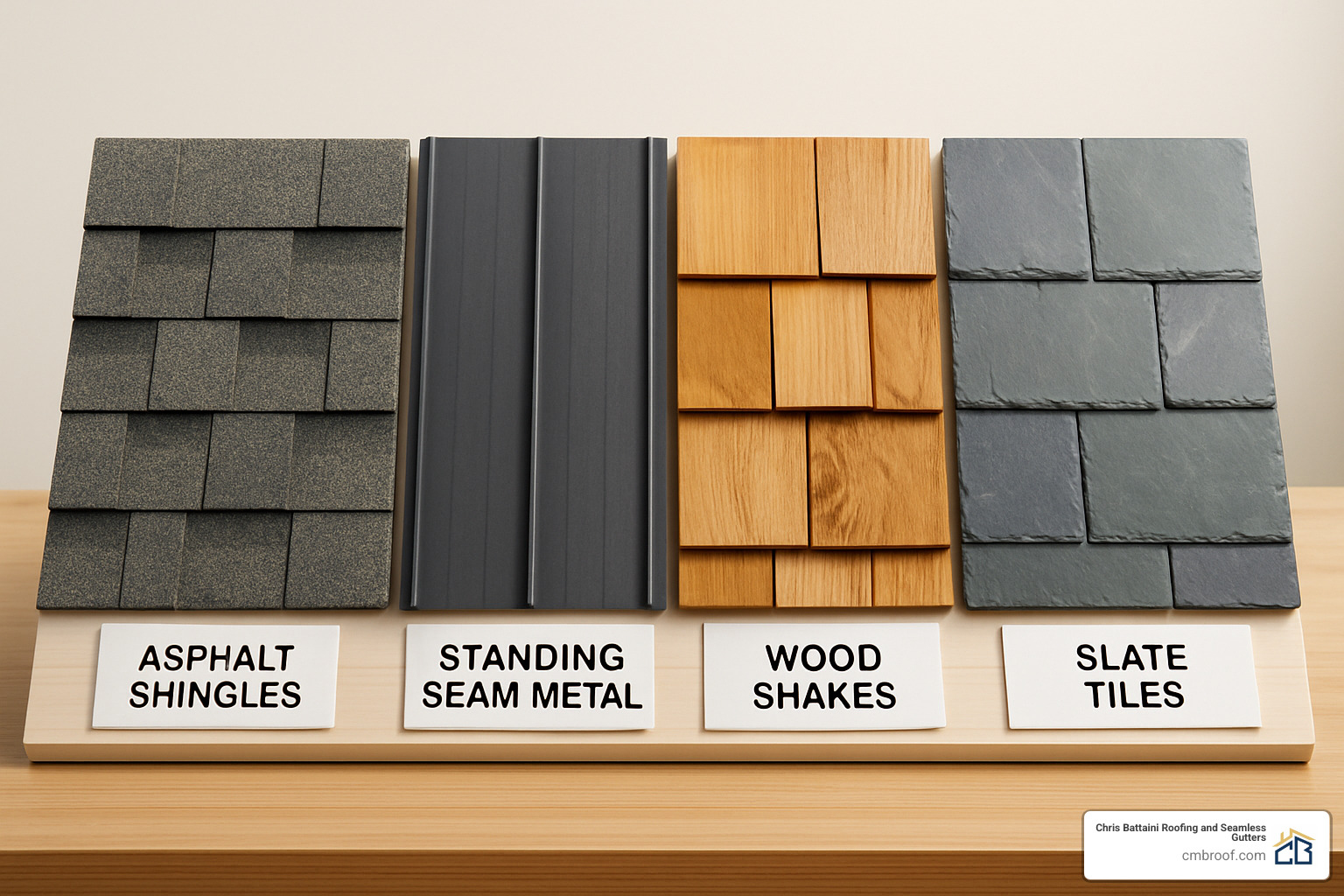
| Roofing Material | Cost Per Square (Installed) | Typical Lifespan | Key Benefits | Considerations |
|---|---|---|---|---|
| Asphalt Shingles | $200-$700 | 15-40 years | Affordable, widely available | Moderate lifespan |
| Metal Roofing | $1,000-$2,500 | 40-70 years | Longevity, energy efficiency | Higher upfront cost |
| Wood Shakes/Shingles | $600-$1,200 | 25-30 years | Natural appearance | Maintenance, fire risk |
| Slate | $2,000-$4,000 | 50-200+ years | Exceptional durability, appearance | Weight, installation expertise |
The price differences are striking, aren’t they? While asphalt shingles might seem like the obvious budget choice at first glance, savvy homeowners look beyond just the initial price tag to consider the true value over time.
Think about it this way: if you divide the cost by how many years the roof will last, the math gets interesting. Asphalt shingles might cost you $10-$35 per square per year over their lifetime. Metal roofing, despite its higher upfront investment, works out to $20-$40 per square annually when you factor in its impressive longevity. Wood shakes land at roughly $20-$48 per square yearly, while slate’s century-plus lifespan brings its annual cost down to $15-$40 per square.
But there’s more to the equation than just dollars and cents. Maintenance requirements vary dramatically between materials. Asphalt might need occasional repairs and cleaning, while metal roofs practically take care of themselves. Wood demands regular treatments to prevent rot and insect damage, and slate—though nearly indestructible—requires specialized knowledge for the rare repair.
Energy efficiency also deserves consideration, especially here in our Northeastern climate. While standard asphalt shingles offer decent performance (with “cool roof” options available for the energy-conscious), metal roofing excels at reflecting heat during summer, potentially lowering your cooling costs. Wood provides natural insulation benefits, and slate’s substantial thermal mass helps moderate temperature swings.
For most homes in Berkshire County and the surrounding areas we serve, asphalt shingles hit that sweet spot of affordability, performance, and curb appeal. Their versatility makes them suitable for nearly any architectural style, from colonial to contemporary. That said, I’ve seen stunning metal roofs on modern farmhouses and charming wood shakes on Cape Cod-style homes that perfectly complement the property’s character.
Your ideal roofing material ultimately depends on your home’s design, your budget constraints, and how long you plan to stay in your home. If you’re planning to sell within 5-10 years, the return on investment for premium materials might not make sense. But if you’re in your forever home, investing in longer-lasting options could save you the hassle and expense of a replacement down the road.
These figures represent average costs based on internet data, not actual pricing from Chris Battaini Roofing and Seamless Gutters. Your specific project costs will depend on your home’s unique characteristics and current material prices.
Smart Ways to Save & Maximize ROI
While asphalt shingles cost per square represents a significant investment, there are several strategies to maximize your value and potentially save money:
- Gather Multiple Quotes: We always recommend getting at least three estimates from reputable contractors to ensure competitive pricing.
- Consider Off-Season Installation: Scheduling your roof replacement during fall or early spring can save 10-15% compared to peak summer rates.
- Evaluate Overlay Options: Where building codes permit and your existing roof has only one layer, installing new shingles over the old ones can save on tear-off costs. However, this approach may reduce your roof’s lifespan.
- Bulk Purchasing: For larger roofs, ask about bulk discounts on materials. Some suppliers offer better rates when purchasing 20+ squares.
- Choose Mid-Tier Architectural Shingles: These often represent the best value, offering significantly better durability and appearance than 3-tab shingles for a modest price increase.
- Maintain Properly: Regular inspections and maintenance can extend your roof’s life significantly. We recommend professional inspections every 2-3 years.
According to Remodeling Magazine’s 2024 Cost vs. Value Report, asphalt shingle roof replacement offers approximately a 61.1% return on investment at resale. This makes it one of the better home improvement investments, particularly if your existing roof is at the end of its useful life.
For more detailed information on the latest ROI figures, you can refer to the 2024 Cost vs. Value Report.
Warranty & Lifespan Math
When evaluating the true asphalt shingles cost per square, consider the warranty and expected lifespan to determine long-term value:
Cost-Per-Year Analysis:
* 3-Tab Shingles: $200-$500 installed ÷ 15-20 year lifespan = $10-$33 per square per year
* Architectural Shingles: $400-$600 installed ÷ 25-30 year lifespan = $13-$24 per square per year
* Luxury Shingles: $500-$700 installed ÷ 30-40 year lifespan = $12-$23 per square per year
This analysis often reveals that mid-tier architectural shingles provide the best long-term value despite their higher initial cost. Additionally, consider these warranty factors:
- Prorated vs. Non-Prorated Coverage: Many “lifetime” warranties become prorated after 10-15 years, reducing their value
- Labor Coverage: Some premium warranties include labor for a limited period
- Transferability: Transferable warranties add value if you plan to sell your home
- Installation Requirements: Most warranties require professional installation to specific standards
Proper ventilation and installation are critical for maximizing shingle lifespan and maintaining warranty coverage. In the Berkshire County and Southern Vermont climate, factors like proper ice and water shield installation can make a significant difference in roof performance.
Financing & Tax Incentives
Managing the asphalt shingles cost per square can be easier with these financing options and potential savings:
Financing Options:
* Home equity loans or lines of credit often offer the lowest interest rates
* Contractor financing programs (typically 6-18 months)
* Credit cards with introductory 0% APR periods
* Home improvement loans from local banks
Potential Tax Incentives:
* Energy-efficient “cool roof” shingles may qualify for federal tax credits
* Home improvement loans may offer tax-deductible interest
* Check with your insurance provider, as a new roof may lower your homeowners insurance premiums
Bundled Services Savings:
* Combining your roof replacement with gutter installation can save on setup and equipment costs
* Adding proper attic insulation during roof replacement is cost-effective and improves energy efficiency
For more information about our asphalt shingle roofing services, visit our Asphalt Shingle Roofing page.
Frequently Asked Questions about Asphalt Shingle Pricing
How many bundles make a square and what do they cost?
When planning your roof replacement, understanding bundle math helps you estimate materials more accurately. In roofing terms, a “square” covers 100 square feet of roof area, but shingles come packaged in bundles that cover only a portion of a square.
For most asphalt shingles, you’ll need 3 bundles to make one square of roof coverage. Each bundle typically covers about 33.3 square feet. Some premium or luxury shingles are heavier and thicker, requiring 4 bundles per square (with each bundle covering only about 25 square feet).
The price per bundle varies significantly by shingle quality:
- 3-tab shingle bundles cost between $27-$45 each
- Architectural shingle bundles run $40-$60 each
- Luxury shingle bundles command $70-$100 each
This means your asphalt shingles cost per square for materials alone ranges from $81-$135 for basic 3-tab, $120-$180 for architectural, and $210-$400 for luxury options.
These figures represent average costs based on internet data, not actual pricing from Chris Battaini Roofing and Seamless Gutters.
Is reroofing over old shingles really cheaper?
Yes, installing new shingles over existing ones (commonly called an “overlay” or “reroof”) can indeed save you $100-$300 per square by eliminating tear-off and disposal costs. It’s tempting when you’re on a tight budget, but this approach comes with important trade-offs worth considering.
The immediate savings are clear: you’ll avoid labor costs for removing old shingles, skip disposal fees (which can be substantial), and enjoy a faster project completion. However, these short-term benefits often come at the expense of long-term performance.
Most building codes only allow a maximum of two total layers of roofing, so if you already have two layers, an overlay isn’t an option. Even with just one existing layer, overlays aren’t suitable if your current shingles are curling, buckling, or uneven.
Perhaps most importantly, adding a second layer can reduce your new roof’s lifespan by 20-25% and may limit or void manufacturer warranties. The extra weight also puts additional stress on your roof structure, which can be problematic in our snow-heavy New England winters.
For homes in Berkshire County and Southern Vermont, we typically recommend complete tear-off for best results. Our freeze-thaw cycles and significant snow loads demand a roof system installed to the highest standards. That said, an overlay might make sense in certain budget-constrained situations where the existing roof is in good condition.
How does roof pitch affect asphalt shingles cost per square?
Your roof’s pitch (or slope) significantly impacts your bottom line when it comes to asphalt shingles cost per square. This often-overlooked factor can add anywhere from 5% to 75% to your installation costs, depending on how steep your roof is.
Roofs with a medium slope (4:12 to 8:12 pitch) represent the baseline for standard installation costs. Once your pitch exceeds 8:12 (meaning the roof rises 8 inches for every 12 inches of horizontal distance), labor costs typically increase by 20-40%. For very steep roofs (12:12 or greater), that premium can jump to 40-75% above standard rates.
The reasons for these increases are practical. Steeper roofs require additional safety equipment, specialized scaffolding, and often more workers to ensure safe installation. The crew moves more slowly and carefully on steep pitches, which means the job takes longer to complete.
There are material considerations too. Steeper roofs actually have more surface area than flatter roofs with the same footprint. A 10:12 pitch roof has approximately 15% more actual surface area than a 4:12 pitch roof on the same house. Steeper pitches may also require additional fasteners and special high-wind installation methods to ensure shingles stay secure.
For homes in Berkshire County with steep roofs, these factors typically add $50-$150 per square to the installation cost. However, there’s a silver lining: steeper roofs often last longer because they shed water and snow more efficiently, which can mean better long-term value despite the higher initial investment.
Chris Battaini Roofing and Seamless Gutters services Berkshire, Hampden, Hampshire, and Franklin Counties in Massachusetts.
Conclusion
Understanding the asphalt shingles cost per square is essential when planning your roofing budget. As we’ve seen throughout this guide, these costs typically range from $80 to $280 for materials alone and $200 to $700 installed, depending on the shingle type, your roof’s unique characteristics, and regional factors.
For most homeowners in our service area, architectural shingles hit the sweet spot between affordability and performance. While they cost a bit more than basic 3-tab shingles upfront, their improved durability and aesthetic appeal typically deliver better long-term value for your investment.
Remember though – even the best shingles won’t perform properly without quality installation. At Chris Battaini Roofing and Seamless Gutters, we take pride in our owner-led approach, with Chris personally overseeing projects to ensure exceptional craftsmanship. Our deep familiarity with New England’s challenging weather patterns and local building requirements means your roof is in good hands.
When finalizing your roofing budget, I recommend taking these practical steps:
First, calculate your actual roof area in squares (remember, each square equals 100 square feet). Then consider all the factors we’ve discussed that might affect your specific project – from roof pitch to material choice. Next, gather multiple detailed estimates from reputable contractors in your area. Finally, look beyond just the bottom-line price to evaluate warranty coverage, material quality, and installation expertise.
Your roof protects everything beneath it, making it one of your home’s most crucial investments. Taking the time to understand costs and options now will help you make choices you’ll be satisfied with for decades to come.
For more information about our asphalt shingle roofing services, visit our Asphalt Shingle Roofing page.
All pricing discussed in this article represents average costs based on internet data, not actual pricing from Chris Battaini Roofing and Seamless Gutters. For a personalized quote custom to your specific home and needs, please contact us directly.
Chris Battaini Roofing and Seamless Gutters proudly services Berkshire, Hampden, Hampshire, and Franklin Counties in Massachusetts.