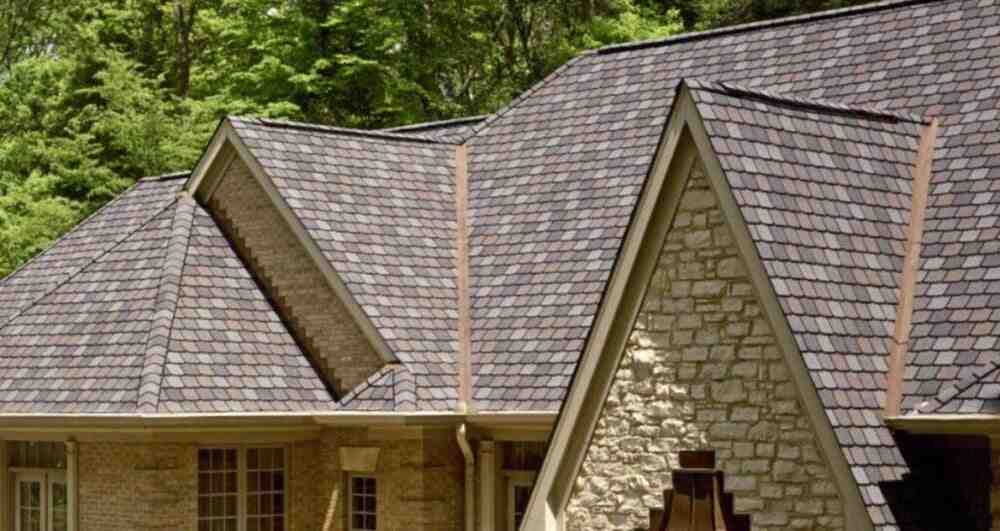

Why Understanding Architectural Shingle Roof Cost Matters for Your Investment
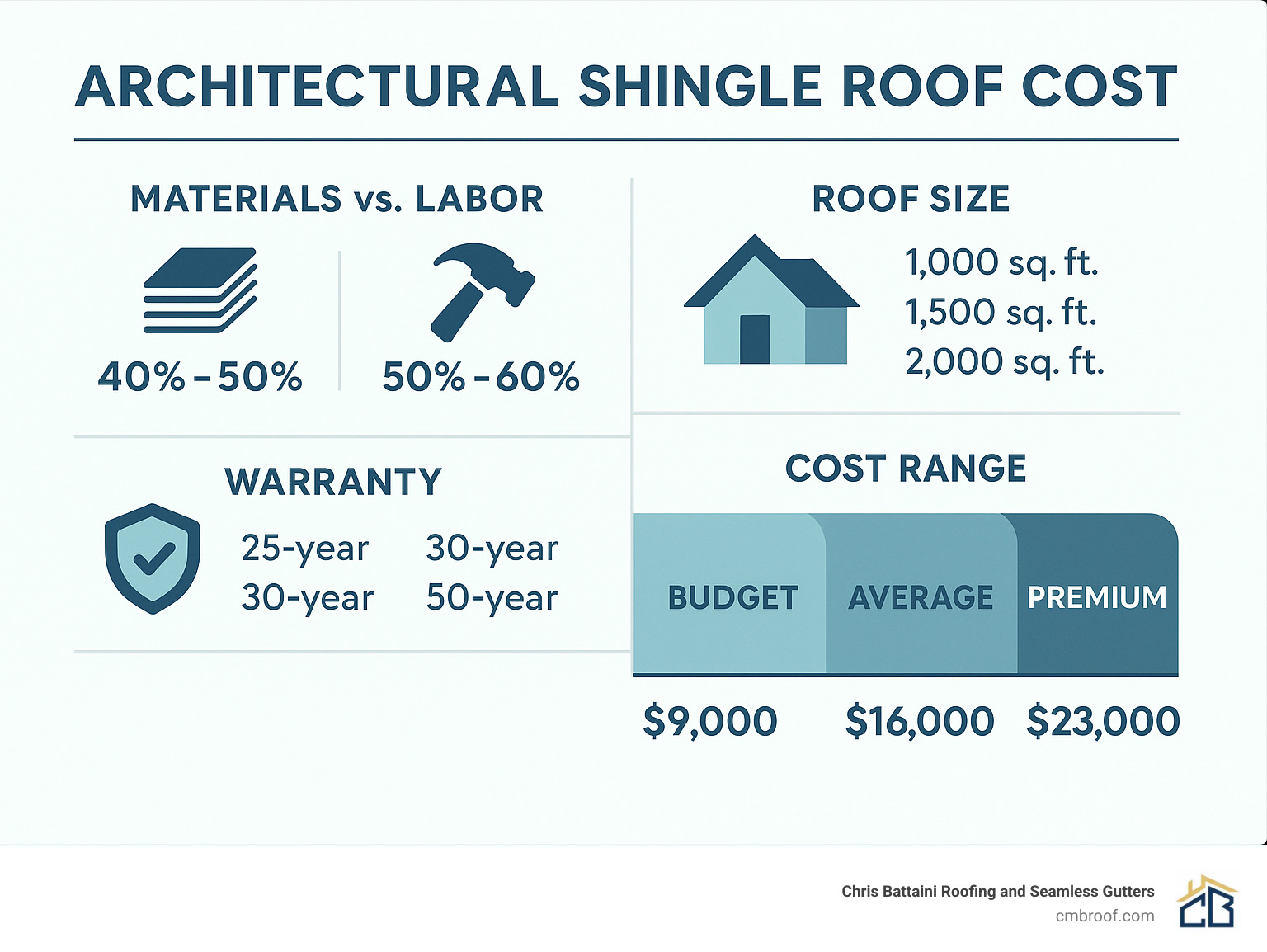
Architectural shingle roof cost varies widely, but most homeowners pay between $9,200 and $22,500 for a complete installation. Here’s what you need to know right away:
Quick Cost Breakdown:
– Per square foot: $2.50 – $10.00 (materials and labor)
– Per roofing square (100 sq ft): $400 – $600 installed
– Average total project: $14,800
– Labor portion: 50-60% of total cost
– Material portion: 40-50% of total cost
Note: These are average costs based on internet data and not actual costs for Chris Battaini Roofing and Seamless Gutters.
If you’re a Berkshire County homeowner staring at damaged shingles or planning a roof replacement, you’re probably wondering what architectural shingles actually cost – and whether they’re worth the investment over basic 3-tab shingles.
The truth is, architectural shingles cost about 25% more than standard 3-tab shingles upfront. But they last 20-30 years (nearly twice as long), resist wind damage better, and can boost your home’s value by up to 6%.
Here’s the challenge: roofing costs swing wildly based on your roof’s size, pitch, complexity, and dozens of hidden factors most homeowners never consider.
This guide breaks down every cost factor, hidden fee, and money-saving tip so you can budget accurately and avoid costly surprises. You’ll learn when architectural shingles make financial sense, what drives the price up or down, and how to spot red flags when getting quotes.
Architectural shingle roof cost glossary:
– asphalt shingle roof repair
– asphalt roof replacement
– asphalt shingle roof leak repair
What You’ll Learn
This comprehensive guide covers everything you need to know about architectural shingle pricing. We’ll walk you through pricing units, expected lifespan comparisons, return on investment calculations, and proven money-saving strategies that can cut your project cost by 15-30%.
Architectural Shingles 101: Dimensional vs. 3-Tab
If you’re shopping for a new roof, you’ve probably heard contractors toss around terms like “architectural,” “dimensional,” and “3-tab” shingles. Let’s clear up the confusion before we dive into architectural shingle roof cost.
Think of architectural shingles as the “premium” version of basic asphalt shingles. While your standard 3-tab shingles are flat and uniform, architectural shingles are built with multiple layers of asphalt laminated together. This creates the thick, dimensional look that mimics expensive materials like slate or cedar shakes.
The construction difference is significant. Where 3-tab shingles weigh around 230-250 pounds per roofing square (100 square feet), architectural shingles tip the scales at 400-430 pounds per square. That extra weight isn’t just bulk – it’s added durability and weather protection.
Here in Berkshire County, where we see everything from ice storms to summer thunderstorms, wind resistance becomes crucial. Most architectural shingles handle winds of 110+ mph, while basic 3-tab shingles typically max out around 60-70 mph.
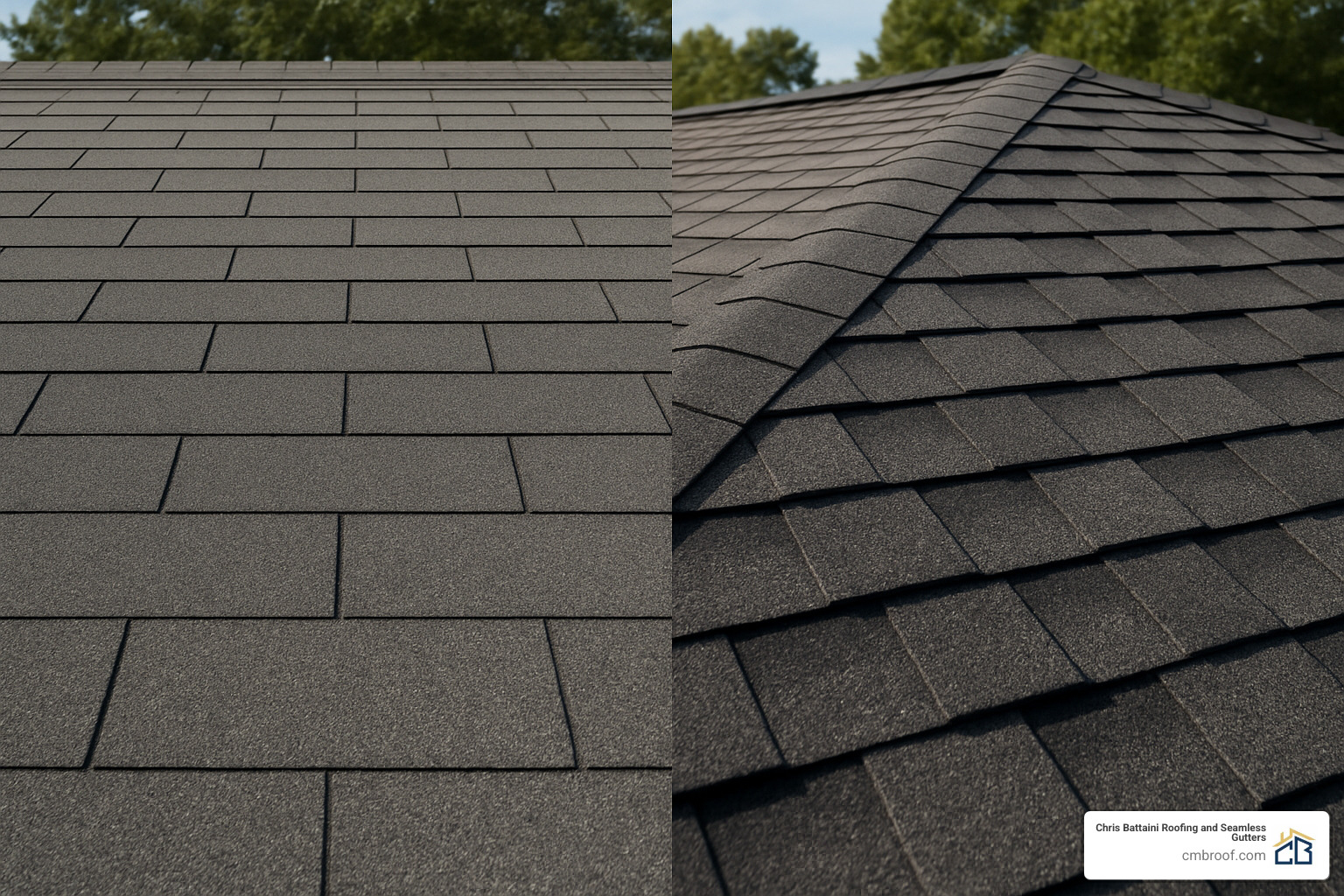
The warranty coverage tells the real story about quality. Basic 3-tab shingles usually come with 10-20 year warranties. Architectural shingles? You’re looking at 30-50 year warranties, with some premium products offering lifetime coverage.
From a curb appeal standpoint, there’s no contest. Architectural shingles add depth and shadow lines that make your roof look more expensive and sophisticated.
The upgrade premium typically runs 25-40% over 3-tab shingles upfront. But when you factor in roughly double the lifespan, better storm protection, and improved home value, the math often works in favor of going dimensional.
Note: Pricing mentioned reflects average costs based on internet data and not actual costs for Chris Battaini Roofing and Seamless Gutters.
Breaking Down Architectural Shingle Roof Cost Per Sq.Ft. & Per Square
When you’re shopping for a new roof, understanding pricing units saves you from sticker shock and helps you compare quotes accurately. Most roofing contractors price by the “roofing square” – which equals 100 square feet of roof surface. So if your roof measures 1,500 square feet, that’s 15 squares.
Architectural shingle roof cost typically runs $2.50 to $10.00 per square foot installed, with most homeowners paying around $400 to $600 per roofing square. Materials arrive in bundles that cover roughly 33 square feet each, costing $40 to $60 per bundle.
These are average costs based on internet data and not actual costs for Chris Battaini Roofing and Seamless Gutters.
Here’s what drives that wide price range: labor makes up 50-60% of your total cost, while materials account for 40-50%. This split means local labor rates dramatically impact your final bill. In our Massachusetts and Vermont service areas, skilled roofers command premium wages because they’re dealing with harsh winters, steep roofs, and seasonal demand that creates scheduling challenges.
The math gets interesting when you consider high-end installations. Premium projects easily cost three times the average when you’re dealing with complex roof designs featuring multiple valleys, dormers, or steep pitches. Add premium shingle brands, extensive deck repairs, or upgraded underlayment systems, and costs climb quickly.
Regional differences are eye-opening too. California homeowners average $21,500 for architectural shingle installations, New York hits $18,200, while Texas comes in around $13,700 for similar-sized projects. Weather patterns, local building codes, and labor availability all play a role.
| Shingle Type | Cost per Sq Ft | Warranty | Expected Lifespan |
|---|---|---|---|
| 3-Tab Asphalt | $3.70-$8.75 | 10-20 years | 15-20 years |
| 30-Year Architectural | $4.00-$7.00 | 30 years | 20-25 years |
| 50-Year Architectural | $6.00-$8.50 | 50 years | 25-30 years |
Costs based on internet research averages
Safety considerations during installation are serious business. Professional roofers follow strict protocols outlined in scientific research on roofing safety to protect workers and ensure quality installation.
Average architectural shingle roof cost by roof size
Real-world architectural shingle roof cost varies dramatically based on your roof’s complexity, but here’s what homeowners typically pay for complete installations:
A 1,000 square foot roof runs $4,000 to $12,000 total. Simple gable roofs with minimal complexity hit the lower end at $4,000 to $7,000, while complex designs with multiple angles push costs to $8,000 to $12,000.
1,500 square foot roofs cost $6,000 to $18,000. Again, simple designs stay in the $6,000 to $10,500 range, but add dormers, valleys, or steep pitches and you’re looking at $12,000 to $18,000.
2,000 square foot roofs range from $8,000 to $24,000. Basic ranch-style homes might hit $8,000 to $14,000, while Victorian or Colonial homes with complex rooflines easily reach $16,000 to $24,000.
These wide ranges aren’t just contractor markup – they reflect real differences in labor time, material waste, and installation difficulty. A simple gable roof might take two days to complete, while a complex hip roof with multiple dormers could require a full week.
These costs are internet research averages, not Chris Battaini Roofing and Seamless Gutters pricing.
For detailed breakdowns of pricing factors specific to asphalt shingles, check out More info about Asphalt Shingles Cost Per Square.
Architectural shingle roof cost: 30-Year vs 50-Year
The warranty tier you choose impacts both upfront investment and long-term value. Most homeowners wrestle with whether the premium for 50-year shingles makes financial sense.
30-year architectural shingles cost $4.00 to $7.00 per square foot installed and typically last 20-25 years in real-world conditions. They offer basic algae resistance and wind ratings around 110+ mph – solid performance for most homes.
50-year architectural shingles bump the price to $6.00 to $8.50 per square foot installed, representing a 10-20% price increase over 30-year options. But you get meaningful upgrades: improved lifespan of 25-30 years, better algae resistance, higher wind ratings (often 130+ mph), and superior granule adhesion that maintains appearance longer.
The ROI calculation favors 50-year shingles if you’re planning to stay put for more than a decade. That modest price bump delivers roughly 20-25% more lifespan, plus improved weather resistance that reduces maintenance headaches down the road.
These are average costs based on internet data and not actual costs for Chris Battaini Roofing and Seamless Gutters.
What Drives the Price? 10 Hidden Factors Homeowners Miss
When homeowners ask about architectural shingle roof cost, they usually focus on shingle selection and roof square footage. But here’s what catches most people off guard: the “extras” that can easily double your project cost without warning.
Roof pitch and complexity top the list of cost drivers most homeowners underestimate. That beautiful steep roof that gives your home such character? It requires safety equipment, specialized installation techniques, and significantly more labor time. Roofs with an 8:12 pitch or steeper can add 30-50% to your labor costs compared to a simple gable design.

Complex hip roofs with multiple valleys, dormers, and intersections create another cost bump. Every valley needs special flashing, every dormer requires careful detail work, and every intersection increases installation time.
Tear-off requirements add $1-$5 per square foot to your project, but skipping this step with architectural shingles is asking for trouble. Multiple layers of old shingles, stubborn materials, or roofs with extensive nailing can push tear-off costs toward the higher end of that range.
Roof deck repairs that only become visible after tear-off can be a major surprise. We’ve seen homeowners budget for a straightforward shingle replacement, only to find extensive rot or structural damage underneath. Deck repairs average $2-$7 per square foot, and extensive damage requiring full deck replacement can add thousands to your project.
Underlayment upgrades might seem like a small detail, but they make a huge difference in our New England climate. Basic felt underlayment costs $0.10-$0.50 per square foot, while premium synthetic underlayment runs $0.50-$1.20 per square foot. That synthetic underlayment provides superior moisture protection during our harsh winters.
Flashing replacement around chimneys, vents, skylights, and valleys costs $15-$40 per linear foot, but proper flashing prevents 90% of roof leaks. We always recommend replacing flashing during a full roof replacement.
Permits and disposal fees add another layer of costs many homeowners forget. Municipal permits range from $100-$800 depending on your location and project scope. Disposal fees for old roofing materials add $40-$80 per ton, and a typical 2,000 square foot roof generates 3-6 tons of waste.
Seasonal demand creates significant price swings. Peak season installation (late spring through early fall) commands premium pricing when every contractor is booked solid. Off-season installation can save 15-40% on labor costs.
Local labor rates vary dramatically even within our service area. Skilled roofers in high-demand markets command $50-$100 per hour versus $30-$60 in more rural areas.
These cost ranges represent internet research averages and not actual costs for Chris Battaini Roofing and Seamless Gutters.
The bottom line? What starts as a $12,000 roofing estimate can legitimately grow to $20,000 or more when these factors stack up. That’s not contractor greed – it’s the reality of proper roofing installation.
For comprehensive information about material options that affect pricing, visit More info about Roofing Materials.
Repair, Replace or DIY? Finding the Smart Money Move
When your roof starts showing its age, you’re facing a classic homeowner dilemma: patch it up, replace the whole thing, or roll up your sleeves and tackle it yourself?
Repair costs typically range from $500 to $2,200, making this the most budget-friendly option upfront. Minor fixes like replacing a handful of damaged shingles might only set you back $150 to $1,000. But when you’re looking at structural repairs involving deck damage, costs can jump to $3,000 to $6,000 pretty quickly.
These are average costs based on internet data and not actual costs for Chris Battaini Roofing and Seamless Gutters.
Here’s a rule of thumb: if repair costs exceed 30% of replacement cost, it’s time to replace the whole roof. Otherwise, you’re just kicking the can down the road.
Full replacement delivers a solid 50-70% return on investment in increased home value. In desirable Berkshire County areas like Lenox or Great Barrington, a quality roof replacement often returns even more than the national average.
But here’s where things get serious: roofing ranks among the most dangerous construction activities. Professional roofers carry proper insurance, use safety equipment that meets OSHA standards, and understand fall protection requirements outlined in scientific research on roofing safety.
There’s another gotcha most homeowners don’t realize: DIY installation typically voids manufacturer warranties. Most architectural shingle warranties require certified professional installation to remain valid.
For detailed replacement information, see More info about Asphalt Roof Replacement.
DIY vs. Pro cost comparison for architectural shingles
Going the DIY route means you’re looking at architectural shingles costing $100 to $250 per square for materials alone. Add underlayment at $50 to $100 per square, flashing and accessories running $200 to $500, tool and equipment rental hitting $300 to $800, and disposal fees of $300 to $600.
For a typical 2,000 square foot roof, total DIY costs range from $3,000 to $7,000. That’s material-only pricing that doesn’t account for your time, the learning curve, or potential mistakes.
These are average costs based on internet data and not actual costs for Chris Battaini Roofing and Seamless Gutters.
Professional installation runs $8,000 to $20,000 for the same roof, but includes labor, materials, permits, cleanup, full warranty coverage, insurance protection, and code compliance guarantees.
The DIY savings look tempting until you factor in the reality: you’re looking at 40+ hours of dangerous physical labor, the potential for costly mistakes that aren’t covered by any warranty, voided manufacturer warranties, and no insurance coverage if accidents happen.
Most homeowners who start DIY roofing projects either hire professionals to finish the job or end up redoing work that didn’t meet code requirements.
Value, Lifespan & ROI: Are Architectural Shingles Worth It?
The short answer? Architectural shingle roof cost pays for itself when you look beyond the initial sticker shock.
Most homeowners get 20-30 years from quality architectural shingles, nearly double the lifespan of basic 3-tab shingles. In our tough New England climate – with those brutal nor’easters, ice storms, and temperature swings – quality architectural shingles regularly hit the 25-30 year mark when properly maintained.
These shingles earn their keep through superior wind resistance (we’re talking 110-130+ mph ratings versus 60-70 mph for basic shingles) and Class A fire ratings. When Mother Nature throws her worst at your home, you’ll appreciate having that extra protection.
Quality roofing can boost your home value by approximately 6%. On a $300,000 home, that’s $18,000 in added value for what might be a $15,000 investment. The math works even better when you factor in the improved curb appeal that makes your home stand out in the neighborhood.
These are average costs based on internet data and not actual costs for Chris Battaini Roofing and Seamless Gutters.
Real estate professionals consistently tell us that roof condition influences buyer perception more than almost any other home feature. A fresh architectural shingle roof signals to potential buyers that they won’t face major roofing expenses for decades.
Insurance companies recognize the value too. Many offer discounts for impact-resistant shingles, algae-resistant coatings, and proper installation by certified contractors. These savings compound over your roof’s lifetime, sometimes recovering upgrade costs within 5-7 years in hail-prone areas.
The energy efficiency angle is becoming increasingly important as our Massachusetts summers get hotter. Light-colored architectural shingles with reflective granules can reduce cooling costs by 10-15%. When you combine that with proper attic ventilation, you’re looking at meaningful annual savings.
For detailed research on roofing longevity expectations, this scientific research on roof longevity provides valuable insights into different roofing system lifespans.
Architectural shingles and home resale value
Professional appraisers don’t mess around when it comes to roof condition. A quality architectural shingle roof immediately signals: recent major maintenance completion, 20+ years before replacement needed, improved weather protection, and modern aesthetic appeal.
The visual impact matters more than many homeowners realize. Architectural shingles create that premium dimensional appearance that photographs beautifully for listing photos and impresses during showings.
Transferable warranties add another layer of value. Some manufacturers offer warranties that pass to new homeowners, giving buyers peace of mind about potential roof repairs.
Insurance and energy-efficiency perks
Impact-resistant shingles qualify for insurance discounts ranging from 5-35%, depending on your location and insurance company. In areas prone to hail damage, these savings can recover the upgrade cost within 5-7 years.
The cool roof benefits are becoming increasingly relevant as climate patterns shift. Light-colored shingles with reflective granules reduce heat absorption, potentially lowering cooling costs by $100-$300 annually. Over a 25-year roof lifespan, you’re looking at substantial savings.
Proper ventilation upgrades during architectural shingle installation provide another efficiency boost. Adequate ventilation prevents ice dams (crucial in our climate), reduces cooling costs, and actually extends shingle life by preventing excessive heat buildup in summer.
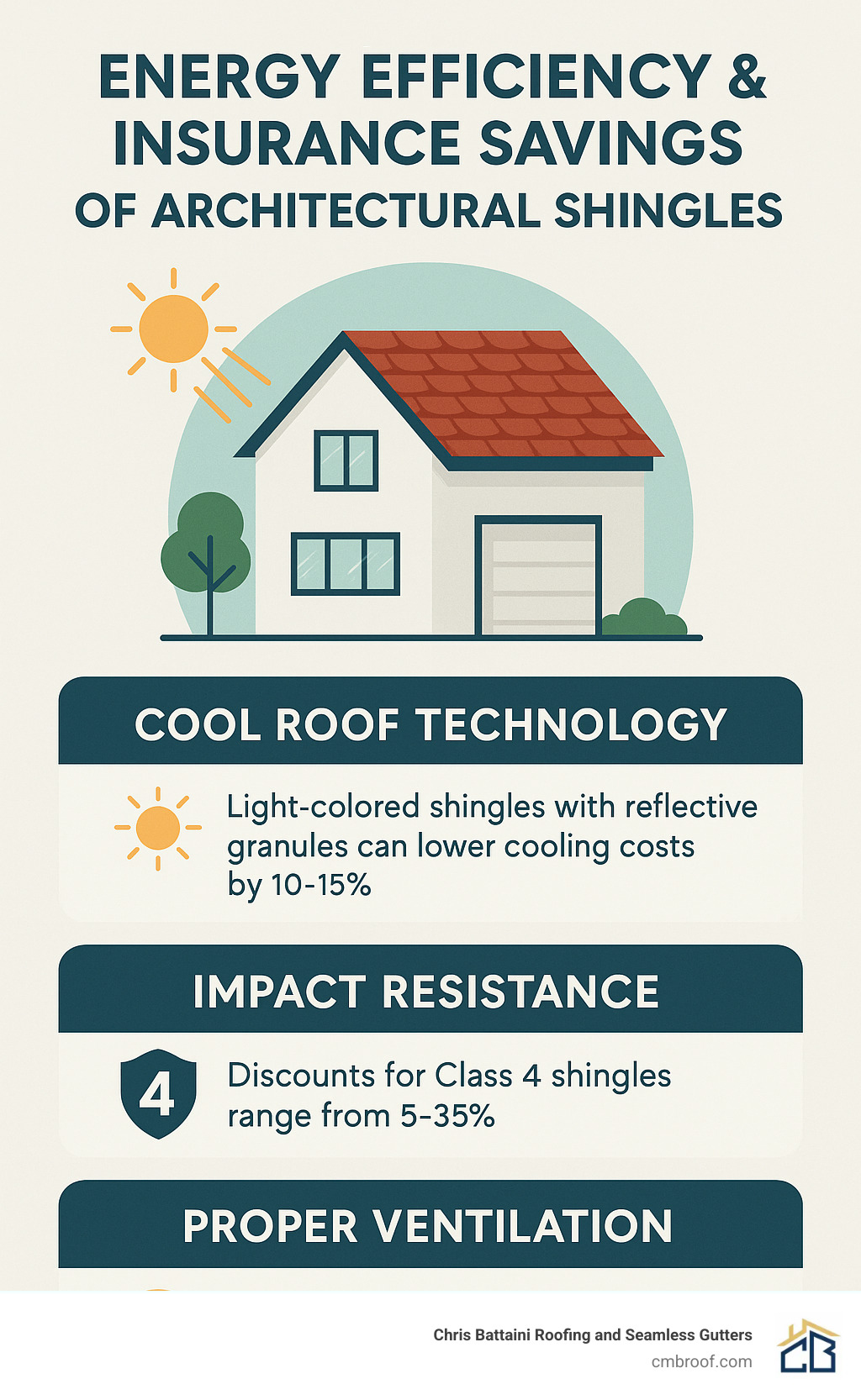
The bottom line? Architectural shingles deliver measurable value through longer lifespan, better weather protection, improved home value, insurance savings, and energy efficiency. The initial cost premium pays for itself multiple times over through these combined benefits.
Frequently Asked Questions about Architectural Shingle Roof Cost
How often should architectural shingles be replaced?
Most architectural shingles last 20-30 years, but here in our New England climate, you might see the lower end of that range more often. Our Berkshire County winters are tough on roofs – those freeze-thaw cycles and ice dams can shorten your shingle lifespan to around 20-25 years.
The key is staying on top of maintenance. We recommend professional inspections every 3 years to catch problems before they become expensive headaches. Between professional visits, take a walk around your house annually and look for obvious warning signs from the ground level.
Watch for missing or damaged shingles after storms, granule buildup in your gutters, curling or cracking shingles, and exposed nail heads. If you’re seeing multiple leaks, widespread granule loss, or notice your energy bills creeping up due to poor insulation, it’s probably time to start planning your replacement.
Can I install architectural shingles over an existing roof?
This is one of those “just because you can doesn’t mean you should” situations. While roof-overs are sometimes possible, they come with serious drawbacks that usually make them a poor choice for architectural shingles.
Building codes typically limit roofs to two layers maximum. If you already have two layers, you’ll need complete tear-off anyway. But even if you’re legally allowed to do a roof-over, here’s why we usually don’t recommend it:
Architectural shingles are heavy – 400-430 pounds per square, nearly double the weight of basic 3-tab shingles. Adding that weight to your existing roof might exceed what your home’s structure can safely handle.
Here’s the real kicker: most manufacturers void their warranties for roof-over installations. Remember those 30-50 year warranties that make architectural shingles attractive? You lose all that protection with a roof-over.
We almost always recommend complete tear-off for architectural shingle installation. Yes, it costs more upfront, but you get proper performance, full warranty coverage, and peace of mind knowing your roof deck is in good shape.
What questions should I ask a roofing contractor before hiring?
Protecting your architectural shingle roof cost investment starts with asking the right questions upfront. A quality contractor will welcome your questions and provide detailed, confident answers.
Start with the basics: “Are you licensed and insured?” In Massachusetts and Vermont, contractors need proper licensing. Ask to see current insurance certificates for both general liability and workers’ compensation.
Experience matters with architectural shingles. Ask “How many architectural shingle roofs have you installed in the past year?” and “Are you certified by major shingle manufacturers?”
Warranty coverage is crucial. Find out what workmanship warranty they provide, ask for local references from the past two years, and understand their process for handling warranty claims.
Get specific about project details: Will they obtain necessary permits? How will they protect your property during installation? What’s their cleanup process like? How do they handle weather delays?
Quality contractors are proud to answer these questions. Be wary of anyone who seems evasive, pressures you to sign immediately, or can’t provide proper documentation.
Conclusion
Your architectural shingle roof cost investment is one of the smartest moves you can make for your home’s protection and value. While that $9,200-$22,500 price range might seem steep at first glance, you’re getting decades of reliable protection, improved curb appeal, and a solid return on your investment.
Think of it this way: spread that cost over 25-30 years of protection, and you’re looking at roughly $1-2 per day to keep your family dry and comfortable. Not bad for something that also boosts your home’s value by up to 6% and potentially saves you money on insurance premiums.
Smart budgeting starts with realistic expectations. Get at least three detailed quotes from licensed, insured contractors – but don’t just pick the cheapest option. Factor in those hidden costs we discussed, like permits, disposal fees, and potential deck repairs that only show up after tear-off begins.
If you’re planning to stay in your home for more than 10 years, 50-year architectural shingles make financial sense despite the 10-20% upfront premium. The extra durability and improved weather resistance pay for themselves over time, especially in our challenging New England climate.
Timing your project strategically can save serious money. Off-peak season installation (late fall or early spring) often brings 15-30% savings on labor costs. Just make sure your current roof can wait – emergency replacements always cost more.
Here’s what you absolutely shouldn’t compromise on: proper installation by experienced professionals. Cutting corners to save a few thousand upfront often leads to expensive repairs, voided warranties, and headaches down the road. Quality installation is what turns architectural shingles from an expense into an investment.
All the pricing ranges we’ve discussed are average costs based on internet data and not actual costs for Chris Battaini Roofing and Seamless Gutters. Every roof tells its own story – your pitch, complexity, size, and local conditions all influence the final number.
The bottom line? Architectural shingles deliver real value through reduced maintenance, better weather protection, improved curb appeal, and increased home value. When installed properly by experienced professionals, they provide decades of reliable protection for your most important investment.
For comprehensive roof replacement services custom to your specific needs, visit More info about Residential Roof Replacement Service.
Chris Battaini Roofing and Seamless Gutters proudly serves Berkshire, Hampden, Hampshire, and Franklin Counties in Massachusetts, bringing owner-led service and exceptional workmanship warranties to every architectural shingle installation project.