
Understanding the Real Cost of Seamless Gutters
Looking for quick answers about continuous gutter cost? Here’s what you need to know:
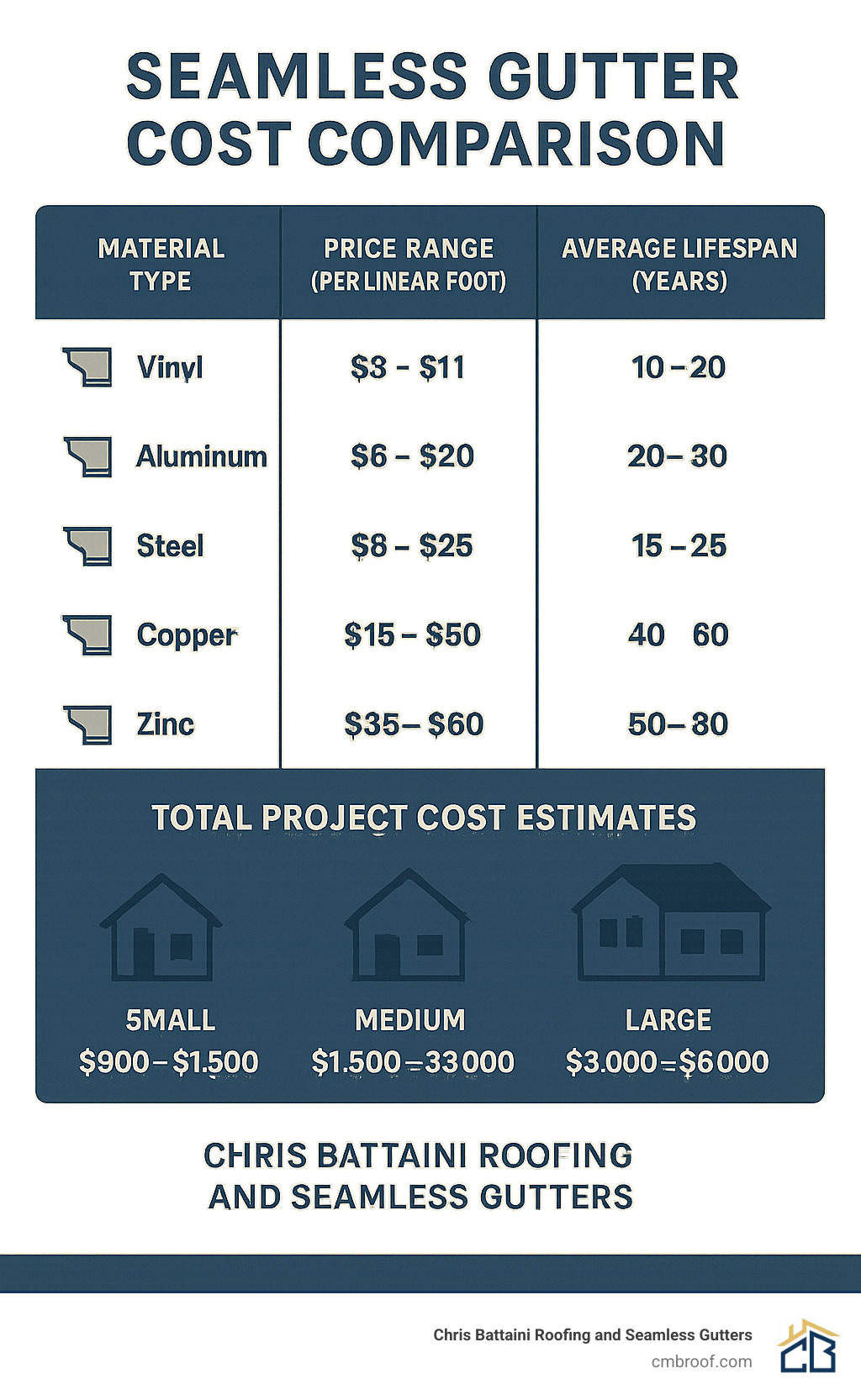
- Average Cost Range: $6-$20 per linear foot installed for aluminum (most common)
- Total Project Cost: $900-$3,000 for typical homes (higher for premium materials)
- Material Price Breakdown:
- Vinyl: $3-$11 per linear foot
- Aluminum: $6-$20 per linear foot
- Steel: $8-$25 per linear foot
- Copper: $15-$50 per linear foot
- Zinc: $35-$60 per linear foot
- Installation Labor: Additional $3-$7 per linear foot
When it comes to protecting your home from water damage, few investments are as important as a quality gutter system. Continuous gutter cost refers to the price of seamless gutters that are custom-formed on-site to fit your home perfectly. Unlike sectional gutters with multiple connection points that can leak, seamless gutters offer superior protection and curb appeal.
As Noah Lantz, director of the Rain Gutter Association, notes: “Marketing is by far the most expensive part of procuring gutter jobs.” This insight helps explain why prices can vary so dramatically between contractors for seemingly identical work.
The national average for seamless gutter installation runs about $2,200, with a typical range between $1,400 and $7,500 depending on your home size, material choice, and location. A standard American home requires approximately 100-200 linear feet of guttering.
What makes continuous gutters worth considering despite their higher upfront cost? Their reduced maintenance needs, fewer leak points, and longer lifespan (20-50 years for most materials) often justify the investment compared to sectional systems that typically develop leaks within 3-5 years.
Note: These are average costs based on internet data and not actual costs for Chris Battaini Roofing and Seamless Gutters.
Important continuous gutter cost terms:
– attaching gutter
– seamless gutter systems
What Are Continuous (Seamless) Gutters & Why They Matter
When it comes to protecting your home from water damage, not all gutter systems are created equal. Continuous gutters (or seamless gutters as they’re often called) represent the gold standard in modern rain management systems for your home.

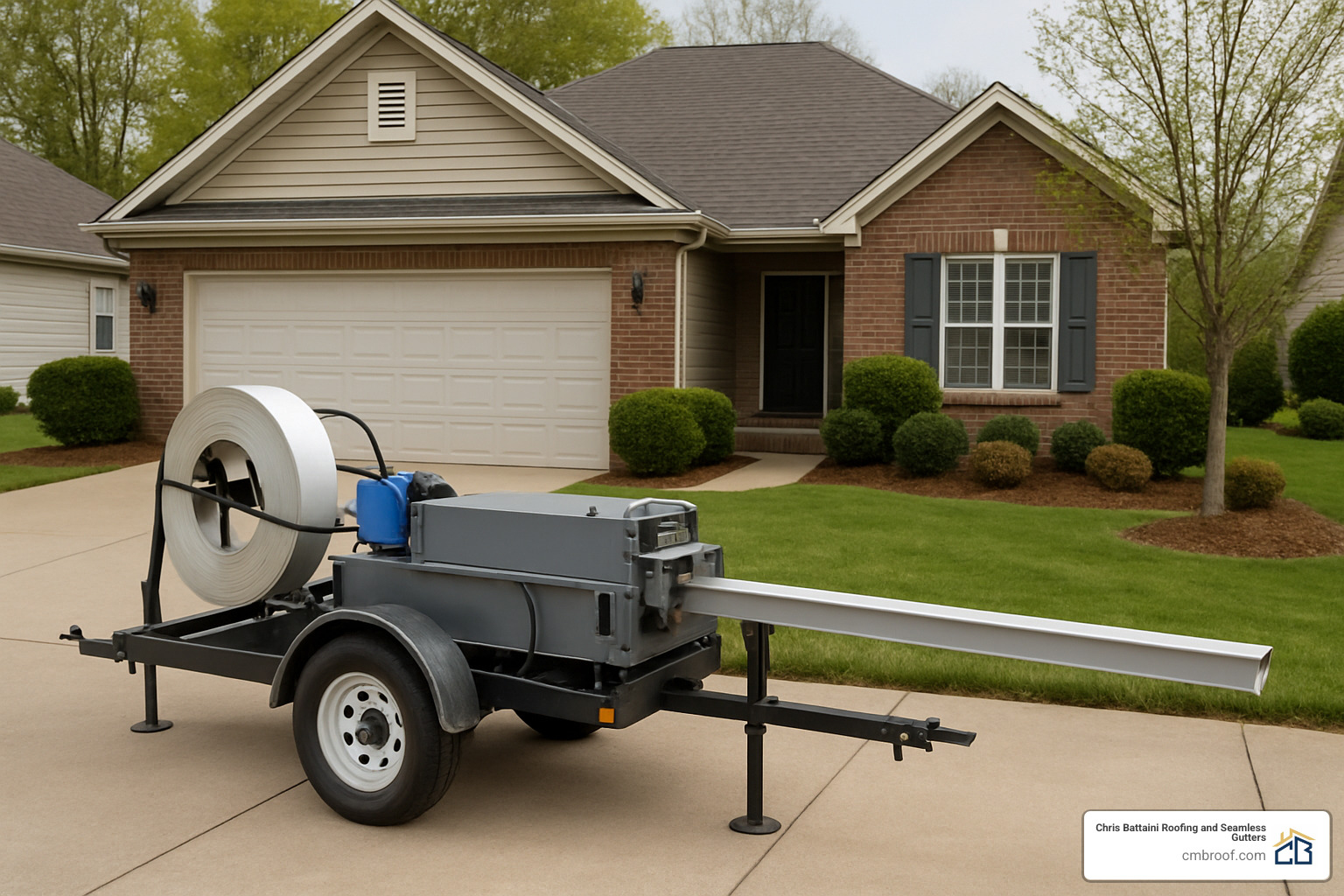
True to their name, seamless gutters are crafted from a single continuous piece of material, custom-formed right in your driveway to match your home’s exact dimensions. Unlike traditional sectional gutters that come in pre-cut pieces and get assembled like a puzzle, seamless systems only have joints at corners and where downspouts connect. This one-piece design makes all the difference in performance and longevity.
The Key Differences Between Seamless and Sectional Gutters
The battle between seamless and sectional gutters isn’t much of a contest when you look at the facts. Continuous gutter cost might be higher initially, but the benefits quickly add up.
Sectional gutters come with seams every 10-20 feet, creating numerous potential weak points where water can escape. These connection points are like tiny ticking time bombs for your home’s foundation. Seamless gutters eliminate these vulnerable spots, dramatically reducing your risk of leaks and water damage.
The custom fabrication process is fascinating to watch – specialized trucks arrive with roll-forming machines that create your gutters on the spot. This ensures a perfect fit for your home’s unique measurements, unlike the “close enough” approach of sectional systems.
While handy homeowners might tackle sectional gutter installation as a weekend project, seamless gutters require professional installation. The equipment needed to form them properly simply isn’t available at your local hardware store.
Perhaps most impressive is the longevity difference. A quality seamless system typically lasts 20-50 years (depending on material), while sectional gutters often begin showing problems after just 3-5 years. With fewer seams to collect debris and cause clogs, seamless systems also require less regular maintenance and cleaning.
Common Styles of Seamless Gutters
When selecting seamless gutters, you’ll typically choose between two main profile styles:
K-Style gutters feature a decorative front edge resembling crown molding, offering both curb appeal and greater water capacity. These are the most popular choice for modern homes, with a typical continuous gutter cost of $8-$15 per linear foot installed.
Half-Round gutters have a semicircular profile that complements historic homes or properties with traditional architectural styles. They typically cost slightly more at $9-$17 per linear foot installed.
Your choice between these styles affects both function and aesthetics. K-style gutters can handle about 40% more water than half-round of the same width, making them ideal for areas with heavy rainfall. Half-round gutters, while classically beautiful, tend to be more expensive and may require special hangers for installation.
Want to explore the benefits of seamless gutters in greater depth? Visit our detailed More info about Seamless Gutters page to learn why so many homeowners are making the switch to this superior system.
Note: These are average costs based on internet data and not actual costs for Chris Battaini Roofing and Seamless Gutters.
Continuous Gutter Cost: 2025 Price Breakdown
Let’s talk money—because when it comes to protecting your home, you need to know what you’re getting into. The continuous gutter cost picture in 2025 has some interesting wrinkles, thanks to shifts in material costs and the ever-changing labor market. I’m going to break this down in a way that makes sense for your budget planning.
Average continuous gutter cost per linear foot in 2025
Your choice of material makes the biggest impact on what you’ll pay. Think of it like choosing between a Honda and a Mercedes—both will get you there, but there’s definitely a difference in price and performance.
Vinyl gutters sit at the budget-friendly end at $3-$11 per foot. They’re light on your wallet and won’t rust, but they might not be your forever gutters—especially in our New England winters where they can get brittle when temperatures plunge.
Most homeowners gravitate toward aluminum, priced between $6-$20 per foot. It hits that sweet spot of durability and affordability. They’re rust-resistant and come in plenty of colors to match your home’s personality, though they might show some battle scars after a serious hailstorm.
Steel steps things up in the strength department at $8-$25 per foot. Think of these as the workhorses of the gutter world—they’ll stand up to just about anything Mother Nature throws at them, though they can eventually rust if their protective coating gets damaged.
If you’re looking for the luxury option, copper gutters run $15-$50 per foot. They’re not just gutters; they’re a statement piece that will eventually develop that gorgeous green patina over time. They’ll likely outlast your mortgage too, with a 50+ year lifespan.
The premium zinc option comes in at $35-$60 per foot. Like copper, these are the marathon runners of gutters, developing a protective patina that helps them last for generations.
Now, don’t forget the labor—that typically adds another $3-$7 per linear foot to your continuous gutter cost. So your all-in installed price looks more like:
- Vinyl: $6-$18 per linear foot installed
- Aluminum: $9-$27 per linear foot installed
- Steel: $11-$32 per linear foot installed
- Copper: $18-$57 per linear foot installed
- Zinc: $38-$67 per linear foot installed
Note: These are average costs based on internet data and not actual costs for Chris Battaini Roofing and Seamless Gutters.
For the freshest numbers on what you might expect to pay, take a peek at the Latest research on seamless gutter prices.
Total continuous gutter cost for a typical home
So what does this mean for your whole house? Most homes need between 100-200 linear feet of guttering—picture wrapping a ribbon around your roofline, and that’s roughly your gutter length.
For a typical single-story home needing about 150 linear feet, here’s what your investment might look like:
- Vinyl: $900-$2,700
- Aluminum: $1,350-$4,050
- Steel: $1,650-$4,800
- Copper: $2,700-$8,550
- Zinc: $5,700-$10,050
There are a few other line items that might show up on your estimate. Old gutter removal will add about $1-$2 per foot ($150-$300 for most homes). You’ll need downspouts too—typically 4-6 of them at $5-$17.50 each. Don’t forget about disposal fees (around $100) and possibly permits ($25-$100 depending on where you live).
Got a two-story colonial or a split-level ranch? Add another $1-$3 per foot to your continuous gutter cost. Working at heights requires extra safety equipment and time, and that gets factored into the price.
Here in our neck of the woods—Berkshire County and Southern Vermont—we have to think about winter’s heavy hand. Our installers often recommend heavier gauge materials (.032 inch instead of the standard .027 inch) to handle snow and ice loads. This might bump your material costs up by 10-15%, but it’s money well spent when January rolls around.
7 Factors That Move Your Final Price
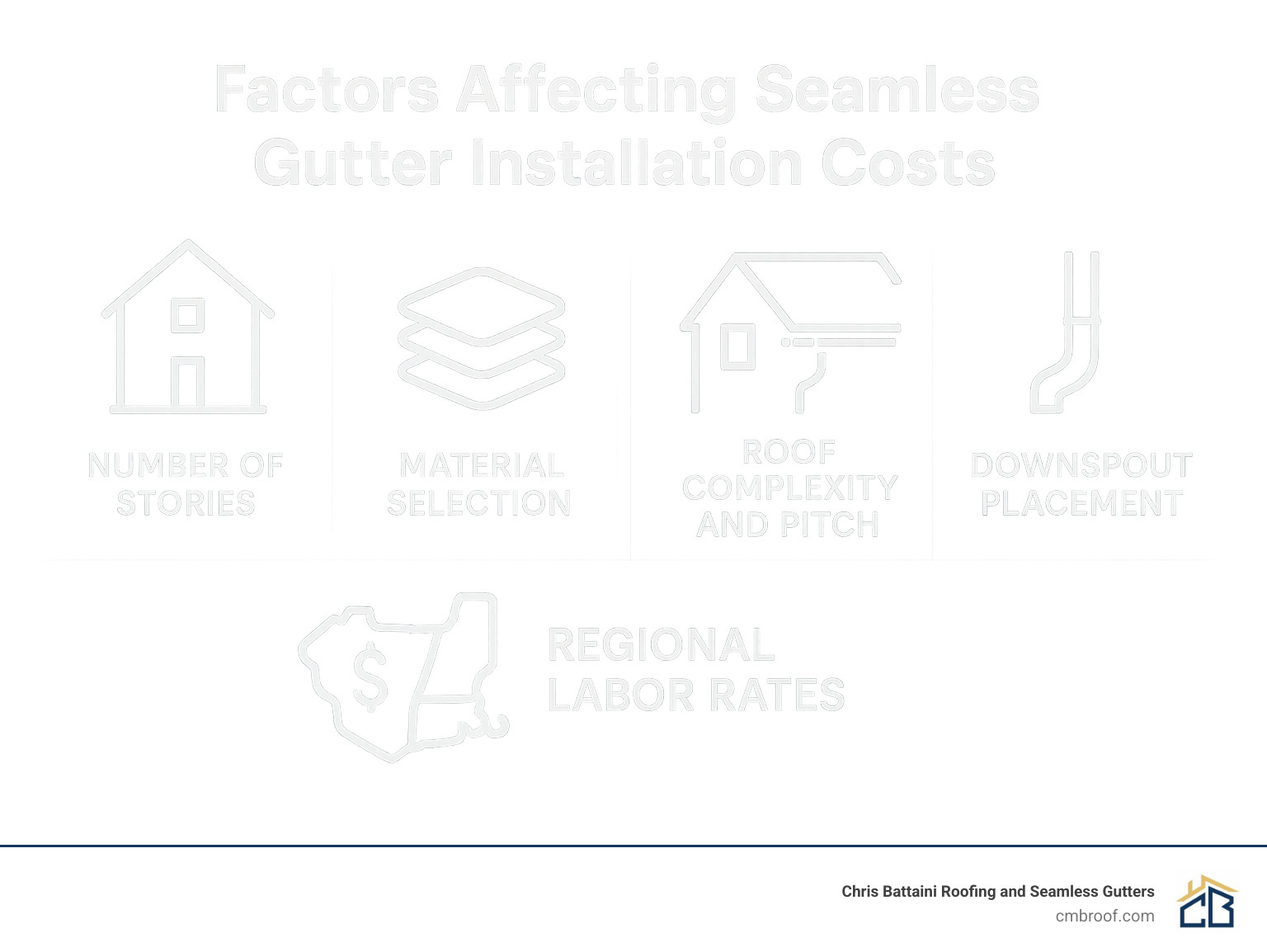
When planning your gutter project, it helps to understand what really drives your continuous gutter cost. Think of these seven factors as the levers that can push your final price up or down.
1. Roof Size and Linear Footage
The most straightforward factor is simply how much guttering your home needs. Larger homes with more roof edges naturally require more materials and labor. To get a rough estimate:
For simple rectangular homes, add the length and width, then multiply by 2. If your home has a more complex shape with multiple wings or sections, you’ll need to measure each edge of the roof that needs guttering. Most average homes need between 100-200 linear feet of gutters.
2. Home Height and Number of Stories
Two-story homes aren’t just twice as tall—they’re often more than twice the price to outfit with gutters. Working at heights requires special equipment, takes more time, and involves greater risk. Expect to pay an additional $1-$3 per linear foot for each story above ground level. Three-story homes can command premium pricing due to the specialized equipment needed.
3. Material Selection
As we’ve seen in the price breakdown, your choice of material creates the widest swing in continuous gutter cost. While aluminum offers the best value for most homeowners (balancing cost, durability, and performance), premium materials like copper might quadruple your project cost. The upside? That copper system might still be functioning beautifully when your grandchildren own the home.
4. Roof Complexity and Pitch
Not all roofs are created equal. Homes with multiple angles, dormers, valleys, and steep pitches require more precise measurements and additional corner pieces. Each corner or transition point adds $5-$10 to your total, while steep pitches may increase labor costs by 10-20%. Those charming architectural details that make your home unique often make your gutter installation more complex too.
5. Downspout Quantity and Placement
The rule of thumb is one downspout for every 20-25 feet of guttering, but homes in rainy regions (like parts of New England) often need more. Each additional downspout adds $50-$150 to your total. Proper downspout placement is crucial—too few, and your gutters might overflow during heavy rain; too many might affect your home’s appearance.
6. Regional Labor Rates
Your zip code significantly impacts your final price. In our service area of Berkshire County, MA and Southern Vermont, labor rates reflect the New England market, which tends to run higher than the national average due to our higher cost of living and stricter building codes. A gutter system in rural Georgia might cost half what the same system would in Boston.
7. Contractor Overhead and Marketing
This often-overlooked factor can create surprising price differences between quotes. As Noah Lantz of the Rain Gutter Association notes, marketing expenses can be “the most expensive part of procuring gutter jobs.” This explains why identical materials on similar homes might receive vastly different quotes from different contractors.
Robert Word, a gutter installation CEO, adds: “Taller houses with unique architectural features tend to slow down installation time,” directly impacting labor costs and your bottom line.
For additional insights into pricing factors, check out the Rain Gutter Association insights where industry professionals share their expertise on what drives costs in different regions.
Costs by Material & Style
When it comes to continuous gutter cost, the material and style you choose dramatically impact both your budget and long-term satisfaction. Let’s explore your options to help you make the best choice for your home.
Aluminum Gutters: The Popular Middle Ground
Cost Range: $6-$20 per linear foot installed
Lifespan: 20-30 years
There’s a reason aluminum gutters account for about 70% of residential installations. They strike that sweet spot between affordability and durability that most homeowners are looking for.
Aluminum never rusts, which is a huge plus in our New England climate where moisture is a constant companion. With over 25 color options available, you can easily match or complement your home’s exterior. If your color preferences change down the road, aluminum takes paint beautifully.
The main drawback? Aluminum can dent during severe hailstorms or if that massive branch from your oak tree decides to make a surprise landing. With proper installation using adequate hangers, though, sagging isn’t typically an issue.
Steel Gutters: When Strength Matters
Cost Range: $8-$25 per linear foot installed
Lifespan: 15-20 years (galvanized), 50+ years (stainless)
If you’re looking for something that can take a beating, steel gutters might be your answer. They come in two main varieties: galvanized and stainless steel.
Steel stands up admirably to our heavy Berkshire County snow loads and ice dams. The material’s rigidity prevents bending and denting, even during those notorious New England nor’easters. For homes in particularly exposed locations, this added strength provides valuable peace of mind.
The downside? Galvanized steel can eventually rust if its protective coating gets scratched or damaged. Steel gutters are also significantly heavier than aluminum, which means your fascia boards need to be in good condition to support them properly.
Copper Gutters: Premium Elegance
Cost Range: $15-$50 per linear foot installed
Lifespan: 50-100 years
Copper gutters are the crown jewels of the gutter world. Nothing else matches their distinctive elegance and incredible longevity.
Initially a bright penny color, copper develops a beautiful green-blue patina over time that many homeowners find irresistible. Beyond their stunning looks, copper gutters can literally last a lifetime—or two! They’ll never rust, and their natural antimicrobial properties prevent the growth of algae and mold.
The obvious drawback is cost. Copper represents a significant investment upfront. However, when you consider that you’ll likely never need to replace them, the long-term value becomes more apparent. In historic districts of Massachusetts and Vermont, copper gutters are often the perfect complement to period architecture.
Vinyl Gutters: Budget-Friendly Option
Cost Range: $3-$11 per linear foot installed
Lifespan: 10-15 years
While most professional installers (including us) don’t typically offer vinyl as a seamless option, it’s worth mentioning as a budget alternative.
Vinyl is the least expensive material and won’t rust, which makes it attractive for tight budgets. However, our New England winters can be tough on vinyl, making it brittle and prone to cracking when temperatures plummet. Most vinyl gutters are sold as sectional systems rather than seamless, which means more potential leak points.
Zinc Gutters: The European Alternative
Cost Range: $35-$60 per linear foot installed
Lifespan: 50+ years
Popular in Europe for centuries, zinc gutters offer many of copper’s benefits at a slightly lower (though still premium) price point.
Like copper, zinc develops a distinguished patina over time and can last for generations. It’s more scratch-resistant than aluminum and requires minimal maintenance over its long life. For distinctive homes in the Berkshires or Southern Vermont, zinc gutters provide a unique European flair.
The main challenges with zinc are its high cost and limited availability. Fewer contractors have experience working with this material, which can make finding qualified installers challenging.
Style Impact on Continuous Gutter Cost
The profile style of your gutters affects both their appearance and functionality:
K-Style Gutters cost about $8-$15 per linear foot installed and feature a decorative front edge that resembles crown molding. They hold more water than half-round gutters of the same width, making them ideal for most modern homes in areas with moderate to heavy rainfall. Their flat backs attach securely to fascia boards, providing excellent stability.
Half-Round Gutters typically run $9-$17 per linear foot installed and offer a classic, timeless look. Their smooth, curved interior allows water and debris to flow more freely, reducing buildup and potential clogs. These gutters particularly complement historic homes throughout Massachusetts and Vermont and pair beautifully with copper and zinc materials.
Size matters too. Standard 5-inch gutters work well for most homes, but upgrading to 6-inch gutters adds about $3-$5 per linear foot to your continuous gutter cost. The upside? They handle approximately 50% more water volume—worth considering if your home has steep roof pitches or large roof surfaces that channel substantial amounts of water.
For more detailed information about gutter styles and installation options, visit our More info about Gutter Installation page.
Note: These are average costs based on internet data and not actual costs for Chris Battaini Roofing and Seamless Gutters.
Labor, Add-Ons & DIY vs. Pro
When calculating your total continuous gutter cost, understanding labor expenses and potential add-ons is crucial for accurate budgeting.
Labor Costs Explained
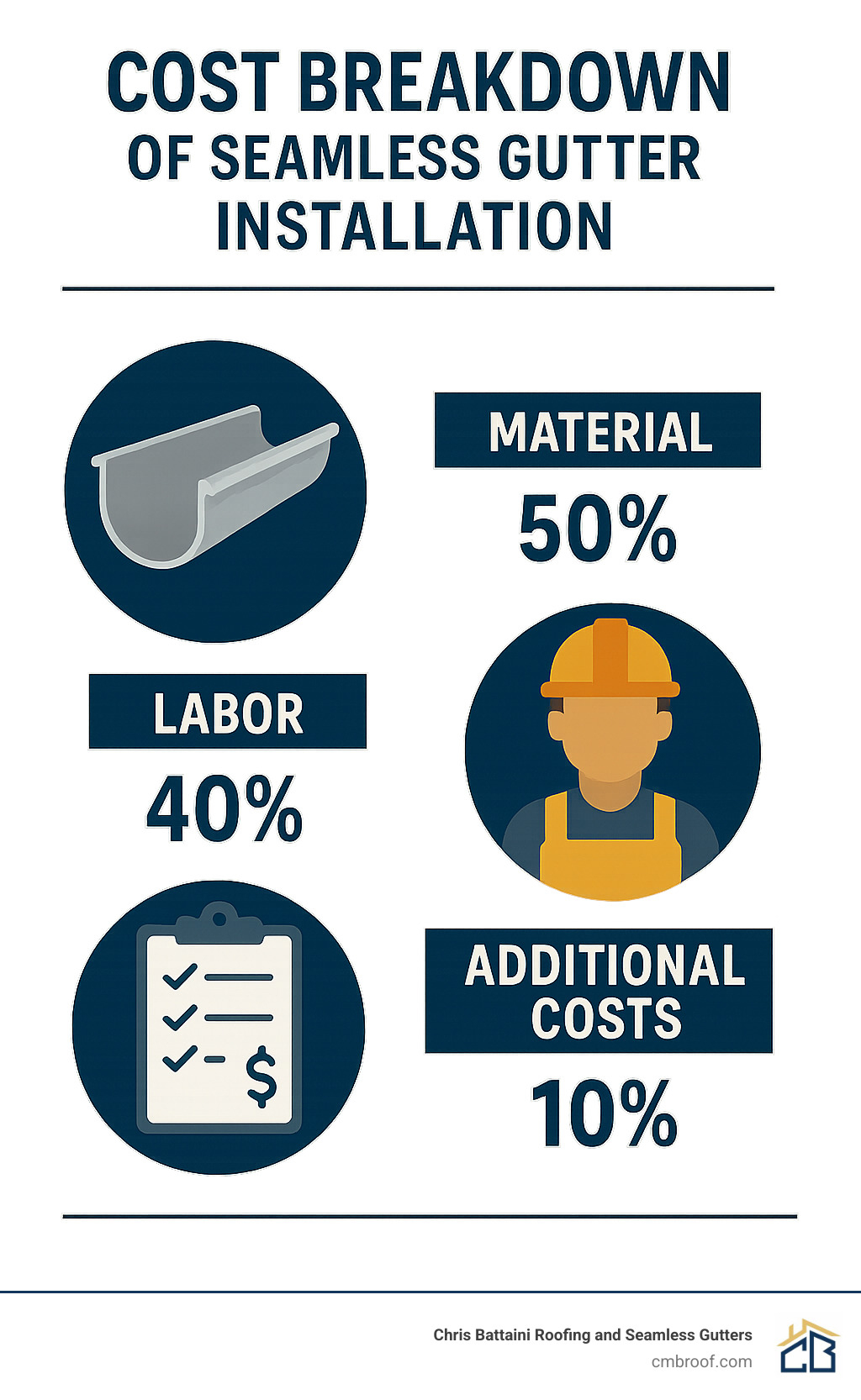
Professional installation is a significant part of your seamless gutter investment, typically running $3-$7 per linear foot. This represents about half of your total project cost, and it’s money well spent. What exactly are you paying for? When professionals arrive at your home, they’re bringing years of expertise along with specialized equipment. They’ll carefully measure your roofline, custom-fabricate gutters on the spot, attach them with proper hangers, ensure the correct pitch for drainage, and skillfully install all corners, end caps, and downspouts.
Your home’s unique characteristics can influence these labor costs. If you have a two-story house, expect to pay an additional $1-$3 per linear foot per story as workers need extra safety equipment and time. Homes with tricky access points requiring specialized equipment or complex rooflines with numerous corners will also increase labor costs. And if your fascia boards need repair before installation, that’s another consideration.
As one homeowner in Berkshire County told us, “I was surprised watching how much precision went into getting the pitch just right – it’s definitely not something I could have done myself.”
Common Add-Ons That Affect Total Cost
Several optional additions can transform your basic gutter system into a comprehensive water management solution – though they’ll impact your overall continuous gutter cost.
If you’re replacing existing gutters, old gutter removal will add $1-$2 per linear foot to your bill, including disposal fees (typically around $100). This isn’t an area to skimp on – proper removal prevents damage to your fascia and ensures a clean surface for the new installation.
Gutter guards are increasingly popular, costing $15-$45 per linear foot installed. While that might seem steep, they prevent leaves and debris from clogging your system, dramatically reducing maintenance. With various styles available (mesh, foam, reverse curve), you can find an option that works for your home and budget. About 80% of homeowners report being satisfied with their gutter guard performance – particularly those who previously spent weekends on ladders cleaning gutters.
For New England homeowners battling winter ice dams, heat cables are worth considering at $12-$20 per linear foot installed. These can be integrated during initial installation or added later, but they’re particularly valuable in areas like Berkshire County and Southern Vermont where heavy snowfall is common.
Fascia repair is sometimes an unexpected but necessary add-on, costing $9-$34 per linear foot. Often finded during old gutter removal, damaged fascia must be addressed for proper gutter attachment and performance. Think of it as fixing the foundation before building the house.
Finally, don’t overlook splash blocks and downspout extensions ($10-$30 each). These humble accessories direct water away from your foundation – critical for preventing basement moisture issues and landscape erosion.
DIY vs. Professional Installation
While you might be handy with home projects, seamless gutters simply aren’t DIY-friendly. The reason is simple: they require specialized equipment that costs thousands of dollars.
Professional seamless gutter machines – the ones that create custom-fitted gutters on the spot in your driveway – cost $7,000-$11,000 for basic residential models, with commercial versions running up to $60,000. These machines require training and experience to operate correctly. The on-site fabrication process ensures your gutters fit your home’s exact dimensions without excessive seams.
Beyond equipment, there are compelling warranty considerations. DIY installation typically voids material warranties, while professional installation includes workmanship warranties (typically 5-10 years). Most reputable installers also offer material warranties of 20+ years, giving you decades of peace of mind.
Safety is another crucial factor. Working at heights requires proper equipment and training – professional crews are insured and experienced with ladder safety. Falls remain among the most common home improvement injuries, and gutter installation involves extended periods working at roof height.
As gutter installation expert Chris Counahan notes: “Hiring a professional is the safer choice; DIY systems fall short on protection.” This is especially true for seamless systems that require specialized equipment and expertise.
When you factor in the equipment costs, safety concerns, and warranty benefits, professional installation becomes the obvious choice for continuous gutters – an investment that protects your home for decades to come.
Note: These are average costs based on internet data and not actual costs for Chris Battaini Roofing and Seamless Gutters.
Money-Saving Tips & Return on Investment
Getting seamless gutters doesn’t have to break the bank. While continuous gutter cost might seem substantial at first glance, there are plenty of ways to maximize your investment and potentially reduce your upfront expenses.
Smart Ways to Save on Your Seamless Gutter Installation
The savvy homeowner knows that a little preparation goes a long way when it comes to managing costs. According to a recent 2025 survey, nearly half of homeowners (44.7%) tried negotiating their initial gutter quotes—and an impressive 91% successfully lowered their price!
Get multiple quotes and compare options from at least 3-5 contractors in your area. This not only gives you pricing leverage but helps you gauge the going rate in your region. Don’t be shy about asking if they’ll match a competitor’s offer—many will if you’re polite but firm.
Timing your project strategically can lead to significant savings. Fall is peak season for gutter installations, when prices tend to be at their highest. Consider scheduling in winter or early spring instead—many contractors offer 10-15% discounts during these slower periods just to keep their crews busy.
Material selection makes a huge difference in your bottom line. For most homes, aluminum offers the best value proposition, balancing reasonable cost with excellent durability. Save premium materials like copper for accent areas visible from the street where they’ll make the biggest visual impact. Only opt for heavier gauge aluminum (.032 inch vs. standard .027) if you live in areas with heavy snow loads.
Consider bundling projects whenever possible. If you’re also planning roof work, ask about package discounts. Some homeowners even coordinate with neighbors to get volume pricing on multiple properties at once. As the saying goes, “buy in bulk, save on each.”
Understanding the Return on Investment
When it comes to home improvements, seamless gutters typically offer around 25% ROI in terms of pure resale value. But their true worth lies in what they prevent—potentially catastrophic damage to your home.
Water damage prevention is where gutters truly earn their keep. Consider the alternative costs: foundation repairs averaging $4,500 (but potentially soaring to $15,000+), basement water damage restoration ranging from $3,300 to $13,000, and fascia and soffit rot repairs running $9-$34 per linear foot. Suddenly, that continuous gutter cost seems quite reasonable by comparison.
Energy efficiency benefits are often overlooked but quite real. Proper water management reduces basement humidity levels, which in turn lowers air conditioning costs during summer months. It also prevents moisture-related insulation damage that can compromise your home’s thermal envelope.
Long-term maintenance savings add up significantly over time. Seamless systems develop fewer leaks than their sectional counterparts, requiring less frequent repairs. They also typically last 20-50 years compared to just 7-15 years for sectional systems—meaning you’ll replace them far less often.
Some homeowners might even qualify for tax incentives in certain regions, particularly for systems that incorporate rain harvesting components, sustainable drainage solutions, or erosion control measures. Check with your local municipality or tax professional to see if you qualify.
As one of our satisfied customers put it: “The peace of mind knowing my foundation is protected during heavy rains is worth every penny I spent on those seamless gutters.”
For more comprehensive information about the long-term value quality seamless gutter systems provide, visit our More info about Seamless Gutter Systems page.
Note: These are average costs based on internet data and not actual costs for Chris Battaini Roofing and Seamless Gutters.
Frequently Asked Questions about Continuous Gutter Cost
Why are continuous gutters pricier than sectional systems?
When homeowners first see quotes for seamless gutters, they often experience a bit of sticker shock. There’s a good reason for that higher continuous gutter cost – and it comes down to three main factors.
First, seamless gutters require specialized equipment. Those impressive roll-forming machines you might see in a contractor’s truck? They cost anywhere from $7,000 to $11,000 for basic residential models. This equipment is essential because it forms your gutters right there in your driveway, custom-fit to your home’s exact dimensions.
Second, you simply can’t DIY seamless gutters. While you might save on sectional gutters by installing them yourself over a weekend, seamless systems require trained technicians who know how to operate that specialized equipment and ensure proper installation.
Finally, there’s the custom nature of the product itself. Unlike mass-produced sectional pieces that come in standard lengths, your seamless gutters are fabricated specifically for your home, eliminating the cost advantages of mass production.
The good news? While the upfront investment is higher, most homeowners find seamless gutters more economical over time. With lifespans of 20-50 years (compared to just 3-15 years for sectional systems) and significantly fewer leaks and repairs, the long-term value becomes clear.
How many linear feet of gutter does my home really need?
Figuring out your gutter requirements doesn’t have to be complicated. For most homes, the math is fairly straightforward.
If you have a simple rectangular home, just measure the length and width, add those numbers together, and multiply by two. For example, a 30′ × 50′ home would need approximately 160 linear feet of guttering (30 + 50 = 80 × 2 = 160).
Homes with more complex rooflines require a bit more effort. You’ll need to measure each section of the roof edge that needs gutters and add all those measurements together. Don’t forget to subtract areas where gutters might not be needed, such as over covered porches or where roof sections meet.
Most average American homes require between 100-200 linear feet of guttering. If math isn’t your strong suit or your home has a particularly complex roofline, we’re happy to provide a free on-site assessment for homes in our Berkshire County and Southern Vermont service area.
Should I add gutter guards during installation or later?
This question comes up in almost every conversation about continuous gutter cost, and for good reason. Gutter guards represent an additional investment ($15-$45 per linear foot), but they can dramatically reduce your maintenance requirements.
Installing guards during your initial gutter installation usually makes the most financial sense. Many contractors (including us) offer package discounts of 10-15% when you combine the two services. There’s also the convenience factor – one installation process means less disruption to your home and property. Plus, when installed together, your guards and gutters share the same warranty start date.
That said, there are legitimate reasons to wait. Budget constraints might make the initial investment challenging. You might want to see how your new gutters perform through different seasons first. Or perhaps you’re still researching which type of guard system would work best with your surrounding trees and debris concerns.
The good news is that about 80% of homeowners report being satisfied with their gutter guard performance, particularly in reducing how often they need to climb a ladder for cleaning. If your property has lots of trees or you’re concerned about maintenance, we generally recommend including guards with your initial installation.
What questions should I ask before hiring a gutter installer?
Getting multiple quotes is smart, but knowing what questions to ask is even smarter when evaluating continuous gutter cost proposals.
Start by asking about experience and specialization: “How long have you been installing seamless gutters specifically?” and “Is gutter installation your primary business or a sideline?” A contractor who specializes in gutters rather than treating them as an occasional add-on service will typically deliver better results.
Next, dig into materials and methods: “What gauge material do you use?” (Look for .027″ minimum, or .032″ in our snow-prone New England area). Ask how the gutters will be attached to your home – hidden hangers are generally preferred for both strength and aesthetics. Also confirm they’ll ensure proper pitch for drainage by using levels during installation.
Don’t shy away from pricing questions: “Does your quote include all materials, labor, and cleanup?” and “Are there any potential additional charges I should be aware of?” Also ask about the payment schedule – reputable contractors typically don’t require large upfront payments before work begins.
Finally, understand the warranty and service commitment: “What warranties do you offer on materials and workmanship?” A quality installer should stand behind their work with clear warranty terms and a straightforward process for handling any issues that might arise.
How long will my seamless gutters last?
The lifespan of your seamless gutter system depends significantly on the material you choose:
Vinyl gutters typically last 10-15 years, making them the shortest-lived option.
Aluminum gutters, the most popular choice, generally perform well for 20-30 years in our New England climate.
Steel gutters vary widely – galvanized versions last 15-20 years before rust becomes an issue, while stainless steel can perform for 50+ years.
Copper and zinc gutters are the marathon runners of the gutter world, often lasting 50-100 years with minimal maintenance.
Proper installation and regular maintenance can extend these timeframes considerably. Most professional installations include warranties ranging from 20-30 years for materials and 5-10 years for workmanship, giving you peace of mind with your investment.
While these lifespans represent averages, factors like local climate, maintenance practices, and installation quality all play important roles in how long your specific system will last.
Note: These are average costs based on internet data and not actual costs for Chris Battaini Roofing and Seamless Gutters.
Conclusion
Looking at the full picture of continuous gutter cost, it’s clear this isn’t just another home maintenance expense—it’s a smart investment in your property’s long-term health and value. Like a good insurance policy, quality seamless gutters quietly protect your home day after day, season after season.
For those of us living in Berkshire County, MA and Southern Vermont, our unique weather patterns make proper water management not just important, but essential. From heavy winter snowmelt to those sudden summer downpours, seamless gutters form your home’s first line of defense against moisture damage.
When planning your gutter project, keep these practical insights in mind:
Budget with the future in view. While $900-$3,000 represents the typical investment for aluminum systems on an average home, premium materials might push that figure to $7,500 or beyond. That initial sticker shock becomes more reasonable when spread across decades of protection.
Think in terms of value, not just cost. Those budget-friendly sectional gutters might seem attractive today, but when they’re leaking and sagging in a few years, the true cost becomes apparent. Seamless systems typically deliver 2-3 times the service life with significantly fewer headaches along the way.
Choose materials that make sense for your situation. For most homes in our New England climate, aluminum hits the sweet spot of durability, performance, and affordability. Save those gorgeous copper gutters for where they’ll make the biggest visual impact—or for when you win the lottery!
Don’t skimp on the extras. Quality gutter guards and properly designed downspout extensions aren’t luxuries—they’re practical additions that improve system performance and dramatically reduce maintenance needs. The small additional investment pays dividends every time it rains.
Partner with experienced professionals. Even the highest quality materials can fail when improperly installed. Proper pitch, secure fastening, and attention to drainage details make all the difference in system performance and longevity.
At Chris Battaini Roofing and Seamless Gutters, we bring decades of local experience to every project. Our owner-led approach means you’re getting hands-on expertise and meticulous attention to detail from start to finish—not a crew of strangers working from a checklist.
Ready to explore seamless gutter options custom to your home’s specific needs? Visit our More info about Seamless Gutters page to learn more about our approach and solutions.
Note: All pricing information in this article represents average costs based on internet data and not actual costs for Chris Battaini Roofing and Seamless Gutters. For a personalized quote specific to your home, please contact us directly.
Chris Battaini Roofing and Seamless Gutters proudly serves Berkshire, Hampden, Hampshire, and Franklin Counties in Massachusetts, as well as Southern Vermont, providing quality roofing and seamless gutter solutions for homeowners throughout the region.