

Understanding Slate Roof Repairs: What You Need to Know
How to repair a broken roof slate in 4 simple steps:
- Remove the broken slate using a slate ripper to hook and pull out the nails
- Prepare the replacement slate of matching size, color and thickness
- Install the new slate using either a slate hook or nail-and-bib method
- Secure the slate without face-nailing or using adhesives
Struggling with a damaged slate roof can be incredibly stressful. When those beautiful, centuries-tested tiles crack or slip away, it’s not just an aesthetic problem—it’s a direct path to water damage and expensive interior repairs.
Slate roofs are treasured for their extraordinary longevity, with hard slate varieties lasting up to 200 years when properly maintained. This makes repair almost always more cost-effective than replacement when damage is limited to under 20% of your roof’s slates.
The good news? With the right tools and techniques, many slate repairs are manageable for careful homeowners. The bad news? Improper repairs are among the leading causes of premature slate roof failure.
“Slate is stone, and stone is long-lasting,” as preservation experts note. But even this durable material requires specific repair methods to maintain its watertight integrity. Repairs using face nails, tar, or cement might seem like quick fixes, but they’ll likely cause more problems down the road.
In this guide, we’ll walk through the proper techniques for assessing, removing, and replacing broken slate—preserving both your roof’s function and its timeless character.
The Real Reasons Your Slate Breaks
Your slate roof can last for generations – after all, slate has an impressively low water absorption index of less than 0.4%, making it highly resistant to frost damage. But even this mighty material has its vulnerabilities. Understanding what actually causes slate to break can help you protect your investment and know when to take action.
Mother Nature takes her toll through severe weather events like hail storms, punishing winds, and heavy snow loads that can crack or dislodge even the hardiest slates. Here in the Berkshires, our freeze-thaw cycles put extra stress on roofing materials year after year.
Human factors often cause more damage than weather. Foot traffic from well-meaning contractors who don’t understand slate’s unique properties can shatter tiles in seconds. As one experienced slate roofer told me, “Half of my annual work involves correcting other contractors’ botched repairs.” This highlights why proper techniques matter so much with these historic roofing systems.
Other common culprits include fallen tree limbs during storms, nail fatigue after decades of service when the fasteners holding slates rust and weaken, and flashing failures around chimneys, valleys, and dormers that create vulnerable points.
Don’t underestimate wildlife either – squirrels and other critters have been known to chew on lead flashings and disturb slates while making themselves at home in your attic. And sometimes the problem started long ago with the installation of inferior slate quality. Soft slate varieties typically begin failing after 50-75 years, while hard slate from quality quarries can easily last 100-200 years.
For more in-depth information about slate varieties and their properties, the Mobile Slate Association guide offers excellent resources for homeowners.
Spotting Damage vs. End-of-Life
Not every cracked slate means your roof is failing. Learning to distinguish between repairable damage and true end-of-life indicators can save you thousands.
Repairable issues include hairline cracks in individual slates, a handful of missing or broken tiles, slates that have slipped out of position, or minor flashing deterioration. These are maintenance matters, not replacement triggers.
End-of-life indicators tell a different story. Watch for delamination (where slates split into layers like a deck of cards), powdering or flaking of slate surfaces, widespread porousness, or moisture absorption. These problems can’t be fixed with spot repairs.
Industry experts widely accept the 20% rule: if less than 20% of your slates need replacement, repair is typically more cost-effective. Beyond this threshold, full replacement often makes better economic sense in the long run.
Telltale Signs You Need Action Now
Don’t wait for water to cascade through your ceiling before addressing slate issues. Early intervention saves money and headaches. Here are the warning signs that demand immediate attention:
Interior water stains on upper-floor ceilings or walls are obvious red flags, but by the time you see these, water has already found its way inside. Finding slates on the ground after storms is another clear indicator – check if they still “ring” when tapped, as sound slates produce a clear tone.
Look for rusty or discolored flashings around chimneys and valleys, and white mineral deposits streaking down exterior walls below the roofline – both signal water infiltration. Inside your attic, inspect for mold, moisture on rafters, or sheathing damage. On a sunny day, check for pinpoints of daylight visible through the roof boards.
“The removal and replacement of individual slates is an important part of maintaining a slate roof,” according to the National Slate Association. Taking prompt action when you spot these warning signs can prevent extensive structural damage and preserve your roof’s integrity for decades to come.
For professional assessment of potential leaks or damage, our Roof Leak Repair specialists can help determine the best course of action.
How to Repair a Broken Roof Slate: Step-by-Step
Ready to tackle that broken slate on your roof? Before climbing any ladder, gather these essential tools for a successful repair:
- Slate ripper (for nail removal)
- Slate hammer (with a pointed punch end)
- Matching replacement slate
- Copper nails (never galvanized!)
- Copper or stainless steel slate hooks
- Copper bib material (about 8″ x 3″)
- Safety gear: gloves, glasses, and fall protection
With your toolkit assembled, you’re ready to restore your roof’s integrity and keep the water where it belongs—outside your home.
How to repair a broken roof slate: safe removal
Your safety comes first when working at heights. According to OSHA fall protection guidelines, proper harnesses and anchors are required when working 6+ feet above ground level. Here’s how to safely remove that damaged slate:
Secure your ladder with stabilizers before climbing, and always attach your harness to a solid anchor point. Once safely positioned, locate the broken slate that needs replacing.
Slide your slate ripper under the slate two courses above the damaged one. Position it carefully to catch the nail holding your broken slate. With firm downward pressure, hook and pull the nail—you might need to push upward if it’s bent. The goal is complete nail removal without breakage.
“Breaking the nail during removal is like starting a domino effect of problems,” as one veteran slater puts it. Take your time with this crucial step.
Once the nails are out, clear away any fragments of the broken slate and inspect the underlayment for damage. This quick check can prevent future surprises when the rain comes.
How to repair a broken roof slate: watertight installation
You’ve got two reliable methods for installing your replacement slate: the hook method or the nail-and-bib technique. Both work wonderfully when done right.
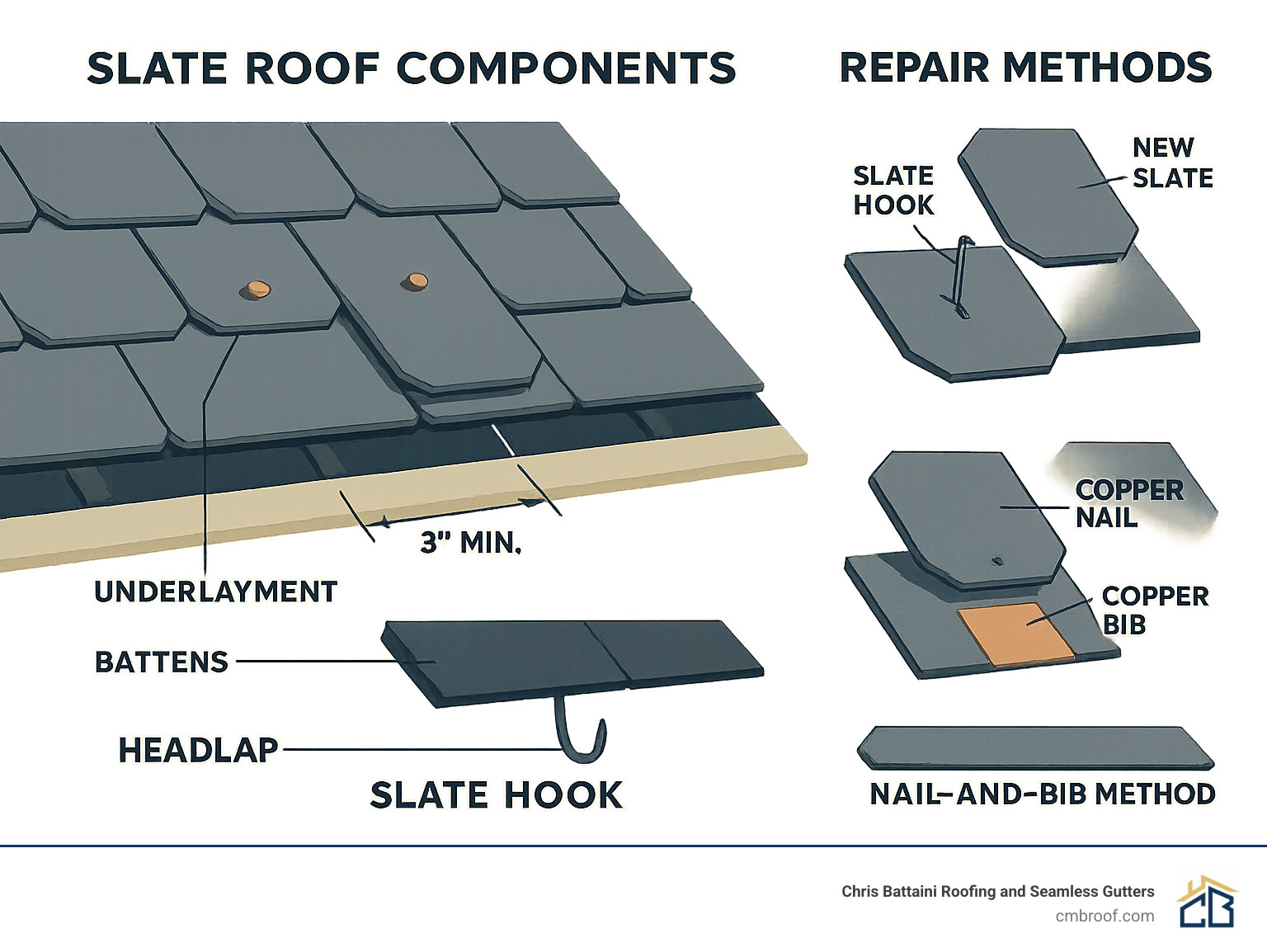
The slate hook method starts with pre-drilling a small hole in the sheathing between existing slates. Drive your copper or stainless hook into position so it will catch and support the bottom edge of your replacement slate. Slide the new slate upward into position, ensuring perfect alignment with neighboring slates, then pull it down to engage the hook. This method is beloved by professionals for its reliability in harsh weather.
The nail-and-bib method begins by sliding your replacement slate into position. Nail it near the top edge through the overlap joint of the slates above it. Then cut a copper bib (about 8″ x 3″) with appropriate edge cuts and slide it up under the slate above, covering the nail head while leaving 2-3″ exposed below the overlapping slate.
As one slate expert with 40 years of experience notes, “Slate hook repairs almost never fail when properly installed.” The nail-and-bib method works beautifully too but requires extra care to avoid damaging adjacent slates.
Whatever you do, never face-nail slates (driving nails through the exposed face) or use adhesives, caulk, or cement. These shortcuts inevitably fail, inviting water where it doesn’t belong. For a visual guide to proper techniques, check out this Basic Slate Roof Repair Video.
Testing Your Fix Before You Climb Down
Don’t pack up your tools until you’ve verified your work. Start with a visual inspection—your replacement slate should sit flush and align perfectly with surrounding slates. The exposure (visible portion) should match neighboring slates, typically with a 3″ headlap.
Give the slate a gentle tap to ensure it’s secure and doesn’t move. For extra peace of mind, have a helper spray water on the area while you check from the attic for leaks. This simple test can save you from a second trip up the ladder.
Before descending, remove any copper filings or debris that could stain your roof or clog gutters. These small metal bits can create unsightly streaks when rainwater carries them down the roof surface.
How to repair a broken roof slate doesn’t have to be intimidating. With patience, proper tools, and these techniques, you can restore your slate roof’s beauty and function for decades to come.
Gear, Safety & Matching Materials

Working on slate roofs requires specialized equipment for both safety and effectiveness:
- Non-slip boots: Rubber-soled footwear with good traction
- Fall protection harness: OSHA-compliant full-body harness
- Heavy-duty gloves: To protect against sharp slate edges
- Safety goggles: To shield eyes from slate dust and fragments
- Ladder stabilizers: To prevent ladder movement and roof damage
- Roof brackets and planks: For creating a stable work platform on steeper slopes
The tools required for slate repair are specialized but available from roofing supply houses:
– Slate ripper: $30-150 (3 lbs, approximately 30.5″ long)
– Slate hammer: $40-100
– Copper nails: $15-30 per pound
– Copper sheet (for bibs): $20-50 per square foot
– Slate hooks: $10-30 per dozen
Buying the Right Replacement Slate
Finding the perfect match for your existing slate is crucial for both appearance and performance. Consider these factors:
Reclaimed vs. New Slate:
– Reclaimed slate of the same age often provides the best color and weathering match
– New slate will weather differently than existing tiles and may stand out visually
Regional Quarry Match:
– Vermont “Sea Green,” Pennsylvania “Peach Bottom,” New York “Monson,” and other regional varieties have distinct characteristics
– Identifying your slate’s origin helps in finding appropriate replacements
Thickness and Size:
– Measure the thickness of your existing slate (typically 1/4″ to 3/8″)
– Slightly thinner replacement slates can ease installation under existing courses
– Match the exact dimensions (length and width) of your existing slates
ANSI Hardness Rating:
– S1 (hard) slates last longest (100-200 years)
– S2 and S3 (soft) slates have shorter lifespans (50-125 years)
– Match the hardness to your existing roof for consistent performance
As one slate expert advises, “Match replacement slates in type, color, weathering characteristic, size, shape, and texture” for the best results.
Safety Checklist Before Every Climb
Before ascending to your roof, complete this essential safety checklist:
- Inspect all PPE: Check harness straps, buckles, and attachment points for wear
- Check weather conditions: Never work on a wet, icy, or windy day
- Secure a helper: Have someone on the ground to assist and monitor safety
- Create an emergency plan: Know what to do in case of an accident
- Inspect your ladder: Look for defects and ensure proper positioning
- Verify roof structure: Ensure the roof can support your weight
- Check electrical hazards: Note the location of power lines before positioning ladders
Professional roofers undergo extensive training and certification for slate work. If you’re uncertain about any aspect of the repair or safety protocols, it’s better to consult professionals like Chris Battaini Roofing and Seamless Gutters who specialize in historic slate roofing.
Repair or Replace? Costs, Lifespan & Long-Term Care
Standing on your ladder, staring at those cracked slates, you’re probably wondering: is it time to repair or replace this whole roof? It’s a question that keeps many historic homeowners up at night.
The good news is that slate’s legendary durability means repair is often the smarter choice. The decision ultimately comes down to a handful of key factors that any slate roof owner should consider.
The widely respected “20% rule” offers a practical guideline: if less than 20% of your slates need replacement, repairing is almost always more cost-effective than a complete tear-off. Beyond this threshold, full replacement starts making more financial sense.
Consider the age of your roof against the expected lifespan of your particular slate variety. Soft slates typically serve faithfully for 50-125 years, while hard slates can protect your home for an astonishing 75-200 years. A 90-year-old soft slate roof might be approaching retirement, while a hard slate of the same age could be just hitting middle age!
Often, it’s not the slate itself that fails but the flashing around chimneys, valleys, and other transitions. These metal components generally need replacement every 30-40 years, even when the slate remains sound.
Your home’s structural capacity matters too. Can your roof framing continue supporting the considerable weight of stone? Some older homes may require reinforcement if they’ve experienced any settling or structural changes over the decades.
From an environmental perspective, repairing slate is the clear winner. Keeping these natural stones in service prevents manufacturing waste, reduces landfill burden, and honors the craftsmanship of earlier generations.
Don’t overlook the impact on your property value either. A well-maintained slate roof can significantly increase your home’s market appeal and selling price. As one Massachusetts realtor puts it, “A properly maintained slate roof is like fine furniture – it appreciates with age and proper care.”
“Unscrupulous contractors will often recommend replacing a good slate roof with asphalt; homeowners should beware,” cautions one preservation specialist. Getting multiple opinions from slate experts is essential before making such a consequential decision.
Average Pricing: Repair vs. New Roof
Understanding the financial implications helps put your options in perspective. The table below shows average costs based on internet data, not actual costs for Chris Battaini Roofing and Seamless Gutters:
| Service Type | Average Cost Range | Factors Affecting Cost |
|---|---|---|
| Spot Repair (1-10 slates) | $300-$2,500 | Accessibility, height, pitch |
| Partial Repair (10-20% of roof) | $3,000-$10,000 | Extent of damage, flashing needs |
| Full Replacement – Synthetic Slate | $7,500-$25,000 (1,500 sq ft home) | Material quality, roof complexity |
| Full Replacement – Natural Slate | $20,000-$60,000+ (2,000 sq ft home) | Slate quality, roof complexity |
Small-scale repairs like fixing damaged underlayment or repositioning slipped tiles typically hover around $900. The high-end costs can soar to at least three times the average pricing depending on material quality, roof complexity, and local labor rates.
These investments should be viewed in terms of lifecycle costs. A $1,500 repair on a slate roof that lasts another 50 years is actually just $30 per year – far less than the annual cost of a new asphalt roof that might need replacement in 15-20 years.
Maintenance Habits That Add Decades
The secret to maximizing your slate roof’s lifespan isn’t complicated – it’s consistency. Think of your slate roof like a classic car: regular attention prevents major breakdowns.
Biennial professional inspections form the foundation of good slate stewardship. Having expert eyes on your roof every two years catches small issues before they become expensive problems. These inspections cost far less than emergency repairs.
Keep those gutters clean! Clogged gutters lead to water backup, ice dams, and moisture problems that can damage not just slates but the underlying structure. This simple task pays enormous dividends.
In snowy regions like the Berkshires, installing snow guards prevents dangerous snow slides that can rip slates right off your roof. These small metal fixtures distribute snow load evenly, allowing gradual melting rather than sudden avalanches.
Don’t forget your flashings – the unsung heroes of your roofing system. Terne-coated steel flashings benefit from repainting every 5-7 years to prevent rust and deterioration. Copper and lead flashings require less maintenance but should still be inspected regularly.
Document all repairs in a dedicated “roof journal.” This record proves invaluable when assessing your roof’s history and planning future maintenance. Include photos, contractor information, and costs for a complete picture.
Those beautiful overhanging trees that frame your home can be slate’s worst enemy. Regular trimming prevents branches from scraping against slates during storms or dropping limbs during winter ice events.
Above all, address issues promptly. As one longtime slate contractor notes, “What could have been a $300 repair often becomes a $3,000 job after a year of neglect.” This is especially true in the freeze-thaw cycles common to Massachusetts winters.
“Inspect and perform minimal maintenance every one to two years,” advise slate roofing experts. This regular attention can literally add decades to your roof’s service life – turning your slate roof from a temporary shelter into a true family legacy.
Chris Battaini Roofing and Seamless Gutters proudly serves Berkshire, Hampden, Hampshire, and Franklin Counties in Massachusetts.
Frequently Asked Questions about Broken Slate Roofs
Do I need a pro if my roof is steeper than 8/12?
Absolutely. When your roof pitch exceeds 8/12 (meaning it rises 8 inches for every 12 inches horizontally), you’re dealing with a seriously steep surface. Even experienced DIYers can find themselves in dangerous situations on these slopes.
Think about it: on a steep slate roof, you’re balancing on an angled surface covered with smooth stone tiles while trying to make precise repairs. One wrong move can mean a serious fall. Professional roofers bring specialized equipment like proper scaffolding, roof jacks, and personal fall arrest systems that most homeowners simply don’t have.
At Chris Battaini Roofing and Seamless Gutters, our teams have years of experience navigating these challenging slopes throughout Berkshire County and Southern Vermont. We’ve invested in the proper safety equipment and training to handle even the steepest Victorian mansards and church steeples safely.
Why is face-nailing or caulk a bad idea?
I can’t stress this enough: face-nailing and caulking are the mortal enemies of a healthy slate roof. Here’s why these “quick fixes” end up causing more harm than good:
When you drive a nail through the exposed face of a slate tile, you’re essentially creating a permanent leak point. That hole will collect water with every rainfall, and no amount of sealant will permanently waterproof it. As one veteran slate roofer bluntly puts it, “If a roofer advises face-nailing slates, tell him to leave immediately and never return.”
As for caulk and roofing cement, they might seem like an easy solution, but they’re actually ticking time bombs. These materials break down quickly when exposed to UV rays and temperature swings. Within a year or two, they’ll crack, shrink, and pull away from the slate—often trapping moisture against the roof deck in the process.
The proper repair methods—using slate hooks or the nail-and-bib technique—work with the roof’s original design rather than against it. They maintain the overlapping, watershed principle that has kept slate roofs dry for centuries.
How long will a proper slate repair last?
When done correctly, your slate repair should outlive your mortgage—and possibly your ownership of the home. A properly executed repair using quality materials should last as long as the surrounding roof itself.
The copper components typically used in quality slate repairs (nails, hooks, and bibs) have a lifespan of 60-80 years before significant deterioration. The replacement slate itself, if properly sourced and installed, should last a century or more.
To put this durability in perspective: on a typical 2,000 square foot home with approximately 3,400 individual slate tiles, if only 50 slates fail over 100 years, that’s a failure rate of just 1.5%. No modern roofing material comes close to this level of longevity.
This extraordinary lifespan is why it makes sense to invest in proper repairs rather than shortcuts. When your great-grandchildren are still admiring your roof’s beautiful patina, you’ll be glad you insisted on the right approach to maintenance and repair.
For a proper assessment of your slate roof’s condition or to schedule a repair that will truly stand the test of time, reach out to our slate roofing repair specialists today. We’ll help you make the right decisions to preserve your roof’s integrity for decades to come.
Chris Battaini Roofing and Seamless Gutters proudly serves Berkshire, Hampden, Hampshire, and Franklin Counties in Massachusetts.
Conclusion
There’s something truly special about watching the sunset reflect off a beautifully preserved slate roof. It’s not just about preventing water from entering your home—it’s about honoring craftsmanship that has weathered Berkshire winters for generations.
How to repair a broken roof slate isn’t merely a maintenance task; it’s an act of preservation. These remarkable stone tiles have protected New England homes for centuries, silently enduring harsh freezes, summer heat, and everything in between while maintaining their distinctive character.
With the right approach, proper tools, and respect for safety, many homeowners can successfully tackle slate repairs themselves. The satisfaction of restoring these historic roofing systems is immense—knowing you’ve extended the life of something designed to last for centuries.
Remember though, there’s wisdom in recognizing your limits. The steepness of your roof, your comfort with heights, and the extent of damage all play crucial roles in deciding whether to DIY or call in specialists. The preservation of these architectural treasures sometimes requires professional expertise.
The environmental benefits of repairing rather than replacing can’t be overstated. Every slate you save from the landfill represents embodied energy preserved and new material production avoided. In our climate-conscious world, few home maintenance decisions are as eco-friendly as properly maintaining an existing slate roof.
Your slate roof is more than just protection—it’s a living link to architectural history, a sustainable choice that increases your home’s value, and a statement about quality that few other building materials can match. With proper care, these remarkable stone tiles will continue protecting your home long after most modern roofing materials would have failed.
For an owner-led assessment or a seamless hand-off when DIY isn’t enough, visit our slate roofing repair specialists today. Chris Battaini Roofing and Seamless Gutters proudly serves Berkshire, Hampden, Hampshire, and Franklin Counties in Massachusetts.
