-
10 Wendell Ave Extension Pittsfield, MA 01201
-
210 Columbia St., Lee, MA 01238

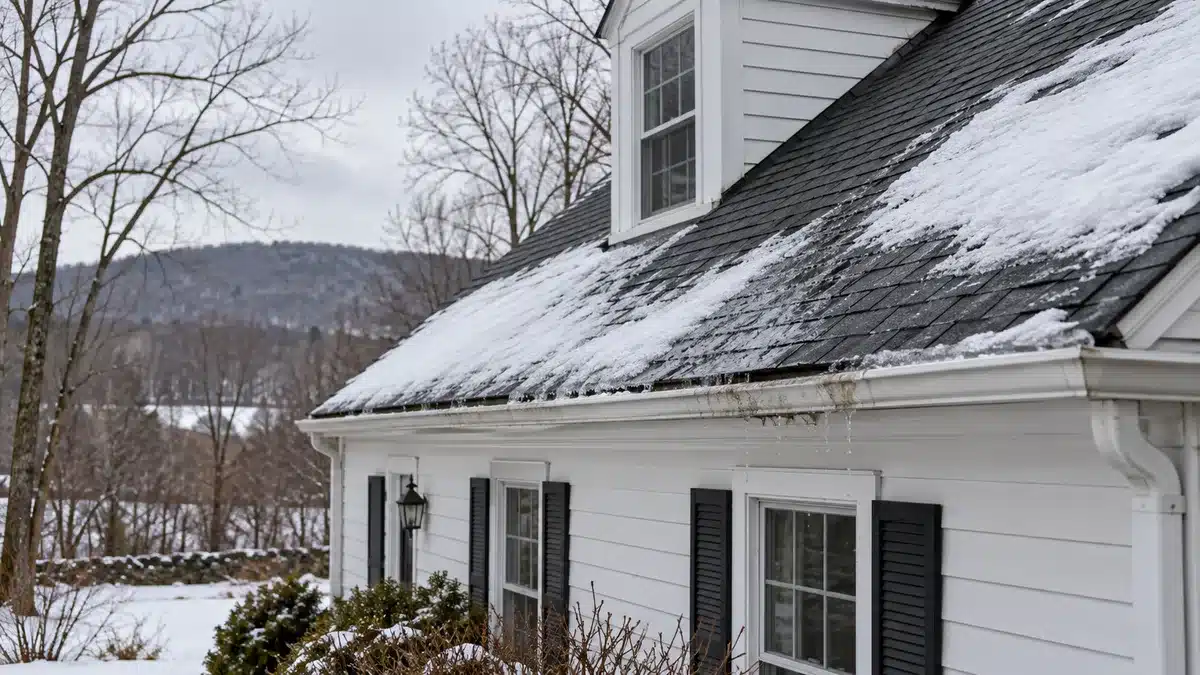
A roof leak after snow melts does not point to one automatic cause. Meltwater may be backing up behind an ice dam at the eave, entering through a roof or flashing defect that ordinary rain has not exposed, or appearing indoors when attic frost melts. The location of the first wet material, the snow pattern, and the timing of the thaw help determine which path deserves attention.
Start with safe observations from inside the building and from the ground. Do not walk an icy roof, chip at an ice dam, or stand beneath unstable snow or icicles.
| Where and when moisture appears | A path to investigate | Useful evidence |
|---|---|---|
| Near an exterior wall or eave while ice remains at the roof edge | Meltwater backing up behind an ice dam | Ice location, snow above it, stain distance from the exterior wall, and thaw timing |
| Below a chimney, vent, valley, dormer, skylight, or sidewall | A flashing, transition, penetration, or roof-covering defect exposed by meltwater | The nearest roof feature, prior repair history, and whether rain causes the same symptom |
| Across several fasteners or a broad area of sheathing during a rapid warm-up | Stored attic frost melting from multiple cold surfaces | Distribution of droplets, outdoor temperature change, and indoor moisture conditions |
| At one low point after the exterior looks dry | Delayed drainage through insulation, framing, or ceiling material | Time lag, growth of the stain, and a wider view of the framing path |
The table narrows the inspection. It does not prove the cause. A home can have an ice dam and an attic air-leak problem together because heat and moisture moving into the attic can contribute to both conditions.
An ice dam forms when snow melts on a warmer part of the roof, flows toward a colder eave, and refreezes. Additional meltwater can collect behind the ice and reach beneath roof coverings. The U.S. Department of Energy’s cold-climate eave guidance describes this backup path and explains why air sealing, insulation, ventilation, and eave protection are parts of a complete cold-roof strategy.
Moisture at the top of an exterior wall, in soffit-adjacent insulation, or along the lower roof deck makes the eave important to inspect. So does a repeated pattern in which the stain appears during a thaw while ice remains at the edge. Still, visible ice alone does not show where water entered or which materials below are wet.
The existing Chris Battaini Roofing guide on preventing ice dams on Massachusetts roofs covers the heat-flow and prevention side of the problem. For a current leak, the immediate task is different: locate the active water path, assess wet materials, and determine whether the roof edge, attic conditions, or both need correction.
Meltwater moves more slowly and persistently than a brief shower. Snow can also hold water against valleys, sidewalls, chimneys, vents, skylights, low-slope transitions, and roof-covering defects. A vulnerable detail may leak during a long thaw even if short rain events have not produced an obvious stain.
When wetness is concentrated below one roof feature, the inspection should examine the full flashing and drainage sequence around that feature, not just the material directly above the ceiling mark. Water can travel along the underside of the deck, a rafter, or insulation before reaching the visible low point.
Compare snowmelt behavior with rain behavior. If the same area leaks during wind-driven rain, the roof detail becomes a stronger lead. If it appears only after a deep snowpack and an eave freeze-up, the ice-dam path deserves more weight. Neither pattern should be converted into a repair recommendation without confirming the entry route.
Warm, humid indoor air can leak into a cold attic and freeze on sheathing, nail points, and other cold surfaces. When outdoor temperatures rise, that stored frost can melt and drip. The ceiling stain may therefore appear on a clear day after the storm has passed.
Broadly distributed droplets, repeated wet fasteners, or dampness near attic air leaks make condensation part of the investigation. Mass Save notes that uncontrolled air movement can contribute to condensation and moisture damage, while exhaust connections and attic details can affect moisture control.
Do not assume that adding a vent will solve the problem. The inspector needs to understand the ceiling air barrier, insulation continuity, exhaust routing, and intended ventilation system. A roof defect may also be present in the same area.
Snow and frost can change quickly. A short record makes the later inspection much more useful:
University of Minnesota Extension guidance warns that winter roof work carries injury risk and recommends professional help. It also explains that water backed up by an ice dam can reach the attic, walls, insulation, and ceiling finishes.
The smallest effective scope depends on the verified path:
Chris Battaini Roofing provides roof leak repair across Lee and Berkshire County and professional roof inspections. A snowmelt evaluation should connect the outdoor freeze-thaw pattern to the first wet material indoors, then define a repair that addresses the confirmed path rather than the most visible stain.
Need a reliable roofer? CMB Roofing provides licensed, insured, and professional roofing services for homeowners and businesses.
We stand by a simple promise: Clear estimates. Quality workmanship. Clean job sites.
From roof repairs and full replacements to storm damage restoration, our team delivers dependable results with durable materials, expert installation, and complete site cleanup.