-
10 Wendell Ave Extension Pittsfield, MA 01201
-
210 Columbia St., Lee, MA 01238

Drip edge on eaves is a metal flashing strip installed along the lower edge of your roof that directs water away from your fascia board and into your gutters — protecting your roof deck, siding, and framing from rot.
Quick answer: What does drip edge on eaves do?
It’s a small piece of metal. But skipping it — or installing it wrong — can lead to thousands of dollars in fascia rot, sheathing damage, and structural repairs down the road.
Berkshire County property owners and facility managers in areas like Pittsfield, Lenox, and Dalton know how punishing Massachusetts winters can be. Freeze-thaw cycles, ice dams, and heavy rainfall put constant pressure on roof edges. Without a properly installed drip edge, that pressure goes straight into your wood.
In roof inspections across Massachusetts, this detail is often the difference between a clean, code-compliant roof edge and costly fascia or sheathing repairs later.
I’m Christopher Battaini, owner of Chris Battaini Roofing & Seamless Gutters, and I’ve been installing and inspecting drip edge flashing on Berkshire County residential and commercial roofs for over two decades. In that time, I’ve seen drip edge on eaves be one of the single most frequently skipped — and most regretted — components in roofing. This guide will walk you through everything you need to know to protect your property the right way.
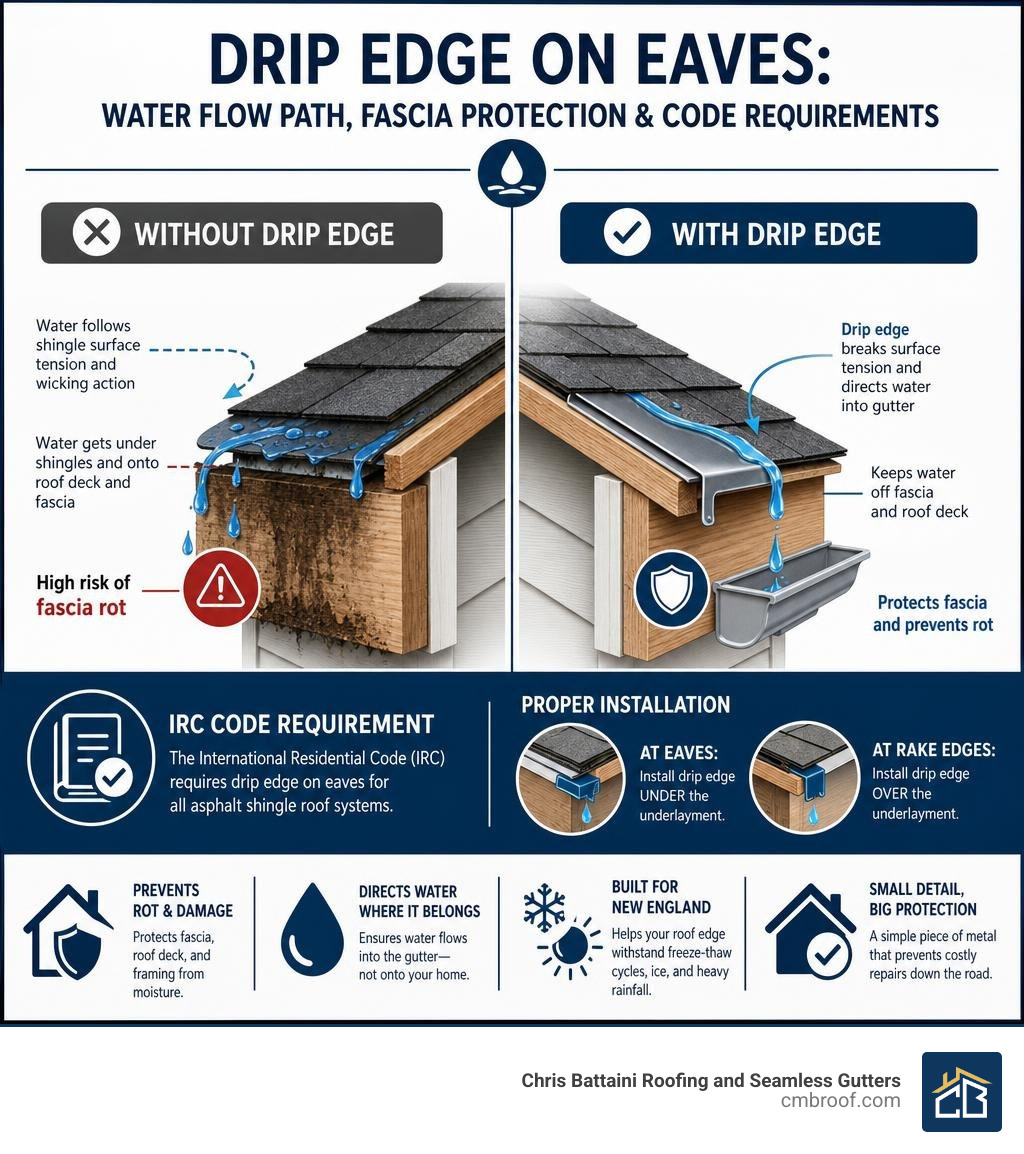
To understand why a drip edge on eaves is so critical, we have to look at the physics of water. Water is lazy, but it’s also highly cohesive. It likes to stick to surfaces. When rainwater runs off the edge of your shingles, it doesn’t always drop straight down into your gutters. Instead, due to surface tension and capillary action, water naturally tries to curl backward, wicking underneath the shingles and directly onto the wooden roof deck and fascia board.
Without a physical barrier to break this surface tension, moisture continuously saturates the edge of your roof sheathing. Over time, this quiet water intrusion leads to swollen roof decks, peeling paint, and eventually, structural wood rot.
According to the comprehensive Drip Edge – Roofing Component Guide | CapOut, this simple flashing profile is designed specifically to redirect water outward, ensuring it drips cleanly away from the building envelope.
Your roof perimeter is divided into two primary sections:
A proper drip edge system must protect both areas. However, because water behaves differently on a flat eave than it does on a sloped rake, the flashing profiles and installation methods differ. When we perform Residential Roofing Services, we treat these two boundaries as distinct systems that work together to seal the entire roof perimeter.
When water continuously wicks back onto the fascia board and the edge of the roof sheathing, it creates a perfect breeding ground for wood-decaying fungi. This leads to dry rot, which compromises the structural integrity of your roof deck.
In towns like Dalton MA and Richmond MA, where heavy snow accumulation is common, water from melting snow can back up at the eaves. If your roof lacks a drip edge, this backed-up water will seep into the fascia and soffit assemblies, eventually migrating into exterior wall assemblies. This causes mold growth, damaged insulation, and rotting rafter tails — structural repairs that are incredibly costly to fix.
In the past, some roofing contractors viewed drip edge as an optional upgrade. Today, building codes leave no room for debate. The International Residential Code (IRC) has mandated the use of drip edge on asphalt shingle roofs for years.
According to the IRC 2024 Drip Edge Flashing: Required at Eaves and Rakes for Asphalt Shingles | R905.2.8.5 | Jaspector, a drip edge is a non-negotiable requirement for both new construction and full roof replacements. Local building inspectors in Berkshire County strictly enforce these standards during rough and final inspections.
To be code-compliant, the drip edge must meet several strict physical specifications:
One of the most common installation mistakes we see is the incorrect sequencing of the drip edge and the roof underlayment. The correct installation order is critical and depends entirely on whether you are working on the eaves or the rakes.
The standard code-compliant sequence, as outlined by the Installation of Drip Edge at Eaves and Rakes – Asphalt Roofing Manufacturers Association (ARMA), is as follows:
Choosing the right profile and material is essential for enduring the freeze-thaw cycles and heavy snow loads of Western Massachusetts. Let’s look at how the different options compare:
| Profile Type | Shape Description | Best Use Case | Climate Suitability |
|---|---|---|---|
| Type C (L-Shape) | Simple 90-degree bend with a small bottom hem. | Low-slope roofs or budget projects. | Moderate; lacks advanced water clearance. |
| Type D (T-Shape / D-Metal) | Features a T-shaped profile with an extended lower flange and a pronounced kickout lip. | Standard pitched residential roofs. | Excellent; provides superior water clearance from the fascia. |
| Type F (Gutter Apron) | Features a longer, angled leading edge designed to slide over the back of the gutter. | Eaves with existing gutters or retrofit applications. | Outstanding; prevents water from dripping behind the gutter. |
While all three profiles are technically code-compliant, they perform differently in real-world scenarios.
The material you choose determines the lifespan and durability of your roof’s edge protection:
Note: When using aluminum flashing, it is vital to avoid direct contact with pressure-treated lumber (like ACQ), as the chemicals in the wood will cause rapid galvanic corrosion of the metal. Always use compatible stainless steel or hot-dipped galvanized fasteners.
While installing a drip edge on eaves is sometimes discussed as a do-it-yourself task during a complete re-roof, we strongly recommend professional installation. Working at the edge of a roof carries significant fall hazards, and retrofitting flashing under existing shingles requires specialized tools and a high level of care to avoid damaging starter shingles, underlayment, or the roof deck.
When we handle a complete Roof Installation Services project, the drip edge is integrated seamlessly from day one, ensuring maximum protection and structural integrity.
A professional installation follows a precise checklist to ensure long-term performance:
If an existing Massachusetts roof is missing a drip edge, it is possible to retrofit it, but the process is far more complex than installing it during a new roof build. To retrofit, a roofer must carefully lift the existing starter shingles, remove old fasteners, slide the new flashing flange underneath the shingles, and secure it without tearing aged, brittle asphalt.
Pricing Disclaimer: The following figures are broad average-cost ranges sourced from publicly available internet data and general industry averages. They are not the actual prices, rates, estimates, or guaranteed pricing of Chris Battaini Roofing.
Because labor conditions, roof access, roof pitch, fascia condition, and gutter configuration vary widely, online industry data should only be used for general planning:
For homes with metal roofing systems, retrofitting presents unique challenges, which you can read about in our guide on Installing Drip Edge on Existing Metal Roof.
At the eaves, the drip edge must always go under the underlayment. This ensures that any condensation or water that gets past your shingles and runs down the underlayment will flow smoothly over the top of the metal flashing and drop into the gutter. If you install the drip edge over the underlayment at the eaves, water running down the underlayment will seep directly under the metal flange and rot out your wood sheathing. You can find more detail on this sequence in Drip Edge Installation: Protect Roof Edges 2026.
Yes, this can be done using a Type F profile (gutter apron) or standard Type D flashing. However, it requires extreme care. If the shingles are old and brittle, lifting them to slide the metal flange underneath can cause them to crack or tear, which may lead to leaks. A professional inspection is highly recommended before attempting a retrofit to ensure the roof deck is still structurally sound.
Yes. Gutters are designed to collect water and carry it away from the foundation, but they do not protect the roof deck or fascia board from capillary action by themselves. Without a drip edge, water can run down the edge of the shingles, cling to the wood, and seep behind the back of the gutter. This can eventually rot the fascia board, causing gutters to sag and pull away from the structure. Combining a high-quality drip edge with professional Seamless Gutters Services is the only way to ensure complete moisture protection.
A drip edge on eaves may seem like a minor detail, but it is one of the most critical defensive barriers on your entire property. It protects the roof deck, preserves fascia boards, supports shingles, and ensures the gutter system can do its job effectively.
At Chris Battaini Roofing & Seamless Gutters, we don’t believe in cutting corners. We provide owner-led, on-site service with exceptional workmanship warranties throughout Berkshire County, MA, with a focus on residential and commercial roofing services and seamless gutter systems. Whether you need a full roof replacement in Pittsfield MA, a gutter upgrade in Lenox MA, or a professional inspection in Dalton MA, we are here to ensure your property is fully protected against the elements.
Use our quote form button to get started: Request a Roofing Quote. You can also learn more about our Residential Roofing Services, Roof Installation Services, and Seamless Gutters Services.
Need a reliable roofer? CMB Roofing provides licensed, insured, and professional roofing services for homeowners and businesses.
We stand by a simple promise: Clear estimates. Quality workmanship. Clean job sites.
From roof repairs and full replacements to storm damage restoration, our team delivers dependable results with durable materials, expert installation, and complete site cleanup.