-
10 Wendell Ave Extension Pittsfield, MA 01201
-
210 Columbia St., Lee, MA 01238

The cost to replace underlayment on a tile roof is one of the more significant roofing maintenance investments property owners may encounter. Here’s a quick snapshot based on industry averages and publicly available online data:
| Roof Size | Estimated Cost Range |
|---|---|
| Small (1,000 sq ft) | $6,600 – $16,500 |
| Medium (1,500 sq ft) | $6,600 – $21,000 |
| Large (2,000+ sq ft) | $7,000 – $25,000+ |
Note: All prices above are average estimates sourced from publicly available internet data. They are not the actual rates of Chris Battaini Roofing and Seamless Gutters. Costs vary widely based on roof size, pitch, material choice, and local labor rates across Massachusetts.
Key cost drivers at a glance:
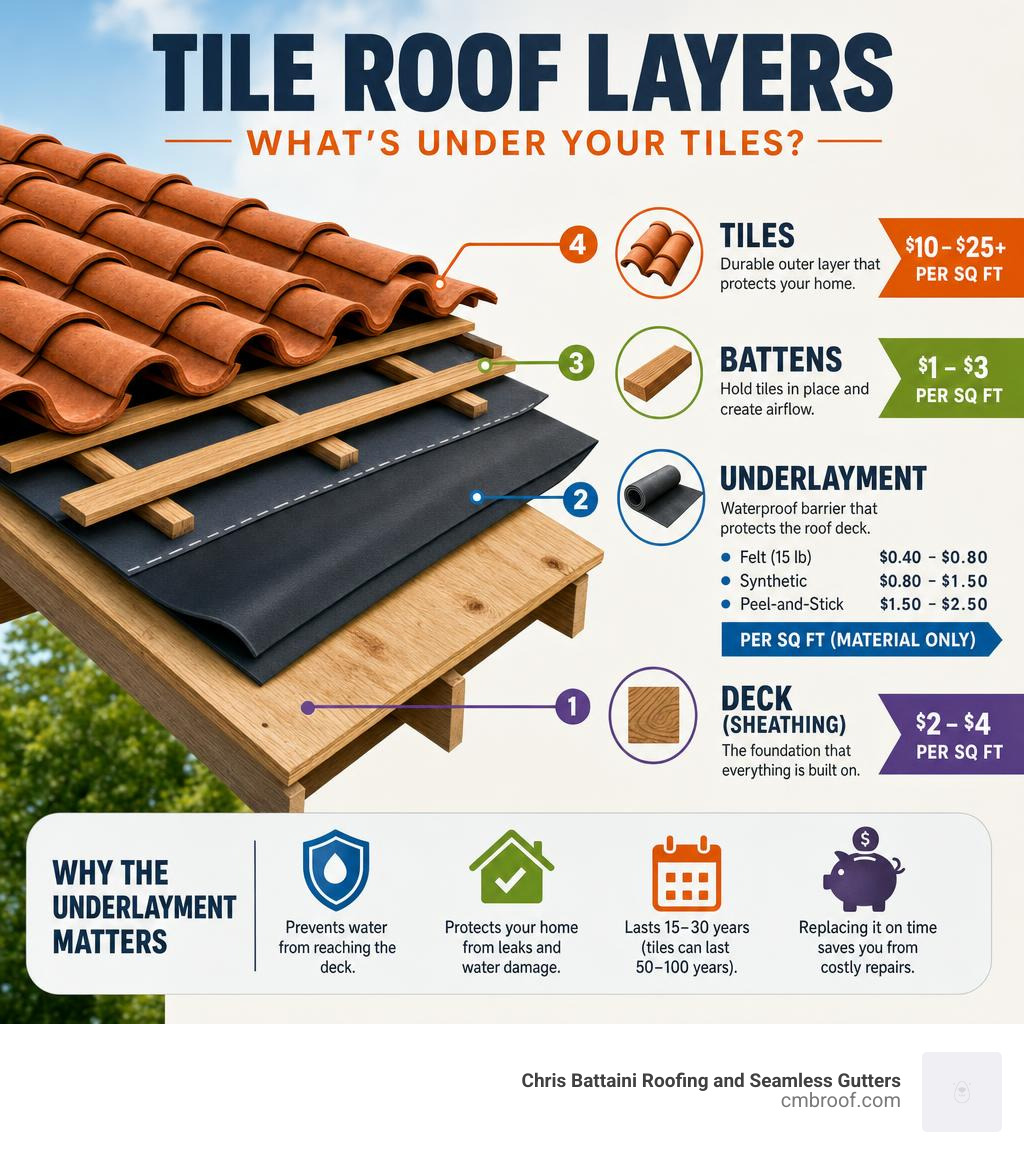
Your tile roof may look solid from the ground, but underneath the tiles, the underlayment is what helps protect the roof deck from moisture intrusion. Tiles can last 50 to 100 years, while the underlayment beneath them often lasts only 15 to 30 years. That means many tile roofing systems in Pittsfield MA, Dalton MA, Lenox MA, and nearby Berkshire communities will eventually require underlayment replacement even when the tile itself remains serviceable.
For property owners in Pittsfield MA, Dalton MA, Lenox MA, and Lanesborough MA, understanding what this project typically costs — and what drives those costs — helps with better planning and budgeting.
I’m Christopher Battaini, owner of Chris Battaini Roofing and Seamless Gutters, and with over two decades of hands-on roofing experience across Berkshire County, I’ve helped clients navigate the cost to replace underlayment on a tile roof with clear communication and high workmanship standards. Let’s break it down so you know what to expect.
For service, call +413-441-4840 or use our quote form here: https://cmbroof.com/contact-us/.
Cost to replace underlayment on tile roof helpful reading:

When evaluating the cost to replace underlayment on a tile roof, it helps to look at the numbers. Based on industry averages and publicly available online data, the average cost to replace general roof underlayment is approximately $3,300. However, tile roofs require a specialized, labor-intensive process known as a “lift and reset.”
Because of this complexity, we see a much wider price range in the market. To account for regional labor differences, roof complexity, and material grades, broad industry estimates for tile roof underlayment replacement typically range from $6,600 to $21,000 or more.
Disclaimer: Please note that these figures are average costs sourced from publicly available internet data and are not the actual rates of Chris Battaini Roofing and Seamless Gutters.
For a deeper dive into related exterior work in Pittsfield MA, Dalton MA, Lenox MA, and Lanesborough MA, review our residential roofing services and seamless gutter installation.
The type of underlayment you choose acts as the foundation of your tile roof’s weatherproofing system. Since the underlayment is shielded from direct sunlight by the tiles, its primary enemies are moisture accumulation, condensation, and natural degradation over time.
Here is a quick look at how different materials compare in terms of cost and expected lifespan:
| Underlayment Type | Material Cost (Per Sq. Ft.) | Lifespan Expectancy | Best Suited For |
|---|---|---|---|
| Asphalt Felt (30lb/40lb) | $0.15 – $0.55 | 10 – 20 Years | Budget-conscious projects |
| Synthetic Membrane | $0.25 – $0.70 | 20 – 40 Years | Standard residential tile roofs |
| Rubberized Peel-and-Stick | $0.50 – $0.90 | 30 – 50+ Years | Long-term protection and premium performance |
To learn more about material performance, read our detailed roofing materials guide.
Traditional asphalt-saturated felt has been the industry standard for decades. While it is highly affordable, it is more prone to drying out, cracking, and tearing under temperature fluctuations. For additional context on underlayment replacement pricing, Angi provides a helpful cost overview.
Synthetic membranes, made from woven polyolefin or polypropylene, offer a major upgrade. They provide superior tear resistance, do not rot when exposed to moisture, and handle UV exposure better during installation. Upgrading to a synthetic option is commonly recommended for tile systems because it aligns more closely with the long service life of clay or concrete tiles.
If maximum protection is the goal, rubberized asphalt peel-and-stick membranes are a premium option. These self-adhering underlayments bond directly to the roof deck.
Because they are self-sealing, they wrap tightly around fasteners driven through them, helping reduce leak risk around penetrations. While they carry a higher material cost, their waterproofing ability and high-temperature formulations make them a strong choice for Massachusetts properties exposed to snow loads and freeze-thaw cycles.

Replacing underlayment on a tile roof is fundamentally different from a standard shingle replacement. The sheer volume of manual labor required is what primarily drives the cost. For an in-depth breakdown of how roofing labor is structured, refer to our roof replacement complete guide.
With an asphalt roof, the old shingles are torn off and discarded. With a tile roof, crews perform a careful “lift and reset.” This means the roofing team must:
Because of this meticulous handling, labor typically accounts for 80% to 90% of the total project quote.
The physical layout of the building plays a major role in final pricing. A steep, multi-story roof in Pittsfield MA or Lenox MA requires additional safety rigging, harnessing, and staging.
If a property in Dalton MA or Lanesborough MA has dormers, valleys, chimneys, or skylights, crews must spend more time cutting, sealing, and flashing these areas. Limited access, tight site conditions, and surrounding landscaping can also increase labor hours across roofing projects in Massachusetts.
When undertaking a major roof project, it is wise to set aside a contingency budget for unexpected discoveries. Once the tiles are lifted, the true condition of the roof system becomes visible. To understand how we address these structural issues, read about our professional roof repair services.
If the underlayment has been failing for some time, water may have reached the plywood decking beneath. If soft, rotting, or warped wood is found, those sections must be replaced to maintain the structural integrity of the roof.
In many cases, crews also inspect and replace metal valley flashing, drip edges, and flashing around chimneys and vents. Local permit requirements in Massachusetts municipalities may also add a minor administrative cost.
No matter how careful a roofing crew is, clay and concrete tiles can become brittle with age. It is standard industry practice to anticipate a 10% breakage rate during removal and reinstallation.
Part of the project may include sourcing matching tile profiles and colors so the finished roof maintains a consistent appearance.
While high-quality clay or concrete tiles can easily last 50 to 100 years, standard underlayment typically lasts between 15 and 30 years. Its lifespan depends heavily on the quality of the material used, ventilation in the building, and local weather patterns. In areas like Pittsfield MA, Dalton MA, and Lenox MA, winter weather and seasonal temperature swings can accelerate wear on older felt underlayments.
Based on publicly available online data and industry averages, the average cost to replace underlayment on a tile roof is approximately $3,300, but tile roof lift-and-reset projects generally range from $6,600 to $21,000+. This wide range is due to local labor rates, roof pitch, complexity, and whether the project uses felt, synthetic, or premium peel-and-stick membranes. These are general market averages only and do not represent the specific pricing of Chris Battaini Roofing and Seamless Gutters.
Yes. Cost control often comes from choosing a high-quality synthetic underlayment instead of a premium peel-and-stick system where appropriate, coordinating roof work efficiently, and addressing related exterior components at the same time. Bundling work with seamless gutter installation may also improve project efficiency. Because tile lift-and-reset work is specialized, it should be performed by an experienced professional roofing contractor rather than approached as a DIY project. Learn more here: roofing contractor.
Your tile roof is a long-term investment, but it is only as reliable as the underlayment protecting the structure beneath it. When it is time to perform a lift-and-reset, working with a local specialist who understands the architectural and weather demands of Berkshire County is essential.
At Chris Battaini Roofing and Seamless Gutters, we provide owner-led, on-site service and workmanship-focused roofing solutions throughout Pittsfield MA, Dalton MA, Lenox MA, and Lanesborough MA. We also support related exterior protection needs with residential roofing services, professional roof repair services, and seamless gutter installation.
Use our form to request a quote here: https://cmbroof.com/contact-us/.
To learn more about our process, Read our Complete Roof Replacement Guide.
Need a reliable roofer? CMB Roofing provides licensed, insured, and professional roofing services for homeowners and businesses.
We stand by a simple promise: Clear estimates. Quality workmanship. Clean job sites.
From roof repairs and full replacements to storm damage restoration, our team delivers dependable results with durable materials, expert installation, and complete site cleanup.