-
10 Wendell Ave Extension Pittsfield, MA 01201
-
210 Columbia St., Lee, MA 01238

Commercial roofing cost is a critical investment that can range dramatically based on numerous factors. Here’s what you need to know at a glance:
Quick Answer: What Does a Commercial Roof Cost?
These are national average costs based on publicly available data and do not represent actual pricing for Chris Battaini Roofing and Seamless Gutters. Actual costs vary significantly based on your specific project.
When you’re facing a commercial roof replacement, the number one question on your mind is simple: What will this cost me?
Unfortunately, getting a straight answer can feel impossible. One contractor quotes $50,000, another says $120,000, and you’re left wondering if you’re being taken advantage of or if there’s something they’re not telling you.
The truth is that commercial roofing costs depend on multiple variables that interact in complex ways. The size of your roof matters, but so does its slope, the materials you choose, how many HVAC units sit on top, whether your old roof needs to be torn off, and even what time of year you schedule the work.
This article breaks down exactly what influences commercial roofing costs so you can budget accurately, evaluate quotes intelligently, and make a confident decision about protecting your building. We’ll cover material options, hidden expenses, and the factors that separate a $5,000 repair from a $200,000 replacement.
Whether you’re a business owner facing your first roof replacement or a property manager who’s done this before, understanding these cost drivers helps you avoid surprises and ensures you’re getting fair value for your investment.
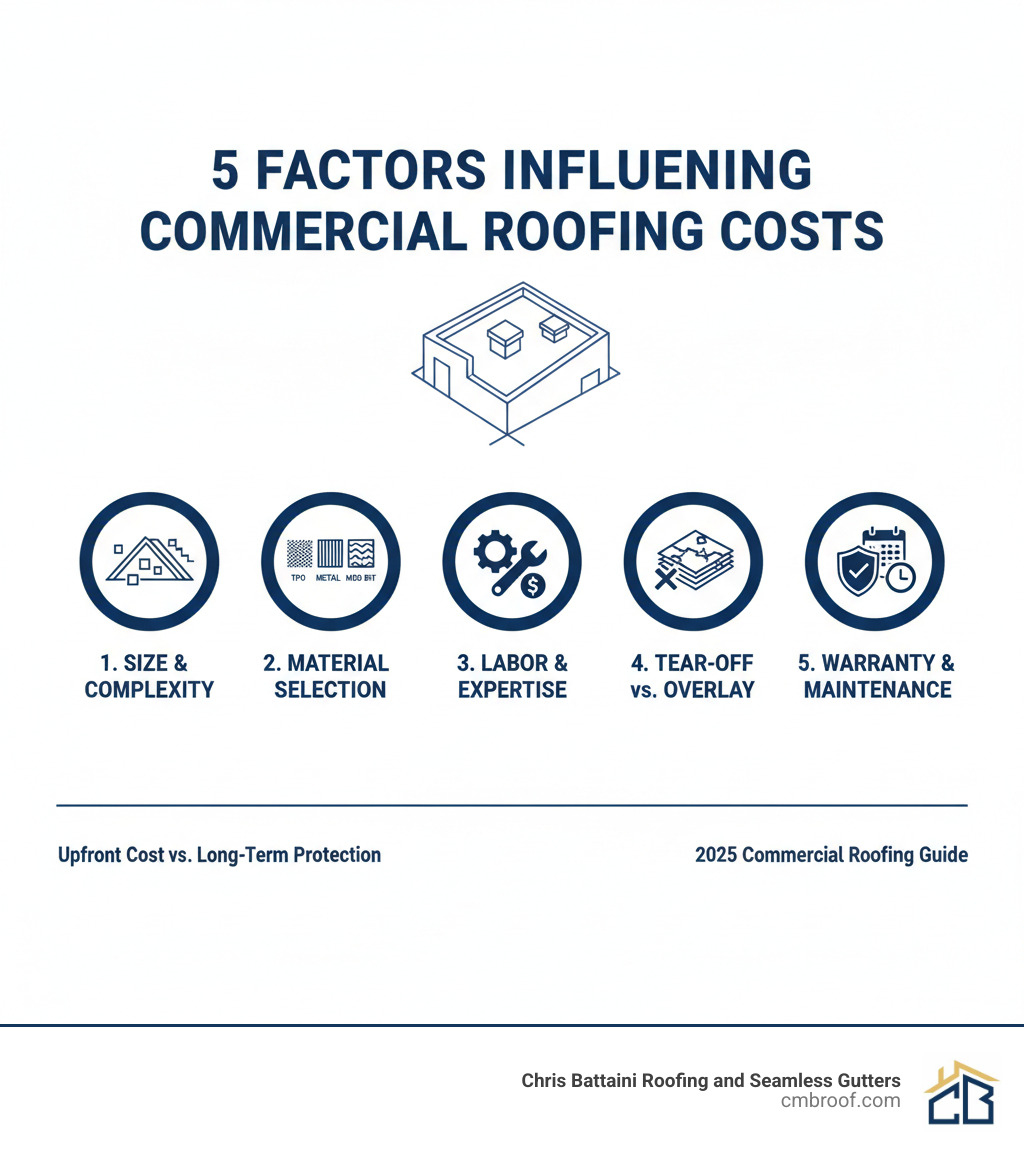
When you’re trying to understand what drives commercial roofing cost, it helps to think beyond the sticker price. The truth is, every roof tells a different story, and the price reflects that uniqueness. We’ve worked on projects that cost a few thousand dollars for targeted repairs and others that topped $200,000 for complete replacements on large, intricate buildings.
The real challenge isn’t just the square footage—it’s how your building’s specific characteristics, material choices, and labor requirements all come together. A simple, rectangular roof with easy access is a completely different animal than one covered with HVAC units, skylights, and multiple elevation changes. Let’s break down what really matters when you’re budgeting for a commercial roof. For more detailed information on our commercial roofing services, please visit our commercial roofing page.

Here’s something that surprises many building owners: a bigger roof doesn’t always mean a proportionally bigger price tag. Yes, a 100,000 square foot roof will cost more in total than a 10,000 square foot one, but the cost per square foot often drops as the size increases. This happens because certain fixed expenses—like mobilizing our crew, setting up equipment, and establishing safety protocols—get spread across more square footage. It’s what we call economies of scale, and it can work in your favor on larger projects.
The slope of your roof matters more than you might think. Most commercial buildings have flat or low-slope roofs, which typically use single-ply membranes, built-up roofing, or modified bitumen systems. These are generally more straightforward to install than steep-slope roofs, which require specialized safety equipment and installation techniques similar to residential work. These are average costs based on publicly available data and do not represent actual pricing for Chris Battaini Roofing and Seamless Gutters. Steep slope installations can range from $5 to $25 per square foot, while flat roof systems often fall between $4 and $13 per square foot for materials, plus labor.
Now let’s talk about complexity—this is where things get interesting. Imagine two roofs, both 20,000 square feet. One is a wide-open rectangle with nothing on it. The other has a dozen HVAC units, multiple skylights, several exhaust vents, pipes, and varying roof heights. Which one costs more? The complex one, every time.
Each penetration through your roof—every vent, skylight, or HVAC unit—requires careful cutting, custom flashing, and meticulous sealing to keep water out. This detail work takes time and skill, which translates directly to labor costs. For single-ply membranes and metal roofs, these penetrations can significantly increase your project cost. Fluid-applied systems like spray foam handle penetrations a bit more easily, but they’re still a factor.
Building height and roof access play a bigger role than most people realize. A single-story building where we can work from ground-based equipment is one thing. A multi-story structure that requires cranes, specialized lifts, or extensive scaffolding? That’s a different conversation entirely. Security requirements, limited access points, and working around your business operations can all add complexity and cost.
Even the structural condition of your roof matters. If your roof is sagging or has drainage issues, you might need a tapered insulation system to create proper water flow. That’s an additional expense, but it’s also an investment in preventing future water damage and extending your roof’s life.
Choosing your roofing material is probably the single biggest decision that will impact your commercial roofing cost. It’s tempting to just pick the cheapest option, but that’s often a false economy. The real question is: what gives you the best value over the life of your building?
Take metal roofing, for example. Yes, it typically costs more upfront—sometimes significantly more. But with a lifespan that can exceed 50 years and minimal maintenance requirements, it often ends up being more cost-effective than cheaper alternatives that need repairs every few years or replacement in 15 to 20 years. Learn more about metal roofing options on our metal roofing page.
The installation method matters just as much as the material itself. With single-ply membranes, you have choices: mechanically attached (fastened to the deck) or fully adhered (glued down). Each method has different material costs, labor requirements, and performance characteristics. For built-up or modified bitumen systems, the number of layers and application process—torch-down versus self-adhering, for instance—all factor into your final price.
Here’s something we can’t stress enough: even the best material will fail prematurely if it’s installed poorly. We’ve seen expensive roofing systems that should have lasted 30 years need replacement in 10 because corners were cut during installation. Quality workmanship isn’t just a nice-to-have; it’s essential for protecting your investment.
Energy-efficient roofing—often called “cool roofs”—deserves special mention. These systems typically cost more initially, but they reflect more sunlight and absorb less heat, which can dramatically reduce your cooling costs during warm months. The upfront premium often pays for itself through lower energy bills, and you might even qualify for tax incentives or rebates.
Labor typically accounts for 40% to 60% of your total commercial roofing cost, so understanding what drives these numbers helps you make sense of your quotes.
Geography matters. The labor rates in rural Vermont are different from those in more populated areas of Massachusetts. Here in Berkshire, Hampden, Hampshire, and Franklin Counties, we see variations even within our service area. It’s not about anyone trying to overcharge—it’s simply the local cost of doing business.
Contractor expertise is worth paying for. Highly experienced contractors with specialized certifications and proven track records might charge more per hour, but they also bring something invaluable: the knowledge to do the job right the first time. They understand the nuances of different roofing systems, they spot potential problems before they become expensive issues, and they typically offer better warranties. It’s the difference between a roof that lasts its full expected lifespan and one that needs premature repairs.
Project duration and complexity directly affect labor costs. A straightforward replacement that takes two weeks costs less than a complicated project that stretches to six weeks. If you need the work expedited because of an emergency or a tight deadline, expect to pay premium rates for overtime and accelerated schedules. Sometimes that’s necessary, but when possible, planning ahead gives you more options and better pricing.
The roofing industry has faced material and labor shortages recently, just like many other trades. These market dynamics can push prices up and extend timelines. Rising asphalt prices, for example, directly impact materials like Built-Up Roofing (BUR) and Modified Bitumen. It’s not fun to talk about, but it’s the reality we’re all navigating right now.
Local building codes add another layer of complexity and cost. These regulations vary by municipality and dictate everything from acceptable materials to the number of roof layers allowed, insulation requirements (R-value), and specific installation techniques. Coastal areas might require improved wind uplift resistance. Warmer climates might mandate cool roof systems. Permitting fees vary from town to town. These aren’t optional expenses—they’re legal requirements that protect building integrity and occupant safety.
Timing can subtly influence your costs too. During peak roofing season when demand is high, you might see slightly higher prices or longer wait times. If your project timeline is flexible, scheduling during off-peak months sometimes opens up more competitive pricing opportunities. It’s not always possible, but it’s worth considering if you have the luxury of planning ahead.
Follow us on Facebook to stay updated on roofing tips, project showcases, and industry insights.
When it comes to your commercial property, choosing the right roofing material is a big decision. It’s truly a balancing act between the upfront commercial roofing cost, how long it will last, and how well it performs day-to-day. You want something durable and efficient, but also within your budget.
Disclaimer: The following prices are national averages based on publicly available data and are for informational purposes only. They do not represent actual pricing for Chris Battaini Roofing and Seamless Gutters. Costs can vary significantly. Contact a professional for an accurate quote specific to your project.
To give you a clearer picture, here’s a general overview of some common commercial roofing materials. This table shows their average installed cost per square foot, how long you can expect them to last, and their main benefits. For a deeper dive into flat roofing options, which are very popular for commercial buildings, visit our flat roofing page.
| Material Type | Avg. Cost/Sq. Ft. (Installed) | Expected Lifespan | Key Benefits |
|---|---|---|---|
| TPO | $3 – $14 | 20-30 years | Energy-efficient (white surface reflects heat), cost-effective, strong heat-welded seams. |
| PVC | $4 – $13 | 20-30+ years | Highly durable, resistant to chemicals and fire, strong heat-welded seams. |
| EPDM | $4 – $13 | 25-35+ years | Extremely durable against weather and hail, flexible in cold temperatures, easy to repair. |
| Metal | $4 – $30 | 40-70+ years | Very long lifespan, high resistance to wind and fire, low maintenance, recyclable. |
| Built-Up Roofing (BUR) | $4 – $12 | 20-30 years | Multiple layers provide excellent water resistance and durability, low maintenance. |
| Modified Bitumen | $4 – $12 | 15-25 years | High tensile strength, good flexibility in changing temperatures, easy to repair. |
Chris Battaini Roofing and Seamless Gutters proudly services Berkshire, Hampden, Hampshire, and Franklin Counties in Massachusetts.
Need a reliable roofer? CMB Roofing provides licensed, insured, and professional roofing services for homeowners and businesses.
We stand by a simple promise: Clear estimates. Quality workmanship. Clean job sites.
From roof repairs and full replacements to storm damage restoration, our team delivers dependable results with durable materials, expert installation, and complete site cleanup.